
March 2019
abstract
Gérer & Comprendre
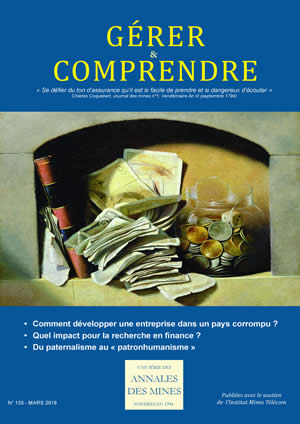
Issue 135
OVERLOOKED…
“Intermediate places” between creation and diffusion in French theater: A theatrical stunt or a tenable model?
By Julia Parigot
Institut Supérieur de Gestion
Diffusion predominates over creation in the value chain of French theater. To redress this situation, a new type of organization is emerging: “intermediate places”, which cut creation free from diffusion and its constraints. What are the characteristics of this new model for theater? What issues must it address? By assembling all means around creation, these places modify the sources of funding and related practices. However the difficulties they encounter raise the question of whether they will last.
TRIAL BY FACT
Enabling firms to develop in a corrupting environment: The cases of China and India
By Paul Labic
and Pierre Memheld
Strasbourg University
A new approach is proposed to this phenomenon for Western firms that want to move into the Chinese and Indian markets. After a review of the literature, the factors abetting corruption, despite its many forms, are classified as internal/external or organizational/individual. Although several studies have concentrated on internal factors, the external ones have often been underestimated. External factors — shown to be dominant In China and India — are described, in particular their effects on decision-making processes in these two countries. Focus is then shifted to the cultural and sociological constituents of the organization of each of these two societies: how to take them into account? By analyzing how corruption operates, this phenomenon can be described as a method for siphoning value. The solutions proposed (specific to the country) open the possibility of siphoning value by developing activities that are secondary to the firm’s core business but that comply with ethics and the law and that protect work teams.
IN QUEST OF A THEORY
Research in finance: When performativity leads to reflexivity
By Hélène Rainelli-Weiss
IGR-IAE, Rennes 1 University
To assess the impact of research in finance over the past sixty years, how to measure the effect of theories on practices, on the financial industry’s growth and, too, on the social norms and institutional arrangements that organize the realm of finance? This article’s principal contribution is to insist on the role of theory in the social construction of finance and on the necessity for financial theory to stop neglecting its performative effects. Research will thus have a more ambitious position in debates on the social utility of finance and will suggest novel perspectives, in particular for regulations in this realm.
OTHER TIMES, OTHER PLACES
Is there a Hawthorne effect?
By François Geoffroy
CRIISEA (EA 4286), IAE Amiens
The experiments conducted by Elton Mayo and his team from Harvard at Western Electric’s Hawthorne factory led to the formulation of the well-known “Hawthorne effect”: the attentive attitude of the staff motivated wage-earners’ behaviors. However more and more studies have questioned these findings and conclusions. This critical, historical reinterpretation of these experiments is based on a review of the literature in several disciplines.
From paternalism to “patronhumanism”
By Amélie Villeger
CEREGE (Centre de Recherche en Gestion), Poitiers University
Whether in the popular press or academic literature, paternalism is often presented like a pernicious, backward form of governance. On the basis of two antagonisms that underlie it, a less Manichean approach is proposed. In the original form of paternalism, traditionalism turned out to be at the service of progressivism. Afterwards, torn between the need to organize the relationship of subordination in work and the fair recognition of the rights and freedoms of everyone, paternalism evolved toward a new equilibrium, a neopaternalism that, described as “patronhumanism”, was strongly influenced by humanist values. free download
Réponse de Pierre MESSULAM — Pour une généalogie du paternalisme
Réponse d’Hervé DUMEZ — À propos du paternalisme. Petite critique d’une approche trop doctrinale et culturaliste
Mosaics
On Elizabeth Currid-Halkett’s The Sum of Small Things, a Theory of the Aspirational Class (Princeton: Princeton Press, 2017)
By Pierre Messulam
On Jérôme Denis’ Le travail invisible des données. Éléments pour une sociologie des infrastructures scripturales (Paris: Presses des Mines, 2018)
By Jean-Marc Weller
Management — Is the comedy over?
On Nicolas Bouzou & Julia de Funès’s La Comédie (in)humaine (Paris: Éditions de l’Observatoire, 2018).
By Antoine Masingue
A firm with a mission: A model of governance for innovation
On Kevin Levillain’ Les entreprises à mission – un modèle de gouvernance pour l’innovation (Paris: Vuibert, 2017).
By Matthieu Battistelli
On Jean-Paul Bailly’s Réformez! Par le dialogue et la confiance (Paris: Éditions Descartes & Cie, 2016)
By Jacques Sarrazin