
March 2010
abstract
Gérer & Comprendre
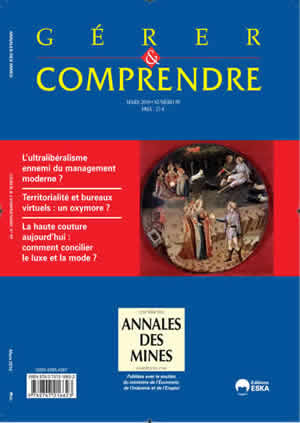
Issue 99
Editorial
By Pascal LEFEBVRE
TESTIFYING
Ultraliberalism, the enemy of modern management?
Entretien avec Henri VACQUIN
By Bernard COLASSE and Francis PAVÉ
From the French Communist Party to management consultancy: an uncommon itinerary, an exceptional experience with social relations in firms…
OVERLOOKED…
How to reconcile the protestant ethic and finance?
By Christophe INARD
Fanny VERRAX
Université de Versailles - Saint-Quentin-en-Yvelines
and Grégory SCHNEIDER-MAUNOURY
Responsable de l’ISR, Inter Expansions, APRIONIS, Chercheur associé CERMAD/ESCEM –Tours-Poitiers
The practices for managing the responsible social investment funds created by Protestant groups are placed in a historical and sociological perspective. Those of the four funds described, beyond the possible ambiguities stemming from their theological justifications, are characterized by a pragmatism that is a far cry from their supposed dogmatism. These practices transcend their religious origins. These funds raise relevant questions about the rehabilitation of finance and the conception of corporate social responsibility.
Solidarity and rivalry in firms
By Jérôme SAULIÈRE
Ingénieur élève des mines
In-firm training periods are an opportunity for young people to discover the world of work from a position somewhere between that of observer and player. When the internship lasts several months, as in the case of engineering students from the Écoles des Mines, students try to fill the same assignments as young recruits. They thus gain an original view of the firm “from underneath”, we might say. With reference to a recent article in Gérer & comprendre, they feel invited to identify with ideal role models. But this identification is alienating. The only way to overcome it is for students to obtain a position that enables them to understand that the images with which they have identified are mere appearances. Identification is especially strong when the internship is in consultancy on corporate strategy, where appearances and very codified relations are key factors. These students’ naive view, as seen through their accounts of this training experience, provides us with thoughts about how business is conducted. For this reason, we are publishing a text written during an internship that was part of the author’s first year of training for the French Corps des Mines.
TRIAL BY FACT
Territoriality and virtual offices, an oxymoron?
By Emmanuelle LÉON
Professeur Associé, ESCP EUROPE
Changes in the organization of work and the determination to reduce the budget allotted to office space have led many firms to reinvent, or even eliminate, offices thanks to modern technology. Evidence of this is the development of “shared workplaces”. The work- place is not just a functional space however. It is also one of the symbols linking wage-earners to their company. Wage-earners spontaneously try to make the workplace their own. A case study conducted in the virtual offices of Accenture shows how a sense of territory arises and marks every space, even virtual spaces.
Corporate social responsibility and flexible human resources: Is “employability” a valid argument?
By Moez BEN YEDDER
Assistant à la Faculté des Sciences Juridiques Economiques et de Gestion, Université de Jendouba, Doctorant à l’Institut Supérieur de Gestion, Université de Tunis
and Lotfi SLIMANE
Maître-assistant à l’Institut Supérieur de Comptabilité et d’Administration des Entreprises, Université de la Manouba
By placing the interests of other stakeholders (for instance, employees) on a par with those of stockholders, corporate social responsibility has compelled recognition in recent years as a concrete form of sustainable development. Though relatively old, flexibility has become an increasingly accepted possibility for improving a firm’s competitiveness or even reorienting its activities in a new direction indispensable for its survival. Given its quantitative dimension however, flexibility often comes under criticism for its social consequences. Precarious employment conditions for wage- earners, competition over labor costs among subcontractors, the broken bond between a firm and its workers… flexibility turns out to be an “antisocial” practice. We thus fail to see how a firm that scrupulously adheres to the ideas underlying corporate social responsibility could implement flexibility in its human resources. In practice however, flexibility and corporate social responsibility seem to be able to live under the same roof.
The local application of a global tool for managing employee qualifications
By Sophie BRETESCHÉ
and Michel DEVIGNE
Ecole des mines de Nantes
This article describes how an agribusiness plant adjusted to the deployment of a global tool for managing employee qualifications. Although this tool required conformity, it was appropriated variously, depending on the occupational environment and the context of the activities actually exercised.
IN QUEST OF THEORIES
Reputation in career management
By Sébastien DUBOIS
Professeur associé, Rouen Business School, Chercheur associé au Centre de Sociologie du Travail et des Arts, EHESS
Reputation is brought forward as a major criterion for managing careers but without being clearly defined. An operational definition is proposed of this social label or image, which is constructed through human relations. The case of artists is especially useful for interpreting the processes at work; and contemporary poets provide a striking illustration of how individuals and, too, organizations (in this case, publishers) manage reputations. Reputation is both a decision- making tool and a key element in strategies.
Haute couture nowadays: How to reconcile luxury and fashion?
By Marine AGOGUÉ
and Guillaume NAINVILLE
Ecole Polytechnique – Marster PIC
An industry’s maturation often brings its business model under review. Contrary to appearances, haute couture should be seen not just through the exuberance of top designers. These fashion houses have had to adapt a purely craftsman’s approach to changes in their historical customer base. They have done this thanks to two “product differentiations”: luxury goods and designer fashionware. This has deeply affected how they are organized. Fashion houses have found original solutions for moving beyond the fashion/luxury opposition and remaining, even yet, among the best profit- making companies. Behind the glamor and glitter, we discover a world with an atypical structure and organization that exercises fascination owing as much to the fine strategies pursued as to the goods produced.
Mosaics
Supermarket cashier… and then?
On Mathias Waelli’s Caissière… et après? (Presses Universitaires de France, 2009).
By Christophe VIGNON
Marriage, capitalism and baby food
On Elizabeth Dunn’s Privatizing Poland, baby food, big business and the remaking of labor, (Cornell University Press, 2004).
By Michel VILETTE