
June 2002
abstract
Gérer & Comprendre
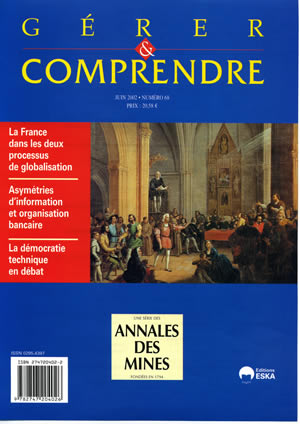
Issue 68
Hommage à Manne HERON
Editorial
By Francis LEFEBVRE
Secrétaire général du Comité de rédaction
DEBATE
France undergoing two globalization processes from the 19th to the 21st century
Séminaire CONDOR
By Hervé DUMEZ
directeur du GDR-FROG et chercheur à l'École polytechnique
In France, debate about the nature and stakes in globalization has thrived over the past few years. But France underwent a first globalization process in the late 19th century, prior to WW I. What are the similarities and difference between these two processes? On 7 February 2002, GDR-FROG organized a session of the Condor Seminar devoted to this question. Suzanne Berger, professor of political science at MIT, and Daniel Cohen, professor of economy at ENS-Ulm, presented contrasting views.
OVERLOOKED
Cultivating a technological advantage within networks: The Compagnie Générale des Eaux
Le cas de la Compagnie Générale des Eaux
By Christophe ASSENS
Maître de conférences - IUT d'Evreux
Alessandro BARONCELLI
professeur, Universita' Degli Studi di Bologna - Dipartimento di Discipline Economico-Aziendali
and Thomas FROEHLICHER
professeur - Grefige - Université Nancy II
Does the networking of firms boost creativity and the diffusion of innovations by fostering unforseen meetings? Or is it impossible to capitalize on the knowledge and know-how scattered throughout a network? Answers to these questions have been drawn from empirical observations of operations at Compagnie Générale des Eaux prior to 1996. A historical survey was made to determine this organization’s overall characteristics; and a case study, conducted to define local characteristics at the level of CGE’s subsidiaries, the latter taken to be nodal points in the network.
The asymmetry of information and the organization of banking: The case of an investment bank
By Utz HOESER
professeur, Universidad Argentina de la Empresa, Buenos Aires chercheur associé au CSO, Paris
and Vincent SIMOULIN
chercheur au Lereps - Université des sciences sociales de Toulouse
Doing business or simply making a decision is always risky. It forces people to justify their choices and to protect themselves as much as possible. Inherent in any decision-making process, this anxiety-causing dimension forces decision-makers to implement diverse protective measures, some of them internalized. To analyze a system that has, as its primary assignment, the management of high risks, more attention must be paid to these measures than to the rationales underlying the choices actually made. Since banking activities revolve around risk-taking, the example of a European investment bank is used to develop this original approach to decision-making about how to fund big projects.
TRIAL BY FACT
Can relational skills become strategic? The case of MAIF
By Éric PERSAIS
Maître de Conférences en Sciences de gestion Membre du Laboratoire CEREGE, Université de Poitiers
and MOSAICS
Since a firm now performs several functions in an interface with the outside, it must have solid relational skills for putting to a constructive use its many ties with other parties. The case of a mutual insurance fund serves to give contents to this idea and to show how such skills come into play in this firm’s long-term development. Points are provided for thinking about how such skills form, points that will help companies manage these key resources. In the current context of open doors and lower organizational boundaries, the expertise acquired in the relational field constitutes a major competitive advantage.
Mosaics
La concurrence dans la joie
À propos du livre de Loïc VIEILLARD-BARON : « Retour à la fête. Ce que la multiplication des concours locaux nous dit de notre société »
By Claude RIVELINE
Ecole des Mines de Paris
De la philanthropie en Amérique
À propos de l'ouvrage de Marc ABELES intitulé : « Les nouveaux riches. Un ethnologue dans la Silicon Valley »
By Jean-Philippe NEUVILLE
INSA - Lyon
Les marchés financiers dictent-ils leur stratégie aux entreprises ?
À propos du livre de Dominique PLIHON & Jean-Pierre PONSSARD intitulé : « La montée en puissance des fonds d'investissement. Quels enjeux pour les entreprises ? »
By Hervé DUMEZ
CRG Ecole Polytechnique
Histoire et pratiques de la fonction personnel
À propos du livre de Jean FOMBONNE intitulé : « Personnel et DRH. L'affirmation de la fonction Personnel »
By Philippe LEFEBVRE
CGS - Ecole des Mines de Paris
WHILE READING
"Technical democracy" debated: On M. Callon, P. Lascoumes and Y. Barthe’s Agir dans l'incertain. Essai sur la démocratie technique
À propos du livre de M. Callon, P. Lascoumes et Y. Barthe : « Agir dans l'incertain. Essai sur la démocratie technique »
By Franck AGGERI
CGS, Ecole des mines de Paris
How can democratic societies cope with the challenges arising out of scientific and technological developments and the excesses that sometimes come along with them? How to define the conditions for a "technical democracy" that would move away from the model that, since the Enlightenment, has been grounded in an alliance between the scientific and political spheres? How to handle the defiance that social groups are manifesting toward experts, technocrats and politicians, whom they accuse of making decisions behind closed doors at the expense of citizens? The sociologists M. Callon, P. Lascoumes and Y. Barthe tackle these questions in a stimulating essay where the voices are heard of ordinary people and emerging social groups, whom decision-makers have ignored for a long time but who now want to have a say. Franck Aggeri shares with us his criticisms and enthusiasm upon reading this book.
Réponse à Franck AGGERI
By Yannick BARTHE, Michel CALLON and Pierre LASCOUMES