
March 2012
abstract
Gérer & Comprendre
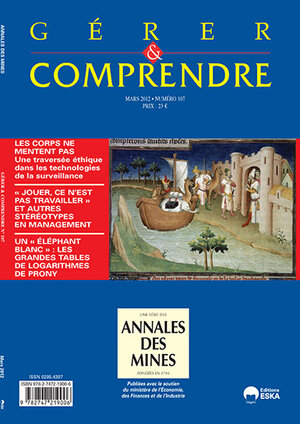
Issue 107
Editorial
By Pascal LEFEBVRE
OVERLOOKED
Bodies do not lie: An ethical journey into surveillance technology
Une traversée éthique des technologies de la surveillance
By Nathalie GRANDJEAN
Agrégée ès-Philosophie, doctorante, chercheuse, université de Namur (Belgique), cellule interdisciplinaire de Technology Assessment (CITA) Centre de Recherche Information Droit & Société (CRIDS)
and Claire LOBET-MARIS
Professeur, docteur ès-sciences du travail, université de Namur (Belgique), cellule interdisciplinaire de Technology Assessment (CITA) Centre de Recherche Information Droit & Société (CRIDS)
Through EU framework programs on research and development, the status and responsibility of the “human sciences” have evolved. The latter used to occupy an outside position as the expertise for evaluating R&D policies or assessing the legal, social, economic or ethical impact of techniques. Nowadays, they are invited to participate in designing innovations, the social acceptability of technological choices being the grounds for this invitation. This review, in the form of a narration, examines the situated, pragmatic intervention by a team of social scientists in a European project for developing a smart multimodal surveillance system.
Managing “good practices” in a multinational firm: The case of Lafarge
By Alexandre PERRIN
Professeur Associé à Audencia Nantes École de Management
The management of “good practices” between the 57 organizational units of Lafarge, a multinational firm, is examined. This codified knowledge, accessible through a data base (Lotus Notes), has enabled employees to consult and propose innovative practices for improving the quality of production and relations with clients. An analysis of a transfer involving the “emitters and receivers of good practices” brings to light three key factors in this management, in particular the predominant role played by the coordinator inside the firm. The skills necessary for playing this role are discussed.
Farm management, an inventory of French research
By Philippe JEANNEAUX
Professeur d’Économie Rurale
and Hélène BLASQUIET-REVOL
Ingénieur d’études
The economic context of farms has changed significantly in recent years, as farmers have been forced to develop new skills and managerial methods. This trend should have led to new research in this field. An examination of bibliographical references from three French databases of studies conducted by a research institute (INRA) has served to draw up an inventory of the output of French research on farm management from 1990 to 2008. A sharp drop is observed of publications in this field. Contrary to initial assumptions and unlike the situation in English-speaking research, theoretical currents in farm management have not been reinvigorated. Strategic management has been the subject of few studies, even though it could become an essential lever for improving the global performance of French farms.
TRIAL BY FACT
Work is not play, and other stereotypes in management: An educational experience
By Bénédicte VIDAILLET
Maître de conférences à l’Institut d’Administration des Entreprises de Lille, Université de Lille 1
The analysis of an educational experience over ten years involving 86 groups of students in a course on human resources has brought to light the stereotypes that students with an education in management formed about the relation to work, the staff’s role and the motivations of the persons they will eventually manage. We thus see the extent to which these students have interiorized a “liberal mode of subjectivity” that thoroughly colors how they understand work situations. This analysis relates the difficulties and issues of education in management to the ability to develop practices that reckon with the real world of work.
Is a public policy of self-entrepreneurship good for entrepreneurialism and the creation of businesses?
By Alain FAYOLLE
Professeur, directeur de centre de recherche, EM Lyon Business School
and Brigitte PEREIRA
Professeur, chercheur en droit et responsabilité sociale, EM Normandie
Several countries have chosen to take up the fight against joblessness by fostering entrepreneurialism and thus stimulating the creation of businesses. The approach adopted in France has led to lifting the administrative and regulatory obstacles to becoming an entrepreneur. The advantages have been praised of “self-entrepreneurship”, a recurrent theme in recent public policies. This article juxtaposes the viewpoints of a jurist and a manager. “Self-entrepreneurship” raises serious questions about how to stimulate the creation of businesses and thus of jobs. First of all, it concerns a variety of persons and needs, only part of which, strictly speaking, have to do with setting up a business. Secondly, far from “freeing” private initiative and propelling an entrepreneurial dynamics, the legislative framework deters and restricts initiatives. Finally, this public policy leads to the quantitative development of a “forced” form of entrepreneurship — business creation by necessity — that, as a few recent studies have shown, has little potential for creating lasting employment and ensuring the survival of these young organizations. The conclusion formulates suggestions for reconsidering how France can foster entrepreneurial behaviors, even among job-seekers.
IN QUEST OF THEORIES
The collective development of intercultural competence in a binational organization: The case of Arte
By Christoph BARMEYER
Professeur à l’université de Passau (Allemagne), titulaire de la chaire Communication Interculturelle et professeur affilié au centre de recherche “HuManiS” (EA1347) de l’École de Management/Université de Strasbourg
Eric DAVOINE
Professeur à l’université de Fribourg (Suisse), titulaire de la chaire
Ressources Humaines
and Organisation
Research on intercultural management has often focused on critical incidents in intercultural interactions. It has seldom drawn attention to the constructive aspect of these interactions, which help develop “intercultural competence”. Intercultural skills, defined variously, figure at the center of several models, which are often restricted to an individualistic approach even though the skills in question are observable mainly during contextualized social interactions. Intercultural skills might come out of group learning processes, which certain contexts favor. The exemplary case of Arte, a European TV channel located in Strasbourg, is presented as a “laboratory of interculturalism”.
OTHER TIMES, OTHER PLACES
A white elephant during the French Revolution: Prony’s logarithm tables
By Jean-Louis PEAUCELLE
Professeur de gestion à la retraite
Projects that end nowhere after having consumed a large quantity of resources are not, unfortunately, so hard to find. Science is a field where such projects have flourished, because an aura surrounds them that hides failure from the authorities exercising oversight. During the French Revolution, one such project, with the objective of calculating logarithms with a very high degree of precision, thrived for eleven years under Gaspard de Prony’s leadership. Despite the mobilization of about a hundred persons, the Bureau du Cadastre came up with nothing. Prony cleverly hid the failure in his reports and accounts. They omitted saying anything about his own shortcomings in handling numbers and blamed higher-ups at the level of the government for shutting down the project.
DEBATED
Is “intercultural competence” a useful concept?
By Yves-Frédéric LIVIAN
Professeur émérite - IAE de Lyon
Although intercultural contacts, exchanges and transactions are increasing owing to globalization, the lessons usually drawn from “intercultural management” must be critically examined since they are ever less connected to reality. The idea that “intercultural competence” is an indispensable precondition for success in international affairs is reviewed. For one thing, this concept assigns too much importance to individual communications and is underlaid by a hypothesis of mutual comprehension that is hard to apply in reality. It overlooks the political and institutional context of international negotiations, and slights the collective dimension. For another, the supposedly needed “know-how” (openness, adaptability, patience…) is the opposite of the current characteristics of the internal management of big firms (standardization, focus on short-term results, constraints). Finally, these intercultural skills are not at all a condition for success — for the phenomenal development of international firms from emergent countries, India and China in particular. The current phase of globalization calls for revising “intercultural” hypotheses, which mainly took shape while international firms from countries in the North were growing during the 1980s.
No international cooperation without cultures: Comments on “Is ‘intercultural competence’ a useful concept?”
By Sylvie CHEVRIER
Professeur, Université Paris-Est Marne-la-Vallée
Mosaics
The mysteries of feasibility
On Christian Morel’s Les décisions absurdes II, Sociologie des décisions hautement fiables (Gallimard, 2002).
By Michel Berry
The firms that are making China
On Dominique Jolly’s Ces entreprises qui font la Chine (Éditions Eyrolles, 2011).
By Vincent Boly
Cooperating, giving, receiving, rendering
On Norbert Alter’s Donner et prendre: La coopération en entreprise (La Découverte, 2009).
By Arnaud Tonnelé