
September 2022
abstract
Gérer & Comprendre
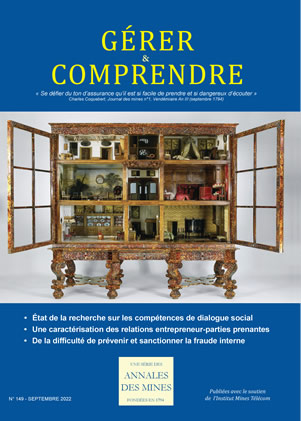
Issue 149
OVERLOOKED…
The career interview in the company: Understanding its (non-)uses by the employees
By Axel POHN-WEIDINGER
Institut de sociologie de Strasbourg
and Marliese WEISSMAN
SOFI Göttingen
While the recent reforms of the French vocational training system have been widely commented on, their concrete effects within enterprises have rarely been analyzed in depth. Based on a comprehensive and comparative survey carried out in two industrial firms, this paper analyzes the (non-)use of one of these reforms’ key instruments: The career interview. It shows that these (non-)uses are structured by employees’ experience of internal mobility and of changes in work organization, as well as by their relationship with the firm.
Skills related to the practice of social dialogue: State of the literature and avenues for research
By Christelle HAVARD
CEREN, EA 7477, Burgundy School of Business - Université Bourgogne Franche-Comté
The quality of social dialogue in companies depends in part on the skills of its actors. What is the current state of research on the skills associated with social dialogue? The aim of this article is to review the literature on social dialogue skills and to identify the heuristic fields that have not yet been explored. It is shown that research exists on individual negotiation skills and on individual trade union knowledge, but also on the strategic capacities of trade unions. Furthermore, the literature deals significantly with the modalities of development of trade union skills. Several avenues for research are then identified to fill in the blind spots in research on managerial social dialogue skills, collective social dialogue skills, and certain unexplored areas of social dialogue.
TRIAL BY FACT
Analysis of stakeholder relationhips in an entrepreneurial project - The case of the digital platform “Location Rétro Mariage”
Cas de la plateforme numérique « Location Rétro Mariage »
By Odile PAULUS
EM Strasbourg, Université de Strasbourg, Large (UR 2364)
and Coralie HALLER
EM Strasbourg, Université de Strasbourg, Humanis (UR 7308)
Relationships between an entrepreneur and their stakeholders have been studied in entrepreneurship through business models (Osterwalder and Pigneur, 2010), effectuation (Sarasvathy, 2001), dialogics (Bruyat, 1993), and the processual approach (Steyaert, 2007). We propose to characterize these relationships through the lens of anthropologist Ingold’s (2017b) theory of life in society. The latter distinguishes two possible modes of relationship: One (correspondence) is adaptive, effectual, dialogical, and the other (hylemorphism) is planned and causal. The modes of relationship between an entrepreneur, their customers, and suppliers are analyzed in the context of the creation and development of a digital platform, “Location Rétro Mariage” (LRM). Four sources of data were mobilized: The entrepreneur’s introspective account, a descriptive statistical analysis of 27 suppliers completed by 10 semi-structured interviews and 310 online customer reviews. Our results indicate that both modes of relationship are present from the perspective of the three stakeholders. However, at the start of the project, the entrepreneur had a correspondence/dialogue/effectual behavior. With time, growth, and success of the enterprise, he evolved towards a hylemorphic/causal behavior. This evolution was not perceived by suppliers who emphasized the role of digitization in the systematization of relationship modes. They perceived the maintenance of the contractor’s attention, notably thanks to possible derogations according to their needs, and the continuity of a friendly and close corporate culture.
Telecommuting and emerging forms of control: The case of the banking and financial sector during the Covid-19 health crisis
By Vincent MEYER
EM Normandie Business School, Laboratoire METIS
Caroline DIARD
ESC Amiens et Membre du centre de recherche en risk management (C.E.R.M.)
and Dounia ROST
Chargée de développement RH du Groupe La Banque Postale
On March 17, 2020, French companies suddenly placed their employees on full-time telecommuting following the first lockdown. This emergency reorganization was made possible by new information and communication technologies. But it also suddenly gave rise to new ways of organizing work, and in particular to new forms of control. The literature on telework tells us that such a change is traditionally accompanied by a strengthening of control by results. Our exploratory study of 17 employees in the banking and finance sector reveals a decline in performance control. While this decline can be explained in part by the singular context of the Covid-19 crisis, our study highlights the emergence of new forms of control by behavior (micro-management, increased number of meetings) and by inputs (increased number of training sessions). Above all, it highlights the strengthening of technological control and the emergence of a more diffuse form of self-control, through the co-construction of a corporate culture based on urgency and hyper-reactivity, a strong sense of accountability, and peer monitoring.
Internal fraud risks - How to effectively dissuade employees?
By Caroline DIARD
Enseignant-chercheur en Management des RH et droit, ESC Amiens
and Nicolas DUFOUR
Professeur Affilié, PSB
The current health crisis has increased the risk of fraud within organizations (cybercrime, accounting fraud, corruption, misappropriation of assets, etc.). Whether it is external or internal, fraud puts the organization at risk, as well as its sustainability, its financial balance, and its reputation. Organizations have therefore set up internal control services to protect themselves from any internal fraud committed by their employees. Employers organize prevention upstream in order to dissuade employees, and implement technological control tools (Diard and Dufour, 2022 forthcoming). The Labour Code provides for the possibility of sanctions. The objective of this contribution is to propose control tools to dissuade employees from committing internal fraud, and to determine which procedures and effective prevention tools to implement. It will also define which dissuasive sanctions to apply. We hypothesize that fraudsters are difficult to sanction, and that prevention and internal control procedures are often perceived as deficient. A qualitative study with 30 employees of a life insurance company confronted with internal fraud highlights the need to strengthen processes, to organize prevention, and to sanction.
Mosaics
La relation à l’incertitude au cœur du management de projet
À propos de l’ouvrage de Thomas REVERDY, « Antimanuel de management de projet : Composer avec les incertitudes », Dunod, 2021, 288 p.
By Thierry BOUDÈS