
September 2021
abstract
Gérer & Comprendre
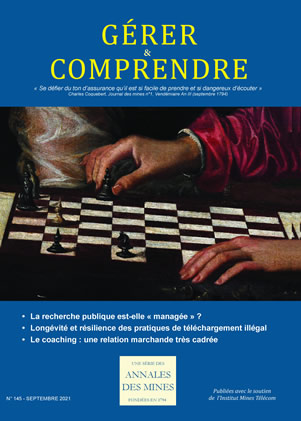
Issue 145
OVERLOOKED…
Niches for a transition as a space for renegotiating the energy system: The case of self-consumption
By Élodie GIGOUT, Julie C. MAYER, Hervé DUMEZ
i3-CRG, École polytechnique, CNRS, IP Paris
Self-consumption, an emerging practice, is considered to be a lever for the energy transition. Paradoxically however, its development on a large scale is controversial. Defined as an entity’s consumption of the energy that it has produced locally, the launching of self-consumption has encountered problems and stirred up controversies among all players in the energy sector in France. Schot & Geels’ (2007) concept of “strategic niche management” is used to shed on this new theme. The self-consumption of electricity is taken to be a window of opportunity for an experimentation that might, under specific conditions, help to deeply change the established system. Identifying the niche to be used to transform a system is easy to do ex post ; but choosing a niche while it is still a niche is a matter, we assume, of lively debate. How do actors, through the discourses that orient their practices, take sides in this debate about self-consumption? On the one side, those who want a controlled development of the niche and, on the other side, those who want to change the system…
Managing public research: Defending independence and continuity
By Jean-Yves Ottmann
Paris-Dauphine University PSL.
The governance of public research involves principles and arrangements, in particular for funding from the national level, which have consequences on research at the local level. This governance is now seeking to make public research “useful” and “efficient” through provisions for competition and project-based funding. In the case of four laboratories of the Atomic Energy Commission (CEA) in France, this article shows how local managers, the true “managers of science”, have adopted strategies for seeing to the continuity of their research and the independence of their teams in the context of this new governance.
The persistence and resilience of illegal access to cultural contents: Perseverance and exits in pirates’ careers
By Anthony GALLUZZO
Université de Saint-Étienne
Coaching: Exploring a practice
By Magali Ayache
Thema, CY Cergy-Paris University;
and Hervé Dumez
CRG-i3, École Polytechnique, CNRS, IP Paris
The market for coaching is thriving. On the basis of interviews with coaches (self-employed, in group practices or working in firms) completed with a nonparticipant observation of two sessions of group mentoring, questions are raised about the paradox of a practice that lacks any theoretical grounds or might refer to a multitude of approaches (psychology, neurosciences, etc.) but that is tightly organized (a dozen sessions, two of them with three parties: the coach, the coached person and a company representative). The hypothesis is formulated that the explanation of this paradox might lie in the commercial nature of the coaching relationship, which explains its tight organization while being consistent with the many approaches left open for the coach’s activity.
OTHER TIMES, OTHER PLACES
Artificial intelligence: between science and market- Some socio-historical elements to better understand a strange scientific experiment (1956-1990)
Quelques éléments sociohistoriques pour mieux comprendre une étrange expérimentation scientifique (1956-1990)
By Jean-Sébastien VAYRE
Université Côte d’Azur
On the one hand, artificial intelligence is fashionable: the main political and economic actors involved in the development of digital technologies are promoting it fervently. On the other hand, artificial intelligence is a matter of debate: some even go so far as to claim that it does not exist. The imbroglio is important. Is artificial intelligence a mirage? In this article, we will see that it is not. We will show more precisely how this confusion has been constructed, which characterizes artificial intelligence, whose existence is real. To do so, we will argue that artificial intelligence is a scientific discipline that, from the outset, has been coupled with an economic practice that produces an imbalance between fundamental and applied research. We will then add that it is precisely this imbalance that is at the root of the vagueness surrounding this scientific discipline and, more broadly, of the instability characterizing its evolution.
Mosaics
“What about reintroducing ‘culture’ in ‘intercultural’?
On Philippe d’Iribarne, Sylvie Chevrier, Alain Henry, Jean-Pierre Segal & Geneviève Tréguer-Felten’s Cross-Cultural Management Revisited: A Qualitative Approach (Oxford: Oxford University Press, 2020).
By Jane Kassis-Henderson
“What if deglobalization marked the end of the alarming expansion of the Big Four (GAFA)?
On François Lévêque’s Les entreprises hyper-puissantes, Géants et Titans, la fin du modèle global? (Paris: Odile Jacob, 2021).
By Christophe Deshayes
“The office, a world in sitting
On Pascal Dibie’s Ethnologie du bureau. Brève histoire d’une humanité assise ” (Paris: Métailié 2020).
By Jean-Marc Weller