
June 2018
abstract
Gérer & Comprendre
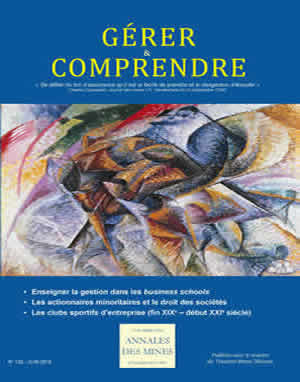
Issue 132
OVERLOOKED…
Employer pools: Toward a regional management of human resources?
By Laëtitia Lethielleux
associate professor in managerial science, URCA, chair of Social Economy and Solidarity, URCA
Employer pools (GE, groupements d’employeurs ) were set up in 1985 with the assignment to facilitate the sharing of employees among firms belonging to the pool. The intent is to create, as best possible, steady full-time employment based on time-sharing. In a tense labor market, these pools are once again receiving attention from French public authorities, who see them as a means for fighting against jobless-ness, responding to corporate expectations for job flexibility and meeting needs in the label market. The findings of a research action program conducted from 2015 to 2017 in the Grand Est Region serve to show how these pools contribute to a regional management of human resources, which rests on two conditions: that players in the labor market change their points of view and that these pools adopt an interorganiza-tional approach.
TRIAL BY FACT
“That makes us grow up, a step into adulthood”: Proposals for changes in the teaching of management in business schools
By Carine CHEMIN-BOUZIR
NEOMA BS, IAE Paris I
and Jean-Baptiste SUQUET
NEOMA BS, IRG - UPEMLV
Teaching managerial theory in business schools is often seen as a communication of theoretical knowledge that students must acquire and recount. The experience described here has tried to move beyond this view and let students realize how real work teams function within an organization and its forms of regulation. The teacher is in the position of accompanying students rather than grading them - a meeting between the two to explore how work teams actually work, something that neither the teacher nor students knew beforehand.
No one can be against virtue… except a system
By Sylvie Chevrier
Institut de Recherche en Gestion (IRG)
The ways of implementing value stream mapping and workers’ health: A study of several cases
By Sébastien Bruère
ergonomist and labor psychologist
More and more firms are adopting lean management to organize work processes. Many criticisms have been directed at it, in particular its effects on workers’ health. At the core of this form of organization is the tool “value stream mapping”. This exploratory, qualitative research program collected data on ten projects for setting up lean manufacturing in France and Quebec. What uses of value stream mapping in these projects advanced, or impeded, the emergence of an enabling organization? This emergence depends on the ways that wastes were defined, goals were set, and information was collected in the workplace for drafting value steam maps.
IN QUEST OF A THEORY
A partnership agreement between shareholders without any stake in the firm? Questions of minority shareholders about corporate law - A dialog with Colette Neuville
By Rachelle Belinga
and Blanche Segrestin
Mines ParisTech
Since founding an association for defending minority shareholders (ADAM: Association de Défense des Actionnaires Minoritaires) in 1991, Colette Neuville has been an eyewitness of interactions between shareholders and corporate management, and has tirelessly striven to advance governance in firms. To defend shareholders, her actions take issue with the role that majority shareholders sometimes play. The latter might have no other quality as a stakeholding partner than the right to vote. Nonetheless, they can control a corporation’s equity and administration. From an original angle for analyzing minority shareholders, radical questions are asked. How legitimate is an investor who holds a majority of voting rights and controls a firm without seeking to safeguard its eventual interests? Should risk, responsibility and profit not be linked? Is there a partnership agreement among shareholders when they no longer have any joint interest?
Collective bargaining on occupational equality: Integrative negotiations?
By Clotilde Coron
Paris 1 University, GREGOR (IAE Paris, EA2474),
and Frédérique Pigeyre
Paris-Est Créteil University, Institut de Recherche en Gestion (IRG, EA2354)
Many research studies have concentrated on the negotiation of company-level agreements in France, a cornerstone of what is called the “social dialog”. However few of them deal with the negotiation of agreements on a point that the Génisson Act of 2001 made compulsory, namely occupational equality. Cutting across several fields of human resources and carrying legal weight, specific aspects of this theme affect the bargaining process. How does the definition of this issue affect negotiations? Since it runs through several processes (recruitment, pay, promotions…), it has an impact on both the room for negotiators to maneuver and the role of labor unions toward management. The many legal requirements that hinge on statistical indicators risk leading to agreements with statistical engagements that might not lie within reach. These negotiations clearly shed light on the integrative aspect of occupational equality, which is not very characteristic of a “social dialog French-style”
OTHER TIMES, OTHER PLACES
Company sports clubs caught between management and labor unions?
By Igor Martinache
agrégé professor of economics and social sciences at Lille 1 University.
Company sports clubs are often seen in relation to the sports federations which they have joined, even though being part of a company endows them with special characteristics. Both management and labor unions might try to manipulate them. A comparison of the declarations of the leaders, past and present, of six such clubs (in firms in various branches of the economy) sheds light on these clubs as part of a company and on the factors that shape and change them. Three “ages” are discerned in their growth: the initial age of patronage, the “thirty glorious years of prosperity” after WW II and, nowadays, the age of decline under the brunt of both the recession and corporate “modernization” - a decline concomitant with the investment by firms in sports-related activities for their wage-earners.
Mosaics
Jacques Girin : A singular work to discover or rediscover
On Jacques Girin’s (with Jean-François Chanlat, Hervé Dumez et Michèle Breton), Language, organizations, situations and layouts (Presses de l’Université de Laval, 2016)
By Franck Aggeri
An analysis of ‟partnership and collaborative research” practices
On Anne Gillet and Diane-Gabrielle Tremblay (ed.), Partnership and collaborative research (Presses de l’Université du Québec and Presses universitaires de Rennes, 2017)
By Damien Collard
The growth of intangible investments
On Jonathan Haskel and Stian Westlake’s, Capitalism without Capital. The Rise of the Intangible Economy (Princeton University Press, 2018)
By Hervé Dumez
Video game, culture and industry
On Pierre-Jean Benghozi and Philippe Chantepie’s, Video Games: The Cultural Industry of the 21st Century? ( Presses de Sciences Po, 2017)
By Pierre Poinsignon