
December 2011
abstract
Gérer & Comprendre
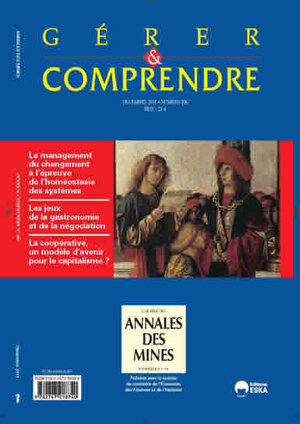
Issue 106
Editorial
By Pascal LEFEBVRE
OVERLOOKED
The intervention of a third party in drawing up plans for saving jobs: the ddtefp’s role
By Philippe CHAPELLIER
Maître de conférences en sciences de gestion à l'IUT de Montpellier, Membre du groupe CREGOR-COST-FCCS, MRM, Université Montpellier II
and Claude FABRE
Maître de conférences en sciences de gestion à l'IUFM de Montpellier, Membre du groupe CREGOR-ORHA, MRM, Université Montpellier II
The “management of change” is defined as an action for bringing an organization from one situation to another, preferred situation while avoiding difficulties inasmuch as possible. The hypothesis of a homeostasis of organizational systems underlies the theory, proposed herein, of resistance to change. This concept of homeostasis improves our understanding and management of complex changes. It is used to propose principles for facilitating this management.
TRIAL BY FACT
Sustainable development reports, from a global to a local logic: Total - Haute-Hormandie
By Nathalie AUBOURG
Maître de Conférences en sciences de gestion
Béatrice CANEL–DEPITRE
HDR - Maître de Conférences en sciences de gestion
and Corinne RENAULT–TESSON
Maître de Conférences en sciences de gestion
Sustainable development reports are part of the toolbox for corporate social responsibility. They often serve as a social and environmental showcase. They fit into a rationale of institutional communication with global aims. Firms are increasingly aware of the requirements set by local parties; their response must be in line with a “territorial logic” in order to ensure their legitimacy. The objectives of legitimacy and proximity appear coherent but are sometimes hard to make compatible. As part of its tools for corporate social responsibility, the firm studied herein (a refinery in Normandy belonging to the group Total) drew up a local sustainable development report. The conjugation of local and global sustainable development reports was evidence of a bottom-up approach in dealings with local parties. It was a source of information of a different sort; consulting local parties was an element in a participatory approach that fit into a process of collective learning.
Managing change and the homeostasis of systems
By Gilles BAROUCH
Diplômé de l’École des Hautes Études Commerciales (HEC) ; Docteur en Gestion de l’Université Paris-Dauphine ; Titulaire d’une habilitation à diriger des recherches de l’Institut d’Études Politiques de Paris ; Professeur senior ; Responsable académique de l’Institut Supérieur du Management par la Qualité, BEM – Bordeaux Management School
The “management of change” is defined as an action for bringing an organization from one situation to another, preferred situation while avoiding difficulties inasmuch as possible. The hypothesis of a homeostasis of organizational systems underlies the theory, proposed herein, of resistance to change. This concept of homeostasis improves our understanding and management of complex changes. It is used to propose principles for facilitating this management.
How do processes think? A study of practices related to returned files in a bank
By Vincent MAYMO
Maître de Conférences à l’université de Bordeaux, IRGO – EFFI, Chaire Management des Entreprises financières
Since 2000, banking processes have been reorganized following a rationale for reducing costs and timing while maximizing the value on account. Standards have been set for malfunctions that generate “non-quality”, for example, when headquarters returns case files toward an agency. Nine months of participant observation in a regional bank in France have been devoted to studying these practices. A managerial approach to conventions has been adapted to explain why practices do not adhere to the standards set by the procedures for managing processes.
OTHER TIMES, OTHER PLACES
The interplay between gastronomy and negotiation, lessons drawn from the congress of vienna (1814-1815)
By Lionel BOBOT
NOVANCIA (CCIP), Enseignant chercheur / Direction déléguée au Corps professoral et chercheur associé à l’INRA (UMR SAD APT, équipe Proximités)
UNESCO has just listed French gastronomy as an immaterial heritage of humanity. The history of this French art de vivre cannot be separated from the art of negotiations, not just diplomatic but also commercial. Despite the downturn in the economy, business luncheons and dinners are still a must for French firms; they represent a strategic investment. Negotiations, like gastronomy, has its origins in the 17th and 18th centuries. Talleyrand and Carême personified the alliance of the two during the Congress of Vienna (1814-1815). Focusing on this alliance during this event lets us discern the advantages and limits (emotions, theatricality and communication) of sharing meals today.
“recruit, reshape, retain”: managing turnover in an intercultural situation — french firms in India
By Dr. Nathalie BELHOSTE
Professeur, Reims Management School – CMAC
The growing Indian market is so attractive that more and more companies are setting up operations there. Once they do so, the recruitment, training and loyalty of the workforce (in particular of qualified English-speaking whitecollars) become priorities for expatriate services. This exploratory study has been drawn from qualitative interviews conducted with French expatriates in India and with their principal Indian colleagues in four big cities. What strategies are adopted in response to this problem in an intercultural context? These strategies heavily depend on a shortor longterm view of local operations, a view related, in particular, to how expatriates interpret the local (cultural or business) situation. These strategic decisions are discussed in light of expatriates’ understanding and their implication at the local level.
DEBATED
Are cooperatives a model for capitalism? A review of the Mondragón case
By Philippe DURANCE
Professeur associé au Conservatoire national des Arts et Métiers (CNAM) Paris, chercheur au sein du Laboratoire interdisciplinaire de recherche en sciences de l’action (LIRSA)
Cooperatives often represent a credible (and seemingly more human) alternative to the present-day capitalistic system. Nonetheless, they have been criticized for not being capable of acquiring the qualities that reinforce traditional firms in a globalized environment. Such criticisms date back to a study of a now mythical case, the Spanish Basque group Mondragón. The classical capitalistic model has evolved, as has that of cooperatives. As this review of the major relevant studies shows, this cooperative has proven capable of adapting and developing beyond the expectations of many observers. However the purchase of a European industrial group in 2005 opened a new fault line between two quite distinct spheres: shareholding cooperative members and other wage-earners. Top executives in Mondragón insist that the cooperative should not be seen as an alternative to the capitalist system, since it is a full part in a single vision of the world.
IN QUEST OF THEORIES
The performance of winemaking cooperatives: a benchmark but without rent
By Frédéric COURET and GAIA and ENITA Bordeaux
The wine industry, faced with a crisis, has turned toward new strategic options and managerial practices. Among the approaches adopted is benchmarking, a cooperative attitude based on understanding partners. In cooperatives with the aim of maximizing payments to their members for their contributions, the best suited indicator of economic performance is the earnings to be shared. But it is not suited as a tool for comparing the economic performance of wine-growers because of the economic rent derived from labels of origin (AOC), of which there are differing perceptions. An innovative method is presented and assessed: the EBR (Bordeaux red wind equivalents) is intended to neutralize the pernicious effects that the rent drawn from these labels has on calculating the earnings to be shared.
Mosaics
From boss to manager: Public research laboratories since the 1970s
On Séverine Louvel’s Des patrons aux managers, les laboratoires de la recherche publique depuis les années 1970 (Rennes: Presses Universitaires de Rennes, 2011)
By Daniel FIXARI
What does “being a white-collar” mean in france today?
On Paul Bouffartigue, Charles Gadea and Sophie Pochic’s Cadres, classes moyennes: vers l’éclatement? (Paris: Armand Colin, 2011)
By Michel VILLETTE
Psychological contracts in organizations: Understanding written and unwritten agreements
On Denise M. Rousseau’s Le Contrat psychologique (CA: Thousand Oaks, 1995)
By Pascale DE ROZARIO and Rémi JARDAT
How to steer systems?
On François Dupuy’s Lost in management – La vie quotidienne des entreprises au XXI e siècle (Paris, Seuil, 2011)
By Arnaud TONNELÉ