
December 2009
abstract
Gérer & Comprendre
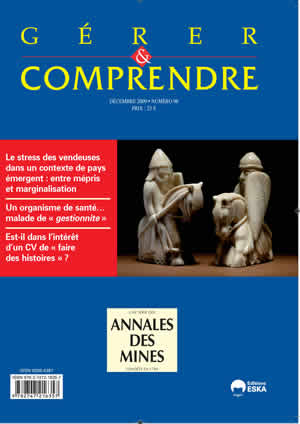
Issue 98
Editorial
By Pascal LEFEBVRE
OVERLOOKED…
The stress of salespersons in an emerging country: Between contempt and marginalization
By Lamia HECHICHE-SALAH
Enseignant-chercheur, Ecole Supérieure des Sciences Economiques
Commerciales de Tunis
Mourad TOUZANI Enseignant-chercheur, Institut Supérieur de Gestion de Tunis
and Asma AYARI
Chercheur, Ecole supérieure des Sciences Economiques et Commerciales de Tunis
To cope with deep changes in their socioeconomic environment, firms are ever more concerned for their success and performance — a situation that used to characterize developed societies but increasingly occurs in emerging countries. This rationale leads sales force managers to require more performance from their personnel. However performance comes at a cost: occupational stress. A qualitative study conducted with 38 Tunisian salespersons, mostly women, in ready-to-wear clothing stores brings to light specific factors of this stress in an emerging country: salespersons’ relationships with customers, their lack of professionalism and of understanding of their occupation, and the feeling of having a stigmatized job that “marginalizes” them.
Liberal governments faced with social strife
By Jean-Louis PEAUCELLE
Three violent social movements are compared: the events in Guadeloupe in early 2009, the silk-worker uprising in Lyon in 1831 and the pin-maker revolt in Normandy in 1831. Despite differences, these three cases share characteristics, in particular the government’s ambiguous handling of disturbances. The doctrine of economic liberalism certainly affected these events, both by shaping the behavior of employers, which was at the origin of the crises, and by keeping the government from assuming the role of mediator.
TRIAL BY FACT
An health-care establishment… suffering from “managementitis”
By Mathieu DETCHESSAHAR
and Anouk GREVIN
Institut d'Economie et de Management de Nantes (Université de Nantes) LEMNA
Several transformations of the health care have had an impact on work. Given an increasing number of requirements, the personnel has to devote more time to organizing their work. What impact does this have on wage-earners’ health, and how does the personnel appropriate the new managerial tools? The comments herein, based on J.D. Reynaud’s theory of regulation, raise questions about management’s role in coping with stress. As shown by a case study in a center of follow-up care in France, the current “managerial” trend has forced the staff to desert everyday activities and occupy themselves with providing input into “management machines”. The contrast between the number of “participatory” managerial tools and wage-earners’ feelings that no one is listening to them exposes how hard it is for a management suffering from “managementitis” to facilitate “spaces of discussion” at the workplace.
From “sustainable” to “profitable” development: The marginalization of an approach to sustainable development in a big firm
By Aurélien ACQUIER
Professeur Assistant dépt SHO, ESCP Europe, Chercheur Associé, CGS, Mines ParisTech
During the past decade, very few big European firms have not created a department for deploying the company’s strategy of sustainable development and carrying out relevant organizational changes. Do such organizational changes strengthen or weaken support for sustainable development? This seldom asked question is broached through a case study of ‘Utilities Corporation’, an international firm that, despite an apparently favorable context at the start, had to cope with the “marginalization” of its approach to sustainable development. A reason for this was the difficulty of establishing a coherent model for piloting sustainable development.
IN QUEST OF THEORIES
The contribution of real options analysis to valuations: The case of eBay
By Marie PEREZ
Maître de conférences, Université Paris X (CEROS)
and Safwan MCHAWRAB
Enseignant Chercheur, Reims Management School
The controversy associated with the overvaluation of firms in the Internet-economy centered around real options, which not only account for the positive difference between stock market and underlying values but also are closely associated with the creation of value. However, there are hardly any studies based on a real options approach, devoted to the undervaluation of companies. But a real options analysis can help us explain the undervaluation of thriving firms. This examination of eBay validates such an analysis for cases of undervaluation. It draws attention to the fact that it is not enough to identify and exercise options; they must also be managed.
Should a résumé tell a story?
By Thierry BOUDES
Docteur ès-Sciences de Gestion, Professeur Associé - ESCP Europe
Loïc CADIN
Docteur ès-Sciences de Gestion, Professeur - ESCP Europe
and Jean PRALONG
Professeur assistant - Rouen Business School, Département Management et Stratégie
Storytelling is fashionable, whether praised for creating meaning or accused of being at the service of murky intentions to manipulate people. In the recruitment process, a résumé is a text where two dimensions meet. Its presentation of the applicant must be both clear enough to be understandable and attractive enough for the person to be selected. The underlying question is: does a résumé that adopts a storytelling approach have more chances of being selected?
Mosaics
Joseph Jacotot, a coach in the 19th century
On Jacques Rancière’s Le maître ignorant – Cinq leçons sur l'émancipation intellectuelle (Fayard, 1987).
By Arnaud Tonnele
A review of Jean-Pierre Segal’s Efficaces ensemble: Un défi français (Seuil, 2009)
By Sylvie Chevrier
Boss at Renault
On Cyrille Sardais’s Patron de Renault – Pierre Lefaucheux (1944-1955) (Presses de SciencesPo, 2009).
By Daniel Fixari
Differences tested: The experience of a global firm —
On Philippe d'Iribarne’s L'épreuve des différences: l'expérience d'une entreprise mondiale (Seuil 2009).
By Christian Herrault