
March 2005
abstract
Gérer & Comprendre
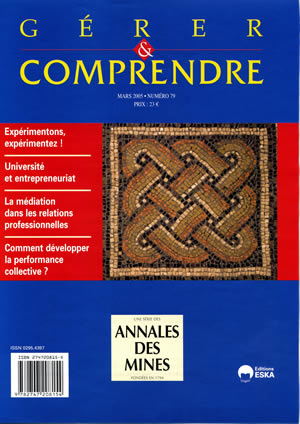
Issue 79
Editorial
By Francis LEFEBVRE
Secrétaire général du Comité de rédaction
DEBATED
Toward ratings for academics? (Follow-up)
By Hashem SHERIF
Ingénieur chez AT & T
and TRIAL BY FACT
LIVE...
Let’s experiment — in order to manage better
By Tatjana GLOBOKAR
CRG - Ecole Polytechnique
In high-risk industries, technological precision requires fine-tuned management, which is particularly hard to achieve given the diverse parties involved. An experiment during a phase of research in managing nuclear maintenance provides evidence not only of the fine-tuning required in a complex sociotechnical organization but also of the operational and epistemological interest of experimentation
Show to create an “entrepreneurship resource cell” in a french university?
By Cécile CLERGEAU
LEN-CEBS et CRGNA - Universtité de Nantes
and Nathalie SCHIEB-BIENFAIT
CRGNA - I.A.E - Université de Nantes
This analysis of the creation of a “resource cell” devoted to entrepreneurship in a major French university presents the problems raised bysuch an initiative and the solutions retained. Thought then turns toward discovering the rationales and tensions underlying the definition and implementation of such a project within a web of negotiations that, involving many actors, has its own set of rules. This initial assessment discusses the difficulties and draws the lessons from this university “intrapreneurship”.
Mediation in french labor relations: A threesome?
By François GRIMA
Université Paris 8, LERGO
and OVERLOOKED…
Designed, under the act of 13 November 1982, to be a simple aid for developing collective negotiations, the“mixed commission” procedure places the mediator in a paradox. He must be both the state’s representative, who sees to it that the law is enforced, and a facilitator aware of the real conditions in an industry where management and labor have been unable to negotiate calmly. Far from being limited to the role of a neutral third party, who moderates a debate involving only labor and management, the mediator asserts his position. While seeing to it that the rules of negotiations areupheld (in line with his official role assignment), he helps to draw up new rules if need be…
Réalités méconnues
Professors-researchers creating firms: A functional analysis of technological innovation and networks of know-how
By Dominique Philippe MARTIN
Maître de conférences, CREM
What practical difficulties do researchers who are professors encounter when they adopt a strategy for setting up a firm in relation to their scientific work? This exploratory study is methodologically organized around two principles. For one thing, the development of a technological innovation breaks down into a certain number of interrelated functions; and for another, validating each function necessitates mobilizing networks of knowhow. On this basis, a set of difficulties are detected for each of the major functions and subfunctions in the process of setting up a firm.
Sur le vif
The mysteries of norwegian management
By Claire TUTENUIT
Consultante
The French who take an interest in Norway all ask the same question: how do they do it? How do they manage to give everyone a minimum wage nearly double the French one while barely working more than thirty-five hours a week? How do they do business with a set of laws no bigger than a small dictionary, with contracts ten times shorter than American ones and without shaking their fists? The contrasting views of a French consultant and a Norwegian executive give us insight into the mysteries of management in Norway…
Mosaics
Michel crozier as he is
On Michel Crozier’s À contre-courant: Mémoires, Paris, Éditions Fayard, 2004.
By Claude RIVELINE
Democracy’s pea ce - ful regression
On Jean-Paul FITOUSSI’S La Démocratie et le marché, Paris, Éditions Grasset, 2004.
By Arnaud TONNELE
By word of mouth
On Alain PEKAR LEMPEREUR et Aurélien COLSON’S : Méthode de négociation, Paris, Éditions Dunod , 2004. IN QUIEST OF THEORIES Brigitte RORIVE LENTIC, Université de Liège, Belgique Thierry PICQ Professeur, EM Lyon
By JEAN-YVES BARBIER
En quête de théorie
The “network firm” revisited: An attempt to put order in the typology of new forms of organizations
By Brigitte RORIVE
LENTIC, Université de Liège, Belgique
The analysis of a dozen organizations set up as networks has led the author to draw up a multidisciplinary typology with the aim of refining the concept of the “network firm”. The latter represents an innovative response by organizations to the necessity to cope with the globalization of their markets, increasing competition and consumers’ new requirements. This typology refines and deepens the examination of critical questions related to the management of such a network (especially in matters of human resource management) by brining to light noticeable differences between types.
How to develop a group’s performance? When a handball player comes to the manager’s rescue…
By Thierry PICQ
Professeur, EM Lyon
How to train future managers in the arts of balancing and tight-rope walking? Inspired by the principles of Daniel Costantini, the trainer of the French handball team that won the world championship in 2001, the author’s response is simple: make your children play handball! They will learn better than in school how to lose before winning, how to play with others to fulfill themselves individually, how to find their place in a group while developing their strong personal points, how to define stages in order to meet major deadlines — in short, everything the world of work will demand of them!