
June 2004
abstract
Gérer & Comprendre
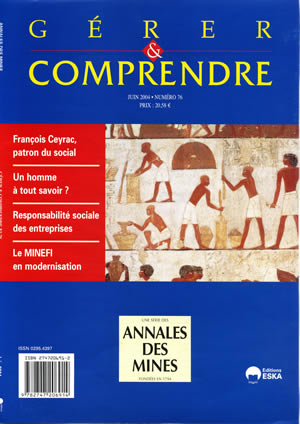
Issue 76
Editorial
By Francis LEFEBVRE
Secrétaire général du Comité de rédaction
TESTIFYING
François Ceyrac : The boss on social issues
Entretien mené et mis en forme par Bernard COLASSE (Université Paris IX-Dauphine) et Francis PAVÉ (CSO-ENPC)
By Francis PAVÉ
CSO-ENPC
Having joined the French associations of industrialists in metallurgy (UIMM) when the Popular Front came to power in June 1936, François Ceyrac later became the “boss of bosses” as head of the nation’s major employer organization. He brought his career to an end in November 1981, another symbolic date in the history of the French left. For 45 years, from the 40-hour workweek to the 1982 Auroux acts , which expanded labor rights and collective bargaining, this eye-witness of trends in French society was a partner in changes in the world of work and a leading actor in modernizing the country’s firms. While listening to him talk about his career, we join him in meeting the political, business and labor leaders who wrote the country’s social history during the 20th century...
TRIAL BY FACT
The momentum gained by implementing logistics: The Manitou Group
By Thierry SAUVAGE
Maître de Conférences
Over the past two decades, logistical and supply chain management have helped push logistics up among a firm’s strategic functions. According to writers on this topic, the assignments and expectations related to logistics have evolved, thus reflecting a maturation that should lead to sharing skills and know-how among various parts of an organization. In an increasingly uncertain business context at a time when individuals have to bear up under the requirements for “reactivity” and “flexibility”, what is the current position of logistics? A study of Manitou, a world leader in forklifts, illustrates theoretical considerations by examining the action and evolution of logistics in the light of behavioral patterns.
A know-all? The limits of a knowledge-based approach: The exemplary case of product-design tools
By David URSO
and Béatrice VACHER
Ecole des mines d'Alès, site EERIE
The reorganization of R&D structures, the rationalization of design, competitive engineering and the codevelopment of products… firms have developed all these new forms of organization in order to gain a competitive edge. Does this suffice? Referring to a study on the manufacturing of molds for plastic — an activity that the automobile industry subcontracts — questions are raised about the interactions between updating knowledge and developing products. The “industrializers of the means of production” provide the only interface between tools and products owing to their capacity for combining human, material and symbolic resources. They are a decisive actor in processes of innovation.
OVERLOOKED
What are the indicators of a firm’s sense of social responsibility? An application to the European aluminum industry
By Sylvie FAUCHEUX
and Isabelle NICOLAI
Centre d'Economie et d'Ethique pour l'Environnement et le Développement Université de Versailles Saint-Quentin-en-Yvelines
The methodological aspects and major empirical results of a study of the European Aluminum Association are presented with the intention of defining and selecting indicators that can help work out a strategy focused on the social responsibility of firms in this branch. At each of the three plants selected for this study, “focus groups” were formed to bring together various concerned parties. Their conclusions were used to draw up two categories of indicators and then design indicators of sustainable development that are adapted to the aluminum industry in Europe.
Mosaics
Understanding labor issues
On Philippe Zarifian’s À quoi sert le travail ?
By Jean-Marc Weller
The toolbox for sense-making
On Bénédicte Vidaillet’s (ed.) Le sens de l’action. Karl E. Weick: Sociopsychologie de l’organisation.
By Mathias Szpirglas
Culture as a resource
On Philippe d’Iribarne’s Le Tiers-Monde qui réussit – Nouveaux modèles.
By Francis Pavé
WHILE READING
Bernard Arnault (1974-1989) reaches economic power
Compte rendu du livre d'Airy Routier, « L'Ange Exterminateur, la vraie vie de Bernard Arnault », Albin Michel, Paris, 2003
By Michel VILLETTE
ENSIA
An American-style businessman; a crafty, clever boss; or an exterminating angel? There are more than enough descriptions of Bernard Arnaud, an emblematic businessman whose dizzying rise to the 47th place among the world’s wealthiest intrigues, amazes and irritates us. Beyond the show and media of the luxury goods business, the formation of LVMH illustrates the often overlooked strategic role of predatory activities in the world of business, in particular at the start of the careers of big entrepreneurs. While critically reexamining Arnault’s itinerary, several questions arise about the operation of capitalism at the start of the 21st century and about shady dealings in the quest to reach the top.
TESTIFYING
The Ministry of the Economy, Finance and Industry undergoes globalization: Its network of economic information outside France
Entretien mené par Frédérique PALLEZ (Centre de Gestion Scientifique (CGS) - ENSMP) et Francis PAVÉ (Centre de Sociologie des Organisations (CSO) - ENPC)
Entretien avec Jean-Yves BAJON
Sous-directeur de l'Information économique à la Direction des Relations Économiques Extérieures (DREE)
In charge of multilateral negotiations, the internationalization of French firms and information about globalization, the Direction of Foreign Economic Relations is the spearhead of international policy-making at the French Ministry of the Economy, Finance and Industry. The DRÉE is now undergoing a major reform for rationalizing its ways and means, in particular its network of 150 Economic Missions around the world. This reform seeks to optimize its information system and introduces ideas based on contracting. Under it, working for both the government and businesses will mean making two “cultures” with their work methods get along together so that they enter into communication and exchanges.