
June 2021
abstract
Gérer & Comprendre
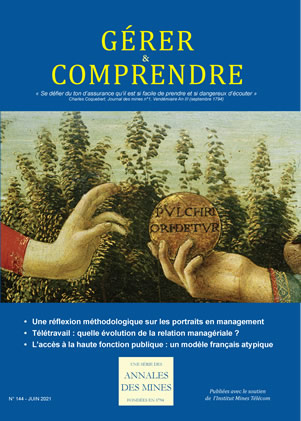
Issue 144
OVERLOOKED
The process of evaluating high potential talents, a political task?
By Pascal Braun
Center of the Sociology of Organizations (Sciences Po-CNRS).
The abundant literature on the evaluation of high potentials still narrowly focuses on the tools for detecting potential talent. Very little research has approached this evaluation as a “process” ranging from drafting the policies for evaluation to discussing the results for career management. Based on two years of nonparticipant observation and 58 semidirective interviews, this empirical, in-depth case study examines the work done by the various parties (and, in particular, the personnel from the department of human resources) involved in a process for evaluating high potential talents. Based on the analytical framework established by Braud (2018) for analyzing the professionalization of politicians, the work done by HR personnel is interpreted as a political task with the goal of legitimating the evaluation process in the eyes of top management and, to a lesser degree, of the employees who undergo evaluation. This work has three dimensions: the work of making the means used for evaluation consistent with corporate strategy; the “symbolic” work on the perceptions of the evaluation process by both top executives and the evaluated; and the work of “mediation” with the persons involved in formulating and discussing evaluations.
Literary portraits as a methodology for field work reports in management
Avec « Le portrait complet d’Henri » (PDF intégral)
By Hervé Colas
CHD Group, CNAM.
How might a researcher be led to write up and describe his work after returning from the field? What form to adopt for this report? A portraiture method is proposed for recounting a reality that can be taken “by surprise” during professional practices. By making a distinction between methods that place the author at the center of, or outside, the report, this article presents the portrait of a local elected official, and compares how it has been drawn with the styles of portraiture used by authors in managerial studies. The discussion focuses on: the idea of a “geographical” approach for completing historical biographical accounts; the scientific “tweaking” of the various roles played by the practitioner/author of the portrait; and a call for precaution when scientific practices, based on firsthand accounts, are not free of risks, neither for the author nor for those portrayed.
Coregulation, firms and the French Anticorruption Agency
By Brigitte PEREIRA
EM Normandie, METIS Lab.
This study aims to show the specificity of the state-enterprise co-regulation that exists in the preventive fight against corruption since the Sapin 2 law. Indeed, the French Anti-Corruption Agency (AFA) was created during the Alstom and Airbus cases. Thus, the AFA allows French companies to no longer fall directly under investigations conducted by foreign authorities (particularly in the USA). On this point, this co-regulation serves the general interest in the fight against corruption by protecting companies that no longer have to automatically transmit strategic information to foreign authorities. However, this co-regulation is multifaceted because it includes both compliance obligations and cooperation with the state without the risk of criminal trial being definitively ruled out for companies, but also for employees.
TRIAL BY FACT
Implementing telework: Reinvented managerial relations?
By Caroline DIARD
Enseignant-chercheur, EDC Paris Business School, OCRE
and Virginie HACHARD
Enseignant-chercheur, École de Management de Normandie, Laboratoire Métis
Teleworking as a new mode of organization implies considering a new managerial relationship. The implementation of remote work raises questions about the importance of trust, the possible control and development of the autonomy of teleworkers.How does the managerial relationship evolve during the implementation of telework?This exploratory qualitative study within a business school determines through the theory of the psychological contract the evolution of individual behaviors. This work demonstrates that managers trust their employees, they are satisfied with the system. There is no specific control, but autonomy and a form of self-control among teleworkers.
MISCELLANY
The French model for filling positions in the civil service put to the test of democratic legitimacy
By Daniel Gouadain
honorary professor.
The French model for filling top positions in the civil service is based on examinations for ranking postulants (and thereby on academic knowledge). It has come out of efforts for promoting equal rights so as not to discriminate against citizens in public employment. Given biases owing to the differences of fortune, culture and education related to family backgrounds, equal rights are hardly consistent with equality in a situation where competition is very intense but equality has gradually become a widely shared value. Questions thus arise. How to fill top civil service positions without compromising the quality of the services rendered? How to make openness compatible with efficiency? Should we be satisfied with a targeted approach to social diversity? Or should we imagine a more global approach? For sure, the specific characteristics of our educational system complicate the task for reformers. Far from being marginal to our system of higher education, the schools (Polytechnique, ENS, ENA) that open access toward top civil service jobs are the topping on this system.
Mosaics
“On John Child’s Hierarchy: A Key Idea for Business and Society” (London: Routledge, 2019)
By Hervé Dumez
“Nazism as an asymptote of criminal management?
On Johann Chapoutot’s Libres d’obéir. Le management, du nazisme à aujourd’hui” (Paris: Gallimard NRF Essais, 2020).
By François Valérian