
June 2020
abstract
Gérer & Comprendre
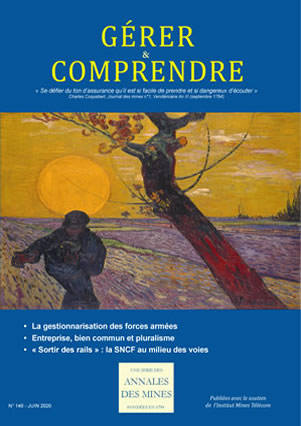
Issue 140
OVERLOOKED…
Chief happiness officer: What does this position bring to well-being at the workplace?
By Sabrina Tanquerel
and Roland Condor
EM Normandie.
The interest and controversy spawned by the creation of a “chief happiness officer” (CHO) lead to asking how this position will actually contribute to well-being at the workplace. Is the CHO a “gadget”, or does this position signal an actual advance toward improving well-being in firms? Answers to this question are based on an analysis of the literature on well-being at the workplace and on a qualitative study of CHOs (or their equivalent). Although CHOs are recruited in an effort to improve hedonistic well-being and foster horizontal management, appointing a CHO has little to do with the pursuit of happiness (eudemonic well-being). Some CHOs are recruited for utilitarian purposes, but this might undermine any contribution they make to well-being in the long run. The contribution to well-being made by appointing a CHO falls short and has to be completed with other arrangements.
“Managizing” the armed forces
By Sophie Lefeez
former French army officer, associate researcher at IRIS (Institut des Relations Internationales et Stratégiques) & CERREV (Centre de Recherche Risques et Vulnérabilités, Caen University).
Since the introduction at the turn of the century of a managerial rationality in the French armed forces, there has been: a multiplication of regulatory texts, the adoption of tools for counting and measuring, the implementation of just-in-time procedures and the conduct of many a reorganization in order to reduce the quantity of resources that are used. To see to the low-cost performance of the armed forces when faced with any adversary, materials have been designed for modules so that the modules can be assembled in kits to suit the situation. Meanwhile, “servants” are invited to adhere to prescribed routines and are assisted by artificial intelligence. Under this “managizing” ideal, the interchangeability of men and materials is total. However this army is locked in a straitjacket of norms and standards increasingly buckled by civilians. Any deviancy from the ordinary is now frowned upon and has fallen prey to biopolitical requirements. Meanwhile, the specific nature of the military is hardly recognized or accepted; the operational effectiveness of the armed forces is at stake, and their very existence is under question.
TRIAL BY FACT
Between managerial exigencies and opportunities for personal development through work: Applying the “need to know” in social services
By Sarah Richard
EM Strasbourg, Humanis Laboratory.
A French act of 26 January 2016 has broadened the possibilities for sharing confidential information in medical and social services. This is supposed to be a response to a major problem of management, since not sharing information has an operational cost and is detrimental to the followup on the disabled persons enrolled in work programs. But how to know which information may be disclosed and which is highly personal? This dilemma is typical of the actual management of ESATs, the establishments and services that provide work to the disabled. In the literature, the grounds for sharing information that is, in principle, confidential or secret is supposed to be the “need to know”. Applying this principle helps avoid situations where not sharing would have negative effects on the organization. How to describe the application of the “need to know” in this protected social service sector? According to the findings of two case studies, both ESATs had to cope with a constant tension between the “need to know” and the defense of a “right to not know”. This tension shaped the way that these establishments compartmentalized the sharing of information; and it led to two paradoxes in information management. These case studies show how actors and organizations react, or not, to these paradoxes.
A call for employee creativity not to be railroaded: The SNCF in the middle of the tracks
By Justine Arnoud
and Isabelle Vandangeon-Derumez
Paris-Est University, IRG (EA 2354), UPEC, UPEM..
How has the SNCF, the French national railway, taken actions for appealing to the creativity of its employees in order to cope with the opening of the country’s rail system to competition? To explore these actions, a pragmatic approach has been adopted to a situated creativity associated with the possibility of investigating work situations together in cases of doubt. This fresh approach is useful for understanding how the SNCF in Normandy has modified its actions, which have been the focus of a longitudinal study. On two occasions, employees had the feeling of a creative group experience. A granular analysis of this experience helps us better understand how it could occur in a firm with the reputation of being a big bureaucracy; but it also emphasizes the limits of this experience and the quick return to rational, normative approaches to human actions, which are not well suited to fostering creativity. These unexpected experiences of creativity are discussed along with the difficulty of forging a new understanding of creativity within organizations.
IN QUEST OF A THEORY
Firms, the common good and the question of pluralism
By Benjamin Chapas
UR Confluence, Sciences et Humanités – UCLy – ESDES.
A strong symbol of the shift that firms are making at a time when their legally defined objective is being broadened to include the social and environmental issues related to their business activities (the Pacte Act in France): countless voices are being raised to demand that firms can and must produce a common good. Tinted with progressivism, this new expectation is, nonetheless, problematic in a context where the distribution of roles between the state and firms in the organization of tomorrow’s world are being redefined. In particular, there is the risk that an eventual “privatization” of the common good would reinforce the structures of domination of man over man via a colonization of minds and the imposition of a single conception of the “good life”.
Mosaics
“The firm as a place of power: For a revival of political economy
On Chassagnon’s, Économie de la firme-monde. Pouvoir, régime de gouvernement et régulation ”, 2018.
By Xavier Hollandts
“A perfect toolbox for the heads of small and medium-sized firms
On Françoise Chevalier’s (ed.) Des PME aux ETI, réussir la croissance. Questions de dirigeants et réponses pratiques ”, 2018.
By Jacques Sarrazin
“‘Mirror, mirror on the wall’: Narcissuses have seized power…On Marie-France Hirigoyen’s Les Narcisse ”, 2019
By Antoine Masingue