
September 2012
abstract
Gérer & Comprendre
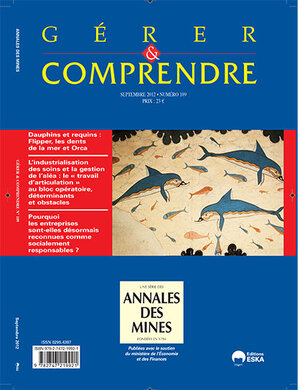
Issue 109
Editorial
By Pascal LEFEBVRE
OVERLOOKED
Dolphins and sharks: Flipper, Jaws, Orca
By David GUTMANN
Président directeur général de Praxis International (Conseiller de Synthèse, Adviser in Leadership)
and Michaël GUTMANN
Conseiller de Synthèse et photographe
What if, by following up on Aesop and Jean de La Fontaine, we tried to identify top executives with two animal figures anchored in our imagination and pop culture: the dolphin and shark. Though seemingly outrageous, this comparison bears references to a system of cognitive representations and helps us better define and understand the roles and actions of the leaders who oversee the fate of our firms. How to tell two major types of managers apart, detect the behaviors, qualities and malfunctions of each type, and assess the potential of their being complementary on a team? Drawing on ethology, psychoanalysis, mythology, etymology, literature and cinema, the effort is made to shed light on the specific forms of each type of management and base this grid of interpretation on concrete cases.
The relational theory of contracts and the governance of interfirm relations: on Ian MACNEIL's work
Autour de l’œuvre de Ian MACNEIL
By Matthieu MANDARD
Maître de conférences en sciences de gestion, École supérieure d’ingénieurs de Rennes, Centre de recherche en économie et management (CRM-UMR CNRS 6211), Université Rennes 1
A formal contract cannot, by itself, govern intercompany relations nor, more broadly, economic transactions. To ensure the success of these, a relational dimension of a social sort must complete it. Ian MacNeil endeavored to show this in his abundant, influential but often poorly known writings.
TRIAL BY FACT
Charismatic leadership and management's powerlessness: a small company's collapse
By Vincent CALVEZ
ESSCA école de Management, UNAM (Université de Nantes, d’Angers et du Mans)
A self-made entrepreneur founded one of the most important French firms in its field. Imbued with a humanist vision derived from social Catholicism, he wanted to build a “democratic firm”, where every employee’s voice would be heard and respected. To this end, he set up a participatory system and a procedure for grading and electing the boss. This vision is described and then analyzed to detect fake appearances. The difference between the charismatic leader’s desire and the reality of management established a system of avoidance that fostered an organizational crisis. Management, thus weakened, proved powerless, unable to correct the company’s recurrent problems. The entrepreneur’s grand dream was shattered when the company went into receivership until a German buyout.
The industrialization of health and management of the unknown: the "work of articulation" in the operating room, determinants and obstacles
By Stéphanie GENTIL
Institut d’Économie et de Management de Nantes – IAE
Using the concept of an organizational arrangement, this research inquires into the impact on work of the managerial turn made in medical establishments owing to the many reforms of the French health-care system. This case study of an operating room in a private clinic draws attention to the “work of articulation” whereby the staff coped with this new situation. Communication was placed at the center of the organizational arrangements worked out in a disruptive situation. The managerial procedures used in the context of rationalizing care provided the needed support for this work of articulation, which was ultimately similar to the work of regulation, whereby the persons involved appropriated these procedures. Within this arrangement however, certain contradictions are pointed out that had an impact on this work, whence a call for new forms of rationalization of the framework of action so as to support this work of regulation.
IN QUEST OF THEORIES
Why are firms now recognized as socially responsable?
By Julie BASTIANUTTI
PREG-CRG, École Polytechnique
and Hervé DUMEZ
CNRS, PREG-CRG, École Polytechnique
According to the European Commission’s 2001 definition, “Being socially responsible means not only fulfilling legal expectations, but also going beyond compliance and investing ‘more’ in human capital, the environment and relations with stakeholders.” For some pundits, this deliberate decision to move beyond “legal expectations” signals an ethical turning point in firms, a new citizenship giving rise to a new field in management. For others, corporate social responsibility has to do with “capitalism’s plasticity” — its ability to adapt to new environments. Moving beyond these contradictory interpretations, this article seeks to understand how and why firms “voluntarily” go beyond their legal obligations.
OTHER TIMES, OTHER PLACES
The emergence of interindustry word groups: the lunar society in 18th-century England
Le cas de la Lunar Society dans l’Angleterre du XVIIIe siècle
By Marine AGOGUÉ
Centre de Gestion Scientifique, Mines ParisTech, France
Cooperation between companies and the exploration of new possibilities for partnerships are key elements in corporate strategies for innovation. Interindustry groups have emerged in recent years, and policies for developing relations between clusters tend to lift the barriers separating industries and develop a synergy among companies that have not been used to working together. The history of Lunar Society, a club that brought together engineers, scientists and thinkers from various economic sectors, was founded during a time of intense social and technological change. It helps us understand the processes underlying the emergence of contemporary interindustry work groups.
When a firm replaces wolunteers with professionals: the history of camif's volunteer network
Histoire de la valorisation et de la dévalorisation du réseau des délégués CAMIF
By Benoît DEMIL, Xavier WEPPE
IAE de Lille - LEM (UMR 8179)
CAMIF, a consumer cooperative for school teachers, grew thanks to its network of volunteers, which covered every French district. From 1947 till the end of the 1960s, these volunteers performed logistic and commercial tasks, thus contributing significantly to the firm’s success. But as CAMIF became “professionalized”, this precious resource was gradually abandoned…
Mosaics
"Capitalism, a god without a bible" - Ideas taken for granted about the dominant economic model
On Jean-Michel Saussois’s “Capitalisme – Un dieu sans bible” – Idées reçues sur le modèle économique dominant (Éditions Le Cavalier Bleu, 2011, 167p.)
By Alain BURLAUD
Management and its subject, between subjectivity and sujection
On “Le management est-il “hors sujet”?, a special issue of Nouvelle Revue de Psychosociologie edited by Gilles Arnaud and Maryse Dubouloy
By Anne-Lise MITHOUT
Accountancy and control, from disciplinary education to societal lessons
On Comptabilité, contrôle et société (Mélanges en l’honneur du professeur Alain Burlaud) edited by Christian Hoarau, Jean-Louis Malo and Claude Simon (Vanves: Foucher, 2011, 413p)
By Madina RIVA
Is ethics too subtle to be left up to businessmen?
On two books by Alain Anquetil: Qu’est-ce-que l’éthique des affaires? and Éthique des affaires, marché, règle et responsabilité (Paris: Éditions Vrin, 2008 and 2011 respectively).
By Michel VILLETTE