
September 2002
abstract
Gérer & Comprendre
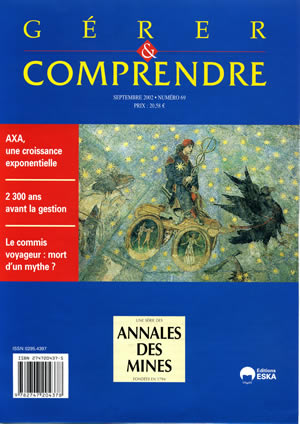
Issue 69
Editorial
By Francis LEFEBVRE
Secrétaire général du Comité de rédaction
TESTIFYING
AXA's exponential growth, 1975-1999
Entretien avec Claude BÉBÉAR
By Michel VILLETTE
Claude Bébéar’s itinerary runs through a series of battles waged in a quasi Napoleonic style. It started with a war of succession, which involved organizing top white-collars in a putsch against the heir apparent. Bébéar thus took over the Anciennes Mutuelles de Rouen, a small company that, with less than 1% of the insurance market in 1975, ranked 24th among French insurers. Eight major merges and acquisitions and twenty-four years later, AXA is number one worldwide in insurance, with 74,8 billion euros in sales and 910 billion euros in assets in 1999. How to explain this exponential growth? The answers emerge through a critical analysis of the events narrated by the person best placed to know what he is talking about: Claude Bébéar himself.
OVERLOOKED
Characteristics of labor in information sector service-providers in Germany, France and the Netherlands
By Christophe BARET
and Christophe EVERAERE
Université Jean Moulin Lyon III - Centre de recherche de l'IAE de Lyon
Results from an international research project on changing forms of employment and work in firms providing services to the information-age economy bring to light the characteristics shared by human resources and human resource management in Germany, France and the Netherlands. Differences can be observed in relation to the country, size of the firm and type of business. The reasons for a low percentage of women employees are discussed, as well as the way certain firms are trying to raise it. Emphasis is laid on the highly individual nature of qualifications and on the consequences this has on practices in human resource management.
TRIAL BY FACT
Corporate governance and jobs: The capital market’s expectations
By Tristan BOYER
Forum
Since the 1980s, the capital markets have played an ever larger role in financing firms’ needs; and pension funds now play a major role in this marketplace. In recent years, dismissals have been blamed on the operation of the capital markets, since the latter demand short-term profits. Furthermore, corporate leaders tend to attribute this demand to the pension funds and to the managerial principles derived from corporate governance. Analyses of the correlation between a company’s announcement of cuts in its work force and the prices of its stock in the North American and French capital markets prove this interpretation wrong. Moreover, as other studies have shown, dismissals do not harbinger an improvement in the firm’s economic situation any more than an increase in stock prices. As another study shows, decision-making criteria used by investors in the capital markets are complex and subtle. This runs counter to the idea of any automatic correlation between dismissals and stock prices.
OTHER TIMES, OTHER PLACES
2300 years before management
By Jean-Louis PEAUCELLE
Ecole Supérieure de Commerce de Paris
and MOSAICS
Once upon a time, before businessmen ruled the world, Hermes, the gods’ traveling salesman and master of the art and science of numbers, protected merchants like he would any kind of thief. The goddess Moneta had not yet set up temple in the stock exchange. And managers were domestics clever enough to make their brothers in servitude labor to produce maximum profits for the masters, who were much too busy with world affairs to take notice over mundane matters. Today, dealers in oil and steel lay down the rules for a global economy, thieves sit on Enron’s board, and Hermes is employed by Arthur Andersen.
Mosaics
Peut-on vraiment expliquer la réussite d'IKEA par l'innovation ?
À propos du livre de Bertil TOREKULL : « Un design, un destin. La saga IKEA » (Paris, Michel Lafon, 2000)
By Michel VILLETTE
ENSIA
Errare humanum est…
À propos du livre de Christian Morel : « Les Décisions absurdes, sociologie des erreurs radicales et persistantes » (Paris, Gallimard, Bibliothèque des sciences humaines, 2002)
By Dominique TONNEAU
Centre de Gestion Scientifique, Ecole des Mines de Paris
Les ombres du Cavaliere
À propos du livre d'Elio Veltri et Marco Travaglio : « L'Odeur de l'argent (les origines et les dessous de la fortune de Silvio Berlusconi) » (Paris, Fayard, 2001)
By Catherine VUILLERMOT
Université de Franche-Comté
Les employés et leur bureau
À propos du livre de Delphine GARDEY : « La dactylographe et l'expéditionnaire. Histoire des employés de bureau 1890-1930 » (Paris, Belin, 2002)
By Jean-Marc WELLER
Ecole Nationale des Ponts et Chaussées
TRIAL BY FACT
Monopolies and innovation: ANFO’s laborious birth
By Jacques CHATEL de BRANCION
Président d'Honneur de la SAEPC
The 2001 explosion of the AZF plant in Toulouse, France, drew attention to the risks related to ammonium nitrate. These risks, deemed relatively low, were studied when Ammonium-Nitrate-Fuel-Oil (ANFO) was invented on 10 July 1957. Made of a mixture of ammonium nitrate and fuel oil, this explosive is still widely used, representing about three-quarters of industrial explosives. During its short lifetime, ANFO has encountered many problems. The story of its invention and early uses will draw the attention not only of the many users of this product but also of readers interested in the relations between inventors and public administrations.
WHILE READING
The traveling salesman, another dad myth? Rereading Arthur Miller’s play
By Isabelle BARTH
Université Lyon 2
A work of literature that conveys a society’s ideas about business is a legitimate subject for study in management. Arthur Miller’s Death of a traveling salesman has, since its creation in 1949, been a worldwide hit in theaters. Willy Loman, the lead character, has become the archetype of the salesman and the foil of the profession. This analysis of the play’s vision of the sales profession focuses on six themes: money, mobility, winning, clients, appearances and motivation. We are forced to admit that popular imagery of the act of selling still centers around these themes, even though managers have continually objected to them. A new interpretation based on linguistics, sociology and the Hermes myth provides a few keys for understanding this predicament, but it does not enable us to arbitrate the confrontation between the knowledge of playwrights and of managers.