
March 1996
abstract
Gérer & Comprendre
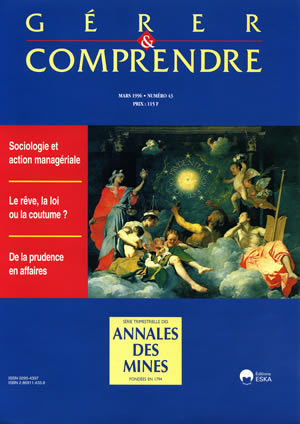
Issue 43
Éditorial
By Pascal LEFEBVRE
OVERLOOKED REALITIES
Dreams, laws or customs? Thoughts about managing peoples
Réflexions sur la gestion des peuples
By Claude Riveline
In any given country, social bonds are made up of a patriotism that is based on the idea of the Nation, of regulations that evoke the idea of the State and of local habits to which the global category of society phenomena refers. In France, it now seems as though the Nation and State have lost prestige while society phenomena have not sufficiently taken up the slack.
TRIAL BY FACT
Sociology and managerial actions: Is a sociological approach useful for management?
L'utilité d'une approche sociologique pour le management
By Erhard Friedberg
Although, for several years now, organizations have undergone repeated, in-depth reforms of development and production, most persons in charge of operations do not have adequate training for adapting their methods of action to the complex workings of human systems. In this respect, the sociology of organizations can be particularly useful by relativizing the classical managerial vision and its blind voluntarism.
Freeze-frame: Managing qualifications in midstream
La gestion des compétences au milieu du gué
By Jean-Marc Le Gall
Can an industry-wide collective agreement that sets up new job classifications and lays down provisions for developing qualifications help modernize the establishments where it will be applied ? An analysis of changes at the CNAV, one of the Social Security funds covered by the agreement, provides an optimistic answer but one full of nuances.
TESTIFYING
The ptt from 1950 to 1980
Entretien avec Émile Simon
By Odile Join Lambert and Frédérique Pallez
The French postal system is a mixture of state-of-the-art technology and outdated Taylorism where, despite vested rights, 15 billion objects a year are conveyed with amazing reliability. The PTT used to be a model of a French-style public service. For years now, it has been prepared for social, technological and economic changes so as to bear up under the laws of the marketplace. Emile Simon, a participant in this process, testifies.
Three ceos against exclusion: Employment, its management and investments in productivity
L'emploi, sa gestion et les investissements de productivité
By Francis Ginsbourger
What role can firms play in employment and the effort to put an end to exclusion ? How can actions of this sort be operationalized in everyday management ? Are company directors thus led to give up investments in productivity or even forsake the criteria for justifying such investments ? From the answers to these three questions provided by three CEOs who are committed to the struggle against exclusion, we see that the ways to manage productivity so as to favor employment and fight against exclusion are yet to be found.
Mosaics
Between a political species and a sociable being
On Les avocats. Entre l'Etat, le public et le marché (XIIIe-XXe siècle) by L. Karpik Michel Villette, Technical solidarity in people-machine networks and the condition of operators : On Les hommes et les machines by N. Dodier
By Marc Blangy, The lawyer
La métamorphose d'un service public
À propos du livre d'Albert David : « RATP, la métamorphose. Réalités et théorie du pilotage du changement »
By Valérie Reicher Brouard
L'avocat, entre animal politique et être sociable
À propos du livre de L. Karpik : « Les avocats. Entre l'État, le public, et le marché (XIIIe-XXe siècle) »
By Marc Blangy
La solidarité technique dans les réseaux hommes-machines
À propos du livre de Nicolas Dodier : « Les hommes et les machines »
By Michel Villette
OTHER TIMES, OTHER PLACES
Management as art: On the saying ars sine scientia nihil est
À propos de l'adage : « ars sine scientia nihil est »
By Hervé Dumez
Could it be that, given the way management is learned, given its approach to problems and despite the scientific coating on top it, that management is more an art than a science ? In 1400, the adventures of a French expert, whose help masons working on the Milan cathedral requested, illustrate the relations still ambiguous even today between art and science.
The subtle game of the principe of solidity
By Christian Morel
A product's technical and aesthetic images are intermingled. The example, among others, of Milan's cathedral is worked out to show the subtle interplay between practice and theory, art and science, in architectural design. Is that what ars sine scientia nihil est means ?
IN QUEST OF THEORIES
Phronesis: An alternative to management as a science and to business as pure opportunism
Une alternative à la gestion comme science et aux affaires comme pur opportunisme
By Michel Villette
For Aristotle, prudence (phronesis) was not a moral virtue but an intellectual faculty, a form of knowledge distinct from both the science of eternal truths (sophia) and from the technical skills of craftsmen or sophists. This Aristotelian notion of prudence is relevant to certain currents in contemporary research, teaching and managerial practices. Is prudence pertinent as a unifying