
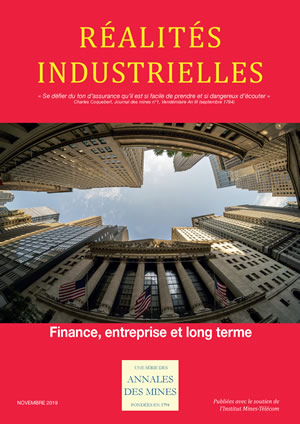
Introduction
By Christophe MOUSSU
ESCP Europe, LabEx ReFi
and Pierre-Charles PRADIER
Université Paris I Panthéon Sorbonne, LabEx ReFi
Financing firms and the investment horizon
Financial markets and short-termism
By Christophe MOUSSU
ESCP Europe, LabEx ReFi
The debate about the “short-termism” induced by the financial markets has gone viral. The usefulness of these markets has come under question along with the goal of maximizing shareholder value. After recalling how these markets are beneficial to business investments, attention is focused on how they give rise to problems of governance, in particular short-termism. There is much empirical evidence for this. Decisive factors related to this short-termism are the targets set for results, the level of coverage of firms by financial analysts, the prospects for investors and the thresholds for incentive pay to mangers. This has significant implications for innovation, investments and jobs. A good education in finance and better calibrated pay incentives would probably help set limits.
The real effects of long-term investors in listed companies
By Alexandre GAREL
Researcher in finance, Audencia Business School
To review the academic literature in finance on long-term investors, the role shareholders alone, in particular institutional investors, is highlighted. Three points are broached: What is a long-term investor? What are the theoretically possible relations between an investor’s investment horizon and corporate decisions? And what do we learn from empirical studies about the real effects of long-term investors in a firm? In conclusion, the various ways of fostering long-term shareholding are discussed.
Sustainable behavior and value creation: Communications addressed to the financial markets
By Jean-Brieuc LE TINIER
Chief financial officer and secretary-general of the FNAC Darty Group
From a purely financial viewpoint, a firm tries to create value and thus makes investments with a profit-earning rate higher than what investors expect after taking account of the risks run. This profit-earning goal imposed by shareholders is a constraint on listed firms. For their investment to soon earn a profit, shareholders put pressure on corporate executives to conduct projects that can turn a fast profit. The economic crises in 2008 and 2011 have shown the consequences of both the financial markets’ risky, short-term viewpoint and the skewed information communicated by firms. However these crises have fostered a new trend: the creation of value should no longer be for shareholders alone but, instead, for all stakeholders. For a firm, this implies developing a long-term strategy in line with the interests of its wage-earners, suppliers and customers while seeing to the necessary short-term profitability demanded by shareholders. How do firms, via their financial divisions, react to capital market constraints while developing a strategy for long-term, profit-earning growth for the sake of all stakeholders?
The American big tech giants: New systemic players in international finance?
By Paul-Adrien HYPPOLITE and Antoine MICHON
Ingénieurs du corps des Mines
Boosted by their unparalleled business success, the American giants of the new technology have accumulated over the last twenty years huge liquidity reserves comparable to the biggest mandatory reserves worldwide. This situation, as is shown herein, results from an ultraconservative management of their capital ‒ in contrast with their image as front-running innovators. Without any major shift in this policy, this propensity to hoard could last, thus depriving the world economy of capital for production activities and holding down, as has been the case for a long time now, the rates of risk-free loans.
Is there room for the long term in market financing?
By Alexis COLLOMB
Conservatoire national des Arts et Métiers
The financial markets have often been criticized as places where only profits count, where the dictates of short-term earnings override long-term interests. This article focuses on equity markets in order to weigh several factors and see whether these markets are inherently incompatible with the “long run”. After considering how the theories of agency and efficient markets have explained the importance of “stock market prices” as an inexorable means for measuring a firm’s current situation, attention is drawn to the fact that market players are now different owing to their priorities and time frames. In the era of fintechs and blockchains, bringing long-term considerations into a market’s objectives is no longer, we must concede, a utopia…
From shareholder ‒ to partner-based governance
Risks and the government of firms
By François VALÉRIAN
Associate professor of finance at the Conservatoire National des Arts et Métiers, Conseil Général de l’Économie
To cope with the risks of wrongful conduct by the head of a firm, a reform of corporate government must be imagined that is based on the principle of a separation of powers and that creates a new position: a director of risks and of compliance who would answer directly to the board of directors.
Corporate reform: From the firm or from the field?
By Cécile RENOUARD
Professor of philosophy, Centre Sèvres, teacher at École des Mines de Paris, ESSEC and Sciences Po, & president of Transition Campus
How to interpret the aspects of the French PACTE Act related to a firm’s economic, social and environmental responsibilities? An analysis of the act and of the recommendations made in the Senard-Notat Report brings to light the limits of the commitments demanded from firms in matters related to social and environmental issues and the climate. What if we shift our viewpoint about the firm’s part in solving these issues away from ideas centered on the current legal definition of “commercial companies” to demands from the field? Shifting our perspective opens the way toward defining means (including obligations of performance) for a convergence between the rationales of finance and of activities outside finance.
Firms with a mission as a vector of the long term
By Blanche SEGRESTIN and Laure-Anne PARPALEIX
Mines ParisTech, PSL Research University
Since short-termism has come under criticism, how can a firm’s strategic choices take account of long-term interests? Can long-term shareholding be fostered, and would it suffice? To answer these questions, this article examines how we apprehend the long term. Instead of defining it in relation to the investment horizon of a firm’s plans, innovation forces us to see the long term as a firm’s capacity for “regeneration”, i.e., for recurrently renewing not just its product line but also its fields of innovation. From this perspective, the issue has less to do with shareholders keeping their stake in the firm during a cycle of product development than with their adherence to a “logic of regeneration”. Two concepts recently introduced by the PACTE Act (raison d’être and société à mission) offer important means for making finance compatible with the long term. Corporate engagements on innovations for a desirable future can thus be entrenched in bylaws, beyond eventual changes of shareholders.
The long-term coherence of cooperatives is more a matter of principles than facts
By Pierre-Charles PRADIER
Université Paris I Panthéon Sorbonne, LabEx ReFi
Cooperatives are organizations with, in principle, a democratic governance; but they can be legally organized in quite varied forms, which, in turn, condition the potential expression of short-termism. When the profits placed in a reserve fund cannot be “shared” (nor directly appropriated), a short-termism specific to cooperatives might arise. Although cooperatives are not always true to their principles, the latter serve, nonetheless, as a source of inspiration for their plans and eventually as a reference mark for evaluating the organization.
Impact investing: The role and effectiveness of such funds
By Isabelle GUÉNARD-MALAUSSÈNE
President of FINANCE@IMPACT and of the committee of the FINANSOL label
Given the urgency of issues having to do with the climate, pollution, biodiversity and all forms of inequality, finance must also help change the world. While some players are ready to go “green” and humanize their products, services and discourse, the financial ecosystem must make a genuine commitment and concretely prove its implication. Given investors’ ever stronger requirements and the increasing number of tools for measuring the social and environmental impact of investment funds, it is worthwhile examining the actual role and effectiveness of impact investing funds, which claim to respond to the major challenges of our times while not sacrificing profits. In France, the funds that invest all or part of their assets in firms certified for their high social utility have, for more than twenty years now, proven their mettle.
Regulations and the state
“Intérêt social” and “raison d’être”: Thoughts about two provisions in the PACTE Act that amend corporate law
By Alain PIETRANCOSTA
Professor, Sorbonne Law School
The so-called PACTE Act of 22 May 2019 on the growth and transformation of firms claims outright to “reconsider the place of firms in society”. Along with the creation of the label société à mission, Article 169 makes two major modifications, the one mandatory, the other optional, of French corporate law. The first adds to Article 1833 of the Civil Code a second paragraph whereby a company “is managed in its social interest by taking under consideration the social and environmental issues related to its activities”. Although we might think that this addition does not upset our conception of “social interest”, it does give rise to questions about its legal and practical implications. The second modification introduces the possibility for companies to insert in their bylaws a raison d’être. Although some of the observed applications amount to an exercise in public relations, this modification has significant legal consequences with which we must reckon.
The role of central banks and supervisory authorities in stimulating consideration for long-term issues: The case of climate change
By Nathalie AUFAUVRE and Clément BOURGEY
Banque de France
Economic agents often think, decide and act with a relatively short-term view ‒ in any case, too short to take account of long-term issues and risks. Central banks and supervisory authorities have a decisive role in leading these agents to reckon with long-term risks. Climate change provides a very good example, since coordinated international actions by these banks and authorities are indispensable for mustering the financial system’s forces. The Network for Greening the Financial System represents a noteworthy advance. For these institutions, this implies modifying methods, carrying out new studies to better understand actual risks and, if need be, helping the supervised organizations to cope and better understand the issues.
Family Firms versus Private Equity: A struggle of business models? The example of the German printing industry
By Dr. Ida BAGEL
CEO Bagel Group
and Prof. Michael TROEGE
ESCP Europe
With the growth of the Private Equity (PE) industry an increasing number of firms remain for substantial periods in the ownership of PE companies. Today, PE owned companies are important and permanent competitors for many traditional Family Firms. The financial and commercial strategies of both types of firms differ substantially. The paper analyses the differences in structure and strategy of PE-owned and Family-owned companies with a particular focus on the functioning of German Family owned Mittelstand firms. Using the German Printing Industry as a case study we try to assess 1) why PE backed firms are particularly dominant in shrinking industries, 2) in how far competition from PE owned companies reduces the viability of the stakeholder focused strategies that are the core of many family firms’ success and 3) whether more widespread PE ownership will erode the institutional environment that has enabled the flourishing of the German Mittelstand.
Financial Regulation and Externalities: Efficiency vs Politics
By Gérard HERTIG
ETH Zurich
Fundamentally, financial regulation aims at facilitating access to finance. From an efficiency perspective, this means that entrepreneurs as well as consumers should get financing at competitive rates. However, the rewards of financial regulation are not necessarily equally distributed, an externality that is likely to favor some financial intermediaries or industrial firms over others. Financial crisis regulation tackles externalities more directly. In particular, prudential regulation generally targets those firms that are most likely to be a source of systemic risk ˗ the aim being to impose the internalization of externalities. However, efficiency is not the sole driver of financial regulation. Lawmakers and enforcement agents may favor specific interest groups or take into account fairness considerations. This kind of intervention is likely to produce externalities by having an impact on the production and distribution of goods and services. In particular, regulatory interventions to facilitate access to finance in specific industries is likely to distort competition within or across industries.
The EU directive on restructuring and insolvency, an opportunity for France to shift focus to the long term?
By Sophie VERMEILLE and Eva FOUREL
Droit et Croissance
Adopted in June 2019, the EU directive on restructuring and insolvency provides France with an opportunity for shifting its legal framework so as to deal more effectively with firms in difficulty. As it currently stands, French law confounds the objectives of effectiveness and equity while penalizing the national economy by supporting the short-term preservation of existing jobs. An “effective” law would allow for eventually reaching not just the current objectives but also the economic objectives set at the EU level.
Incentives for financing long-term externalities
Finance, firms and the long term
By Claire CASTANET
Autorité des Marchés financiers (AMF)
It is often said that the capital markets thrust a short-term view onto firms. However finance is not entirely synonymous with the short term, since there are long-term investors, who want to be associated with firms over a period of time. A firm that wants to endure has to be headed by persons whose concerns are not reduced to adding value to the company’s stock values as fast as possible. Besides making shareholders richer, can a firm try to have an impact on society? Regardless of the answer, society and social movements are ever more strongly demanding that firms support financing for long-term environmental and societal changes.
What can institutional investors do in matters related to climate change and responsible investments?
By Jean-François BOULIER
President of the French Association of Institutional Investors (Af2i)
Institutional investors, everywhere around the world, are involved in the long-term financing of the economy ‒ in France to the tune of approximately €3200 billion (more than a year of GNP), an amount that has constantly grown over the past decades. Dutch retirement funds alone manage the equivalent of more than two years of their country’s GNP. The role of these institutional investors depends on whether they are insurance or retirement funds or organizations managing mandatory reserves; but this role is long-term, and this is reflected in portfolio management, which is, paradoxically, subject to restrictions under various regulations. In recent years, financial institutions have turned toward “responsible investments” for sustainable financing the economic activities in which investments are made. This article sheds light on institutional investments, in particular their sustainable dimension (in relation to fields outside finance). In addition, regulatory and bookkeeping trends are explained that tend toward greater economic and social utility.
Green bonds, a tool for financing the environmental transition
By Franck BANCEL
Professor, ESCP Europe
and Dejan GLAVAS
Doctorant, ESCP Europe
The environmental transition needs major investments to make production carbon-free. For more than a decade, the green bond market has been growing to meet the needs of investors and of the organizations that issue bonds in the effort to fight against global warming. Do these green bonds differ from conventional bonds? Why do firms issue them? If they actually help limit climate change, what can be done to develop them?
From ESG ratings to stress tests aligned with the Paris Agreement and sustainable development goals
By Anne-Catherine HUSSON-TRAORE
NOVETHIC
Based on declarations and on multiple criteria for environmental, social and corporate governance, ESG ratings for big firms emerged at the turn of this century. The result is a database, big but barely legible because it has not been standardized. Firms determine the information (scope, methodology and indicators) to provide, thus making it nearly impossible to make comparisons within a single sector or from one data collection period to the next. Since 2015, when the Paris Agreement and sustainable development goals were adopted, the ESG ratings have changed. The intent is now to measure the real impact, both negative and positive, of a firm’s activities and analyze its strategies in order to test its resilience in coping with the major environmental and social challenges that it will have to face.
Can firms finance the long-term environmental transition?
By Claire TUTENUIT
EpE
Firms, whether in industry, services or finance, are interested in mustering investments for preserving the climate and biodiversity. The needs and opportunities are huge. However most of these investments are not economically viable given a not very attractive coupling of risk and profitability. Incentives provided through public policies or even policies that create obligations to be imposed on certain actors are indispensable for unleashing investments, which could then become massive. The big projects of the environmental transition ‒ more than €100 billion per year ‒ depend on decisions by public authorities and on public opinion being sufficiently mature in matters related to the environment.
Miscellany
Introduction to blockchains
By Ilarion PAVEL
Conseil général de l’Économie (CGE)
This technical introduction to blockchains takes as its starting point a concrete problem: making an electronic payment in a decentralized network by using a cryptocurrency like bitcoin. Such a system immediately raises questions about requirements related to the protection of privacy, security of the payment, and structure of transactions and their validation in a distributed network. To meet these requirements, a step-by-step explanation is made of the structure of a blockchain, while presenting a few important tools, such as hash functions, cryptography with asymmetric keys and electronic signatures.
The role of Ports and Free Zones in the Development of Africa: The “Djibouti Model”
By Mowlid ADEN
Djibouti Ports & Free Zone Authority (DPFZA)
This article is essentially a positive story of ports & free zones-led progress. Why are ports so critical? A well-organized port can make the difference between locally or, in the case of Djibouti, regionally produced products being viable for export, or priced out of the market. A well-run facility builds self-reliance in the local executive management and economy, thus drawing new industry and investment, and promoting tourism. Furthermore, enhancements to port infrastructure frequently raise forces to shore up the weaker links in regional supply chains, such as below-standard roads and railways.