
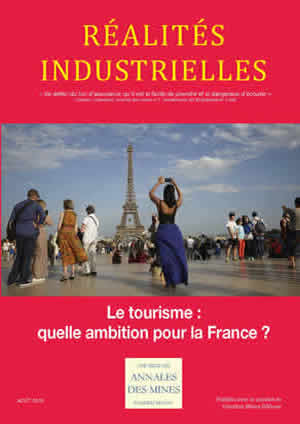
Foreword
By Laurent FABIUS
Ministre des Affaires étrangères et du Développement international
Introduction
By Emma DELFAU
Sous-directrice du Tourisme, direction générale des Entreprises
1. Promoting France as a destination
Has tourism become a strategic issue?
By Frédéric PIERRET
Directeur général d’Alliance 46.2 (1)
The number of tourists represents the equivalent of 93% of the world’s population. In barely half a century, humanity has started traveling, and this trend tends to be accelerating by nearly 5% per year, thus generating jobs and wealth on par with other big sectors of the planetary economy. Given its exceptional advantages, France figures among the front-runners in international tourism. The country has the means of coping with stiffer competition and taking up new challenges - but not alone!
French tourism: A major economic sector with a strong potential
By Georges PANAYOTIS
Président-directeur général de MKG Group
Having always been one of the champions of tourism, France is now catching its breath. Competition between destinations and a disrupted chain of added value are major issues. The French tourist industry must find the right responses to them in order to fully develop its enormous potential and thus become a force impelling the country’s economic growth. Besides its major side-effects, direct and indirect, this industry also conveys global economic growth to many sectors. This fantastic tool for boosting the brand “France” internationally contributes to territorial development and is a seedbed for innovations in digital technology. So, let’s set our energies free!
The myth of the lackey: How to change mentalities?
By Julien BARNU
Ingénieur des Mines
Although the actions needed to keep our tourist industry from becoming less competitive are well known, the major impediment to launching them is psychological. The only way to turn France into a genuine leader in tourism is to arouse a national awareness through communication campaigns adapted to the situation. This strategy has been successfully adopted elsewhere, and even in France but on a smaller scale.
Tourism: Which ambition for France? New forms of geographical marketing
By Christian MANTEI
Directeur général d’Atout France
Advertising internationally the diversity and treasures of tourism in France is not as easy as it seems at first sight. Several challenges must be taken up to reach the objectives set by Laurent Fabius, minister of Foreign Affairs and International Development, and thus maintain our leadership. We must welcome 100 million visitors by 2020 and become the first tourist destination in Europe in terms of earnings.
The role of local authorities and elected officials in promoting tourism
By François de MAZIÈRES
Député-maire de Versailles
Given the presence, day in day out, of twenty thousand visitors - seven million per year - Versailles is the fourth tourist destination (after Disneyland Paris, the Louvre Museum and the Eiffel Tower) in France, which is still the first tourist destination in the world. Despite Versailles’ privileged rank in tourism, the city has difficulty benefitting from the visitors attracted to the Versailles Palace. Tourists come in droves to visit the palace, but for a single day and, therefore, without wandering outside organized circuits and thus appreciating the wealth of the surrounding area’s natural and historical heritage. Since 2008, one axis of urban policy seeks to correct this imbalance in order to impart a momentum to the local economy and stimulate revenues for local authorities. This is to be achieved by promoting the cultural legacy, boosting the brand “Versailles” and developing balanced plans for urban development and infrastructures that will be a countervailing force to a commercial urbanism that wreaks havoc, in particular on our conception of culture.
The Loire River valley by bicycle: A French success story!
By Philippe COUPY
Directeur de l’Association France Vélo Tourisme (1)
and Nicolas PINSON
Association France Vélo Tourisme
How to explain the success of an innovative tourist program that is now twenty years old? Its long itinerary for discovering the Loire River valley by bicycle covers a large area spanning two regions. The complicated method at the origin of this program, now a reference mark in French tourism, is described; and light, shed on the keys to this success. Bicycle tourism, an activity accessible to everyone, holds promising economic prospects.
What strategy will Spain pursue to become the second country of tourism in the world?
By Jérôme BONNAFONT
Ambassadeur de France en Espagne
Traditionally based on “sun and beaches”, tourism in Spain has matured but is still not sustainable. This key sector in the national economy – 11 % of GNP and 12 % of jobs - is trying to keep its place in the economy and in international classifications - third country according to the number of foreign tourists and second in terms of earnings. It is, therefore, diversifying and adapting to the new requirements of “connected” tourists who come from farther away in quest of new experiences. Spain’s national touristic strategy is based on upgrading its infrastructures, diversifying offers and making innovations, in particular a more sustainable model of tourism. Underlying it are advertising campaigns in coordination with other parties and an action plan worked out in collaboration with the private sector so as to adjust as best possible to the latter’s needs.
2. How to satisfy tourists’ new expectations?
Airports, the gateway to a country, play a crucial role in welcoming tourists
By Augustin de ROMANET
Président-directeur général d’Aéroports de Paris
Airports play a leading role in France’s strategy for winning back its (lost) share of the tourist market. For airports like other businesses in tourism, the image of the brand “France” must be improved by focusing quality, in particular, by providing more human presence and a broader offer of personalized services - while also improving the competitiveness of its prices, a factor of attraction for foreigners who will be visiting our country.
The intermodality of itineraries facilitated for tourists
By Franck GERVAIS
Directeur général de Voyages-scncf.com
Voyages-SNCF.com guides tourists in France during their travels, all the way from preparations till the return home and even afterwards, as they share experiences with friends. This has led us to a switch from simply selling train tickets to fully accompanying customers from home and back.
New forms of collaborative tourism, a strongly growing demand
By Nicolas FERRARY
Directeur France d’Airbnb
Tourism, a sector where not much has changed in past decades, has recently opened up to new players in the economy of sharing. Consumers are caught up in digital tourism, facilitated through on-line distributors and networks of exchanges between private persons. Transportation companies, traditional hotels and even organizations in touristic or leisure activities now have to take into account these communities of sharing, where members find the experiences they are looking for. How to reinvent tourism by supplying a personalized, original travel experience?
BlaBlaCar and collaborative tourism
By Frédéric MAZZELLA
Directeur de BlaBlaCar
In ten years, BlaBlaCar, a world leader in long-distance car pooling, has become a full-fledged, alternative form of transportation that conveys across Europe more than thrice as many travelers as Eurostar. When the idea dawned of optimizing the enormous potential (going to waste) of millions of cars with nearly no passengers and of creating a network for passengers who wanted to ride with automobilists going in their direction, my motivation was to find a feasible solution for this optimization. I did not know, however, that this service would deeply change how cars are used and how we travel.
A single destination for new experiences: Adapting the supply-side of tourism in Paris to new expectations
By Nicolas LEFEBVRE
Directeur général de l’Office du Tourisme et des Congrès de Paris
For contemporary tourists, traveling is a succession of experiences that starts before departure (when brochures, guides and Internet sites are consulted), runs through the voyage itself and continues once the destination is reached. Among these experiences is the real-time sharing over distance with family and friends - a sharing facilitated by the rapid adoption of mobile digital devices and social networks. Professionals working in tourism are trying to adapt to these changes. This is definitely the case in Paris not only in tourist businesses, such as hotels and transportation. It is also the case in cultural and leisure activities, the supply of which is being adapted to new expectations so as maintain Paris among top-ranking touristic destinations worldwide. Responding to a demand for (re)new(ed) experiences means promoting, through tourism, the big, innovative metropolitan area formed by Paris and its suburbs in the 21st century.
Luxury and even excess: A promising niche for tourism in France
By François DELAHAYE
Directeur général de l'Hôtel Plaza Athénée
In a sharply competitive environment, the hotel business in general and luxury hotels in particular must invest in rehabilitating establishments and providing new offers and services in response to market requirements, which are continually changing owing to the new geopolitics and poles of wealth. To reverse the trend of France slowly losing its leadership position in visits by tourists, it is necessary to foster a mind-set and strategy capable of taking up the challenge. However this cannot occur without coordination of the hotel profession and involvement by local authorities and elected officials.
3. Innovation and digital technology: Tourism’s prospects
The hotel group ACCOR faces worldwide competition: A successful digital transformation
By Vivek BADRINATH
Directeur général adjoint d’AccorHotels en charge du Marketing, du Digital, de la Distribution et des Systèmes d’information
ACCOR, the top-ranking hotel operator in the world with 3.700 hotels (480.000 rooms) is present in 92 countries thanks to its 14 internationally recognized brands ranging from luxury to economy class. Since its creation 45 years ago, it has always placed innovation at the core of its strategy for satisfying customers, partners and its 180.000 employees. Owing to accelerated changes in technology and in customer behavior patterns, digital technology has become a necessity in tourism - now the leading service distributed on line in France and Europe. For this reason, ACCOR has recently invested heavily in a digital revolution of its activities. The plan “Leading Digital Hospitality” has the objectives of reimagining the place of digital technology during the customer’s complete itinerary, improving the supply of services proposed to investors and consolidating the group’s market share in distribution. Digital technology is a challenge for us all. It must form the cornerstone of the company’s global strategy and thus benefit from a specific form of governance devoted to it at the highest level in decision-making.
The emergence of start-ups in tourism
By Laurent QUEIGE
Délégué général, Welcome City Lab
The world of tourism has recently discovered, not without fear and apprehension, a new category of players who are disrupting habitual business plans and behavior patterns. These new players are start-ups. Welcome City Lab is a global platform of services for boosting innovation and integrating start-ups in the tourist industry. The goal is to place Paris in the top rank of innovation in this field. Thanks to this website, these start-ups and their activities can be identified. An explanation…
Big data at the service of tourism
By Olivier ONDET
Orange Business Services
I am in the fortunate position of being both an observer of, and player in, the big data revolution affecting several sectors of the economy. Orange Business Services assists clients undergoing a digital metamorphosis and helps them profit as best possible from this technology. This article illustrates how this revolution is being played out in a major sector of the French economy: tourism.
Do tourism in the age of the Internet and the resulting disintermédiation signal the end of traditional tour operators?
By Geoffroy de BECDELIÈVRE
Président de Marco Vasco, spécialiste du voyage sur-mesure sur Internet
Having suffered from the recession and the fear of terrorist attacks, the tourist industry is in the throes of another crisis, of which no one dares predict the end. Donatello, a well-known tour operator, has been placed in receivership and is going to be broken up. Facing difficulties due to changes in the market, Kuoni has decided to abandon its tour operator activities and focus on services in the travel business. Another company, Nouvelles Frontières, is barely recovering from losses amounting to millions of euros and the reduction of its work force by a third… Who will fall victim next? Does all this portend the extinction of the traditional business of tour operators?
What weapons do independent hotels have to cope with on-line travel agencies and big groups?
By Krystel BLONDEAU
Directrice générale de la Fédération Internationale des Logis
Although France is still the first touristic destination in the world, independent hotels persistently feel uneasy owing to two processes (paradoxical at first sight): “eventmentalization” (turning the experience of the present into an event) and uniformization in the hotel market. It seems pointless to try to fight against the giants providing reservation services via the Internet. The consolidation and future of independent hotels depend on tighter requirements with respect to clarity, creativity and the diversity of offers. It no longer suffices to exercise the hotel trade with talent in order to succeed. It is also necessary to “tame” market trends, take care of one’s on-line presence and pay close attention to customer feedback. For this, professionals in the hotel business can count on the Fédération Internationale des Logis.