
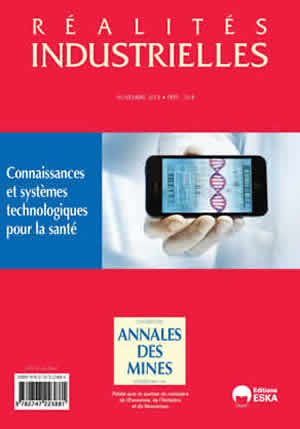
Foreword
By Etienne CANIARD
Président de la Mutualité française
I - Forms of technology and medical practices
Is technology at odds with humanistic medicine? A (spurious) question as old as Methusalem
By Antoine VIAL
Spécialiste en Santé publique
At a time when communicating electronic applications are proliferating in medicine and health, voices are being raised against this “intrusion” of techniques in the medical sphere to the detriment of humaneness. What are the grounds underlying this anxiety? Are techniques intrinsically at odds with humanistic medicine? Do we come across facts in the history of medicine that serve as solid grounds for this anxiety, or sense of precaution?
What are new technologies in medicine and surgery good for?
By Philippe MERLOZ
Professeur, Clinique Chirurgicale Universitaire d’Orthopédie – Traumatologie – Hôpital Albert Michallon du CHU de Grenoble-La Tronche (38700), Université Joseph Fourier Grenoble 1
New forms of technology, a consequence of the advances and discoveries made since the start of the 20th century, have taken an important, sometimes preponderant, place in care. We now have to deal with major issues. How to provide quality care in the difficult context of rising health costs, the aging of the population in Western lands and funding systems that a lasting economic slowdown have made obsolete?
Smart ambient devices for sustaining longevity
By Norbert NOURY
Professeur à l’Université Lyon 1, où il enseigne l’électronique et les dispositifs médicaux
Bertrand MASSOT
Maître de Conférences à l'Institut des Nanotechnologies de Lyon (INL) au sein de l'équipe Capteurs Biomédicaux et enseigne la Physique à l'Institut National des Sciences Appliquées de Lyon (INSA Lyon)
Claudine GEHIN
Maître de Conférences à l’Institut National des Sciences appliquées de Lyon, où elle enseigne l’électronique au département « Génie électrique »
and Eric Mc ADAMS
Docteur en Génie Biologique et Médical diplômé de l’Université de Leeds (Royaume-Uni)
The progress accomplished in medical knowledge, nutrition, the improvement of working and living conditions, etc., have prolonged the human life-span. Information and communications technology is taking part in this process owing, in particular, to the democratization of diagnostic tools and the home delivery of treatments. Despite this technology’s undeniable contribution to longevity through the concept of “smart health homes”, generalizing smart devices raises technical and ethical issues: on the one hand, the difficulty of processing large quantities of data; and on the other, the intrusion of technology in patients’ homes.
New technology for training in medicine and surgery
By Florence ZARA
Université de Lyon 1, CNRS, LIRIS, UMR5205, F-69622
Lucile VADCARD
Laboratoire des Sciences de l’Éducation, Université Grenoble Alpes
and Tanneguy REDARCE
Université de Lyon, CNRS, INSA de Lyon, Laboratoire Ampère, UMR5005, F-69621
Most educational programs in medicine try to foster in students and trainees an articulation between theoretical knowledge and practical know-how. Training in situ is indispensable for putting theories to the test, acquiring manual dexterity and developing the ability to make the called-for decisions. However the current training dispensed at the workplace might put patients at risk, whence a question, recurrent in medical circles: how to choose a place of training where risky gestures can be practiced without putting patients at risk, a place with the characteristics necessary for endowing trainees with an operational know-how that can be transposed to real-life situations? Training systems based on simulation are the answer under condition that thought be devoted to both the goals of training and the technical means to be adopted to reach them. “Simulators” should be designed that take into account educational aspects, digital logistics and material devices (instruments for surgery).
The current state of simulation in the health field
By Mehdi BENKHADRA
Médecin anesthésiste-réanimateur, instructeur en Simulation médicale
Simulation in the field of health is a revolution that allows for training professionals without using patients as guinea pigs. Simulators can now be used to teach how to provide care in complicated cases that call for the right knowledge, practical skills and perfect coordination among care-givers. Such teaching techniques are being developed in France, somewhat belatedly in comparison with North America and certain European lands. To fully deploy its advantages, simulation must be adopted by the academic community. Both the objectives and investments in it must be clearly defined along with, not to be forgotten, the training for trainers. A 2012 report by the French High Authority has described the emergence of simulation in health and made recommendations about a framework for its implementation. This revolution’s ethical goal can be voiced in a slogan: “Never again for the first time on a patient!”
An integrated, interoperable platform of telehealth: The EU’s HIPERMED
By Jean-Marie MOUREAUX
Professeur, Centre de Recherche en Automatique de Nancy (CRAN) – UMR 7039 CNRS Université de Lorraine
This article presents a joint European project funded by the Celtic Plus cluster: HIPERMED (HIgh PERformance TeleMEDicine Platform, http://www.hipermed.org.) Thanks to this project, a platform of high-performance e-medicine has been set up with a single interface with various multimedia tools and services for both health professionals and patients. Through this platform, distant sites are able to exchange in real time streams of data, including high-definition videos (from cameras or surgical equipment), X-ray images (DICOM) or even text files. The project won the silver medal in the “Excellence” category during the Celtic Plus meeting in Monaco on 23-24 April 2014.
II - Technology and knowledge
Computer-assisted decision-making in medicine
By Stefan DARMONI
Professeur, Service d’Informatique Biomédicale, CHU de Rouen
Nicolas GRIFFON
Docteur, Service d’Informatique Biomédicale, CHU de Rouen
and Philippe MASSARI
Docteur, Service d’Informatique Biomédicale, CHU de Rouen
Systems of computer-assisted decision-making in medicine theoretically allow for improving the quality of care, but their integration in practices is still a distant reality for most health professionals. The major impediments to this integration are: the ongoing evolution of knowledge in health, the problematic interoperability between systems of medical information, and resistence from professionals. Several recent initiatives are pointed out that settle, at least partly, these problems. They should facilitate operationalizing computer-assisted decision-making systems in health establishments. Nonetheless, the tight interrelation between recommendations, the means at the disposal of doctors and local practices necessitates an accurate assessment of the impact of such systems with the aim of limiting the negative consequences on patients.
Toward simulating skills in surgery?
By Pierre JANNIN
Inserm UMR1099 Université de Rennes 1, LTSI Équipe Medicis
The operating room, an “ecosystem” centered around patients, is equipped with tools through which several specialists interact and collaborate in order to deliver the right therapy under the best conditions. Nowadays, improving quality in surgery entails assistance from a computer. The findings of research programs on the simulation of surgical skills and procedures are presented.
What virtual reality brings to the care provided for cognitive deficiencies
By Evelyne KLINGER
Équipe Interactions Numériques Santé Handicap (INSH), ESIEA, Laval. –
For studying and treating cognitive deficiencies, researchers and therapists have, since the early 1990s, tapped the possibilities offered by the concepts and technology stemming from virtual reality. This technology opens a new space for interactions and expression, where patients can be immersed in ever more varied conditions ranging from elaborate systems of multisensory immersion (e.g., CAVE®) to the devices (e.g., Wii) that, used in everyday life, are available at ever lower prices. Using several parameters, this technology explores a person’s activities and thus helps us understand his/her performance in meaningful simulated tasks. There are promising applications for health and disabilities, even though integrating this technology raises questions about understanding how humans function, simulating tasks and interfacing participants with this virtual reality. The multidisciplinary studies conducted in this domain necessitate human, social, clinical and technological qualifications.
Sytis to the rescue of the hearing-impaired
By Jean-Michel RACZINSKI
Alliance Manager, Arkamys
One out of five persons in France is hard of hearing and feels a sense of isolation. Since hearing aids are still expensive, few people have them. Sytis technology signals the revolution they have been waiting for. This application improves the quality of what is heard during telephone communications.
E-health: New uses of individual forms of technology in public health
By Fréderic DURAND SALMON
Président fondateur de la société BePATIENT
and Loïc LE TALLEC
Médecin conseil de la société BePATIENT
Individual forms of technology in health are part of what has been called “mobile health”. M-health has profited from the development of networks and communications, and from the invention of connected devices. The new approach replaces patients as individuals at the center of prevention and care, and requires their active participation. Faced with new obligations (for example, changes to be made in lifestyles), patients want new rights and a new place in the health system. All this modifies the patient’s relationship with the health professionals who follow up on his/her case. Meanwhile, a deep change has occurred in public health: chronic epidemiological illnesses stemming from the aging of the population now outrank the more familiar transmissible, infectious diseases. M-health, a genuine revolution, has turned processes related to a cure (for an illness) into care (attending to the patient). Identifying the possibilities for mobile health in matters of care and prevention provides us with a clear picture of both the potential and the conditions necessary for developing m-health.
Ontology-based interoperability in the field of health
By Stephen Randall THOMAS
Ph.D., DR CNRS IR4M UMR8081, CNRS Université Paris-Sud, Orsay
Informatics is now indispensable in all areas of life, including health. Given the multiplicity of languages, lack of coding standards, differences between platforms, etc., major problems crop up when sharing computer-based data or models. Problems of interoperability are directly related to computerization. Although humans do not encounter serious problems when clearing up ambiguities in a language, such is not the case of computers. These machines need semantically clear contexts in order to explore the different “cyberspaces” related to health. Efforts in favor interoperability, thanks to the adoption of a common universe of reference, are described. The implementation of this strategy and the success of its penetration will depend on interfaces that emancipate users from computer code, which is much too daunting. Tools now being deployed are presented.
New forms of technology for autonomy and health: A shift in the frontier of knowledge
By Gérard DUBEY
Sociologue, Télécom École de Management
Expectations are high with regard to certain forms of health technology. They mostly have to do with “relocalizing” or “repersonalizing” medical data and information. Illness is to be treated no longer from an exclusively “functional” angle but from an approach that includes the patient’s culture, history, knowledge and experiences. This signals a shift toward a social - more qualitative than technological - approach to health, but wherein doctors find their place as practitioners. What links “expert" to “lay” knowledge is the social condition of production, the fact that this knowledge takes shape through relationships.
III - The art of care, a business rationale: What equilibrium for health?
Robot-assisted surgery: Why and how?
By Clément VIDAL
Société Endocontrol
In the era of robotization, medicine stands out: given differences in pathologies and anatomy among patients, medical practices cannot be reduced to a set of perfectly replicable gestures. Acts of surgery are necessarily individualized, adapted to each patient. Medico-surgical robotics must cope with this difficulty, whence its difference with other fields. Although industrial robotics provided the model for the first experiments in robot-assisted surgery, ever more relevant solutions are being implemented in operating rooms or studied in R&D laboratories.
Regulations for health technology?
By Isabelle de LAMBERTERIE
Directrice de recherche émérite CNRS
What do we mean by “norms” and “regulations”, especially in matters related to health technology? Given the variety of forms of regulation, this article focuses only on legal regulations stemming from recent EU and French legislation. Regulatory actions involve controls and assessments by independent administrative authorities, such as HAS or CNIL in France. Nor should we forget stakeholders’ strategic contribution to regulations through professional codes of conduct. An original form of regulation in the health field is “Open Living Labs”, a European network that focuses on users. As we read these pages, we realize that legal regulations have effect only if they fit into a broader framework of technical, political, economic and organizational forms of regulation.
Personalized medicine: What are we talking about? The prospects
By Robert PICARD
Ingénieur général des Mines, Conseil général de l’Économie, de l’Industrie, de l’Énergie et des Technologies (CGEiet)
Personalized, individualized… a new form of medicine might be taking shape under our very eyes. It takes into account the patient’s biological individuality as revealed by new techniques in the most advanced fields, genomics and cellular biology, and through the processing of masses of data. Initially imagined by the pharmaceutical industry in its quest for new models of development, the idea of an individualized medicine has been expanded. It has appeal but also arouses anxiety. It activates businesses of all sizes, research institutes and medical laboratories. Nevertheless, opinions diverge about the scope and time-line for implementation, while the investments needed to stay in the race are rising and rising… Are bioinformatics and genomics monopolizing research? Can the individualized treatment of patients be associated with other techniques? What new approach to public health can help answer these questions?
Medicine tomorrow: Breakthroughs and care in the future
By Pascal GLEYZE
Société Persomed. Persomed est une société d’Édition produisant des contenus médicaux multimédia destinés à l’information sur la santé et proposant des interfaces en ligne permettant l’amélioration de la communication entre usagers et acteurs de la santé. www. Persomed.com Sarl, Siège social : 2, rue de la Concorde, Colmar
We are living in a period when health care must come under review. The social risks and loss of earnings of our current health system are pointed out, along with the breakthroughs and valid operational solutions for refounding medicine and turning it into an export that is a source of wealth. Educating care-givers (the art of care) and those to whom care is provided, ontologically redefining medical information thanks to a valid processing of masses of health data, developing on-line interfaces adapted to our times (spaces for individuals and communities, e-health), all these can lay the grounds for founding anew the field of health. Given its cultural capacity for creation and solidarity, its academic and business networks, and the tools discussed in this article, France - more than any other land - is capable of redefining the values and services of health care for the future. These services are exportable and, therefore, a source of jobs and wealth for our country.