
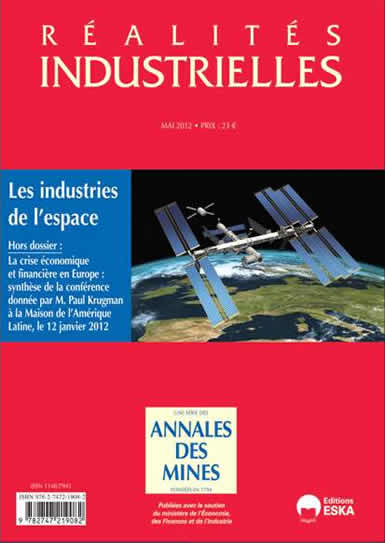
Editorial
By Emmanuel SARTORIUS
Ingénieur général des Mines, Conseil général de l’économie
Foreword
By Laurent WAUQUIEZ
Ministre de l'Enseignement supérieur et de la Recherche
The issues
The European Space Agency’s scientific program
By Jean-Jacques DORDAIN
Directeur Général de l'Agence spatiale européenne (ASE)
Europe is in the front rank of advances in knowledge thanks to its space programs. During the past thirty years, it has realized a large number of first-timers in space, whether exploring the universe and solar system, improving the understanding of our planet or making progress in the sciences that benefit from special conditions for conducting experiments in space. Examples abound, ranging from landing a probe on Saturn’s moon, Titan, through the flights around Mars and Venus and the programs for monitoring the polar ice caps or the salinity of our oceans, to the missions for understanding the physics of weightlessness. This impressive chain of successes has enabled Europe to take the first place in several scientific domains, claim major discoveries and open the way toward spinoffs from this scientific progress. Given its budget (relatively small compared with its principal partners), the EU, through the programs of the European Space Agency (ESA) and its member states, has acquired a competitive technological and industrial infrastructure on the cutting edge of innovation and placed it in the service of communities of scientists on the continent. They are the ones who define the ESA’s scientific programs, which are carried out in close cooperation with member states and their national agencies
France’s space policy
By Yannick D'ESCATHA
Président du Centre National d'Etudes Spatiales (CNES)
Without our being aware of it, the space industry is everywhere in our everyday lives owing to the growing number of applications and services for both governments and the general public. Space is, therefore, a strategic sector for public policy, industry, the economy and science. Thanks to its massive investments since the 1960s, France is now a key player in European space policy. The country purposes to hold its position in order to profit from its investments, wield the strong economic leverage gained from the space industry and help build a “Europe of space”. The major axes of French space policy are: - independence of the access to and use of space; - the utility of space and its applications;
What would be the military consequences if France lost its advantages in the space industry?
By le Colonel Iñaky GARCIA-BROTONS
Chef d’Etat-major du Commandement interarmées de l’Espace
and François RAFFENNE
Responsable du suivi des questions de sécurité/défense UE et OTAN au sein de la division « Relations Institutionnelles » d’Astrium
As demonstrated during France’s recent military operations abroad, space is highly significant for defense. The credibility of the country’s political and diplomatic position still depends on its ability to evaluate situations autonomously and sovereignly. A loss of autonomy in this domain would have lasting consequences on the country’s strategic future and its capacity for remaining in control of its destiny.
The many fields of application
Space and telecommunications
By Jean-Paul BRILLAUD
Administrateur d’Eutelsat
The space industry’s impressive, uninterrupted growth has been fueled by developments in telecommunications and the media. Thanks to the quality technology (uniform, high-definition coverage of the territory) and low transmission costs, satellites are a centerpiece in developing the digital economy and society. In a world where high-speed connections to Internet are becoming a basic commodity like water or electricity, the issue of access for everyone at an affordable price is being raised as a question of fairness among citizens, companies and geographical areas. Given their complementarity with land-based networks, satellites are sources of opportunity and a key vector for reducing the digital gap between haves and have-nots.
Space and services
By Eric BÉRANGER
Ingénieur des Mines, CEO d'Astrium Services
The spectrum of services provided by the space industry covers four main fields: telecommunications, navigation, observation of the Earth, and scientific programs. Telecommunications has experienced a fantastic commercial development thanks to applications, both civilian (such as television) and military. There are many challenges to be taken up. They are not just technical but also social, political and financial. Given their unique properties (ubiquity, precise global coverage, availability), satellites are still the inevitable vector for more and more applications: broadcasting; robust, secure communications; navigation; monitoring; the study of the weather or environment; etc.
New services, newcomers
By Alain BORIES
Directeur de la Stratégie et du Business Development d’OHB
This title refers to the media’s astonishment when, in January 2010, a small German firm, OHB, won the bid for supplying fourteen satellites to Galileo. Headlines ran: “A hardware shop has beat Carrefour”. New services, since Galileo, like GPS, will spawn applications in various fields. Newcomers not just because OHB, in this context, was now playing in the sandbox with big firms but also because the EU Commission has become a new player in the space industry. A sketch of a few elements in the evolution of Europe’s space industry…
The space industry is ready to take part in environmental policy
By Joël CHENET
SVP Relations Institutionnelles et Business Développement, Thales Alenia Space
Given the deepening climatic and environmental crises, along with the inexorable chain of effects on the planet and its inhabitants, political leaders must, more than ever, act strongly and coherently. For this purpose, they will be able to rely on an industrial and scientific community that, developed and experienced, can provide solutions and create applications. This will, in turn, help create new jobs in France and Europe.
Prospects for exploring the solar system
By Catherine CÉSARSKY
Haut Commissaire à l’Energie Atomique, présidente du Comité des Programmes Scientifiques du CNES
and Richard BONNEVILLE
Directeur adjoint des Programmes, de la Stratégie et des Relations Internationales du CNES
The problems and issues are pointed out related to using human beings and robots to explore the solar system. Exploring Mars is of special, scientific interest, given the still far-off possibility of setting up a manned base there. Plans are being worked out for exploring Mars sooner by using robots, with a program for bringing back samples. Probes could be used to explore the moon and nearby asteroids before sending human beings. Unmanned spacecraft could explore the big planets and their satellites. Given that all this calls for considerable means, broad international cooperation is essential, in particular for manned flights. Europe’s assets for contributing to such a program are discussed.
Independent access to space, a precondition for any space policy
By Jean-Yves LE GALL
Président Directeur Général d’Arianespace
Europe’s space policy has been crowned with achievements that are commercial and financial as well as technical: 46 successful launches. They have come out of a resolute, determined policy pursued for more than forty years, at the initiative of France, in particular. This policy arose out of Europe’s early awareness of the need to equip itself with satellites so as to ensure its sovereignty and not depend on other nations. Based on the commercial success of Arianspace and on the support of member states in the European Space Agency, the independent access to space is the prerequisite for any space policy.
The European space industry
By Anne BONDIOU-CLERGERIE
Directeur Affaires R&D, Environnement et Espace, Groupement des Industries Françaises Aéronautiques et Spatiales (GIFAS).
and Jean-Jacques TORTORA
Secrétaire général d’Eurospace
Space industry companies in the European manufacturing sector may not seem impressive when measured by sales and the labor force: respectively, 5,4 billion euros in consolidated turnover and 31.000 jobs in 2010. Nonetheless, they have a role to play in the re-industrialization for which policy-makers in all European lands are calling. In this regard, they have several advantages. Space is one of the major technological adventures of our century. Its applications definitely provide economic leverage; they are a source of attractive jobs, which cannot easily be shifted outside the continent.
Major players outside Europe
Adapting American space policy to international changes
By Xavier PASCO
Chercheur à la Fondation pour la recherche Stratégique, Paris. Chercheur associé au Space Policy Institute, George Washington University, Washington D.C.
The assumed attraction, seen as a “cultural exception”, of US space policy has always hidden a mundane reality of short-term calculations, some of them with little regard for solidly grounded scientific strategies. For instance, the program for exploring the moon was mainly a way to proclaim the superiority of the American political and economic system over its Soviet counterpart. During the Clinton administration, the country’s ambitions in space were mainly intended to reinforce the nation’s economic and industrial supremacy. The Bush administration recentered space policy around defense and directly funded it through major public programs. The use of space is guided by military purposes. In 2012, American space policy, while still referring to the same objectives of power, necessitates other means and new strategies: policies and budgets must be efficient. Laying claim to the legacy of a previous Democratic administration that touted the economic and political efficiency of public investments, the Obama administration seems to have opened a new chapter in the history of US space policy.
Russia and space
By Isabelle SOURBÈS-VERGER
Géographe, chercheur au CNRS, directrice-adjointe du Centre Alexandre Koyré (CNRS, EHESS)
More than twenty years after the breakup of the Soviet Union, Russian space policy is usually perceived and presented as a survival. The failures of launching Soyuz in 2011 and of the Mars probe (Phobos) are evidence supporting this view. Thinly disguised accusations about hostile interference on satellites and broader criticisms of cooperation with the West — which has profited from the excellence of Russian technology without any counterpart through a transfer of technology — have contributed to the petrified image of an isolated community lacking confidence in itself. This interpretation fails, however, to take into account: the restructuring of the Russian space industry; the effort being put into modernization; or the redefinition by political authorities of the country’s potential in space as part of a project for restoring national power. These new orientations deserve attention, since their implications, whether for competition or cooperation, reach far beyond Russia, given this country’s place in the space industry worldwide.
China and space
By Isabelle SOURBÈS-VERGER
Centre National de la Recherche Scientifique (CNRS)
In September 2011, the first module of the future Chinese space station was placed in orbit; and in December, a new policy paper came out describing the country’s space programs till 2017. China has thus placed itself in a leading role, alongside the USA, whose position in this field is still unequaled despite the difficulties of setting future objectives. This situation evinces the idea of a bipolar world. Beyond current fluctuations in policy-making by both parties, it suggests an eventual reversal of roles, as China becomes the driving force in the conquest of space and the United States slowly wanes owing to a lack of political willpower. But this view, implicit in several analyses, is groundless. Comparing the two countries’ technical capacities (as well as the applications related to the space industry and the exploration of space) reveals that China, despite the manned flights, is far behind not only the USA but also Russia, Europe and Japan. Nonetheless, China has both genuine aspirations in this field and long-term plans. Seeming to compete with the world leader is not a source of dissatisfaction to the Chinese. The country’s fundamental goals, when placed in context, are of a different sort however. They are mainly related to issues that China must address in order to build the “moderately prosperous society” it wants to become by 2020.
Miscellany
A synopsis of the lecture “The economic and financial crisis in Europe and the United States” by Paul Krugman (winner of the Nobel Prize in economic sciences) in Paris on 31 January 2012, invited by the Cabinet Lunalogic and Annales des Mines
By Yves LE YAOUANQ
Ingénieur des Mines, doctorant à la Toulouse School of Economics
and Nicolas GOVILLOT
Ingénieur des Mines, Direction générale du Trésor, Service des affaires bilatérales et de l’internationalisation des entreprises
The winner of the 2008 Nobel Prize in economics, Paul Krugman defended a Keynesian interpretation of the current situation. He dwelled on the positive role of government spending in stimulating the economy, and thrashed the proponents of austerity programs. According to him, the eurozone’s problem is not (at least, not just) a lack of discipline in national budgets. Instead, the size of private indebtedness (households and firms) led to overconsumption and has given rise to current problems. Recalling that the European crisis is both economic and political, this supporter of European federalism advocated setting up a genuine governance for the eurozone, in particular by assigning the European Central Bank a role (similar to that of its American counterpart, the Federal Reserve) in stimulating the economy, in addition to its current assignment of controlling prices. This expanded authority could apply the solutions advocated by Krugman for handling the crisis, namely the recourse to inflation. Such a solution should not, however, impede the long-term reforms necessary for attenuating Europe’s inevitable loss of influence and lightening the burden being transferred to future generations.