
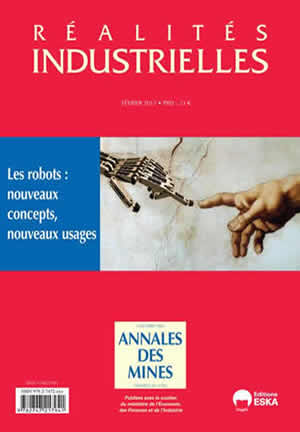
Editorial
By Pierre COUVEINHES
Rédacteur en chef des Annales des Mines
Foreword
By Françoise ROURE
Contrôleur général économique et financier, présidente de la section Technologies et société au Conseil général de l’industrie, de l’énergie et des technologies (CGIET) - Ministère de l’Economie, des Finances et de l’Industrie
et Lionel ARCIER
Contrôleur général économique et financier, membre permanent de la section « Régulation et ressources » et de la section « Sécurité et risques »au sein du Conseil général de l’Industrie, de l’Energie et des Technologies
An inventory by sector
Conquering the ocean’s depths: Robot submarines
By Dominique VILBOIS
Président Directeur Général du Groupe ECA
The ocean’s depths are still mysterious, but at stake for the future of our planet is the exploration and use of the natural resources there (fish, plant-life, minerals, oil and gas) and the study of the ocean’s impact on the climate. We must address these issues in order to offer a future to upcoming generations. The progress made in underwater robotics opens the prospect of improving our knowledge of an environment inaccessible to man and of tapping its resources. The current state of science in underwater robotics is described, along with its civilian applications (current or foreseen for the near future); and a quick overview is presented of this attractive new market.
Robotics’ added value in terms of quality, safety, etc. in aeronautics
By Pierre-Laurent KOCIEMBA
Président de NDT-Expert
A new world pattern is emerging in the aeronautics industry. China, now among the top-ranking players, is investing in a national aircraft construction industry. It intends to become a strong competitor in this field. To take up this new challenge, Airbus and Boeing, the two world leaders, must improve, year in, year out, their competitiveness by investing in research and the development of new technology (carbon, propulsion, wings) and new production strategies (such as lean manufacturing).
Robotized painting in the automobile industry: Saving energy thanks to the concept of “internal load”
By Cédric PERRES
Directeur général de SAMES Technologies, Innovalley - Meylan (Isère)
and Asbed KECHICHIAN
The automatized painting of automobiles has to be adapted to the possibilities offered by robots so as to optimize the equation relating speed (dependent on robots) and the volume sprayed (dependent on the spray system). SAMES’ robotized solution, Accubell 709 Evo, has significantly evolved to meet up to the new requirements.
Problems of safety in industrial robots
By Adel SGHAIER and Philippe Charpentier
Institut national de recherche et de sécurité (INRS)
Robotics has expanded considerably in recent years. Applications using robots are ever more varied; and the physical limits between man and machine are being trimmed. New issues related to safety and the prevention of occupational accidents are arising, whence the need to identify and then reduce the risks associated with robots. It is important to imagine systems in which people can work safely with robots. The current state of work on the safety of industrial robotics is described; and a preliminary study of work-related accidents caused by robots, presented. Solutions are then proposed for improving security.
CAP Robotique’s actions
By Philippe ROY
Délégué Adjoint, Cap Digital
and François HANAT
Chargé de mission, Cap Digital
Cap Robotique is a high-tech “cluster” of about fifty establishments (small businesses, research laboratories, designers) involved in a process of innovation that will transform our relation to sickness, isolation, effort… and re-enchant teaching, caregiving and leisure activities.
The robotics economy: New facts, current issues
By Dr. Françoise ROURE
Contrôleur général économique et financier, Présidente de la section « Technologies et Société » au Conseil général de l’Industrie, de l’Energie et des Technologies (CGIET) - Ministère de l’Economie, des Finances et de l’Industrie
and Grégoire POSTEL-VINAY
Ingénieur général des Mines, Chef de la mission Stratégie - Etudes économiques de la Direction générale de la Compétitivité, de l’Industrie et des Services (DGCIS) - Ministère de l’Economie, des Finances et de l’Industrie
Owing to the economics of automation and the standardization of quality, the machine tool industry sought to increase the global productivity of the factors of production by drastically cutting labor costs. In the economics of robotics, another factor of production — knowledge capable of putting information to work — is to be taken into account in addition to labor and capital. More and more robots will be used, in particular, to provide services to an ageing population. The vast, new prospects of robotics lie at the interface between several sciences: mechanics, software, electronics, nanotechnology, medicine, risk analysis, economics, sociology, marketing and communications.
Coming developments and prospects
New uses for mobile robots
By Guy CAVEROT
BA Systèmes Rennes S.A.S
First applied in production logistics to cut costs, improve product quality and rationalize the work flow in factories, robotics is moving toward new applications in the fields of construction, health and nuclear power. BA Systems has tapped its know-how acquired in industry to respond to new needs for protecting human beings, improving their gestures and safety, and automating activities conducted in hostile environments. For the sake of diversification, BA Systems has adopted an original organization of innovation based on installing the function of “relational innovator” in charge of developing external relations, in particular with research laboratories and the users of the new technology.
Toward a semantic cartography of indoor environments
By David FILLIAT
Enseignant-Chercheur à l’ENSTA ParisTech
In robotics, research on cartography increasingly focuses on “models of semantic environments” containing human concepts, such as parts or objects. We have developed a robot that was able to design an indoor map during a competition in exploring buildings. Using sensors of a new type (in-depth cameras), our approach proves that it is possible to construct such models; but it is based on highly complex systems.
Drones: Their miniaturization and its impact on their deployment and uses
By Catherine FARGEON
Membre du Conseil général de l’Armement (CGARM)
and Peter Van BLYENBURGH
Président de l’Unmanned Vehicle Systems International (UVSI)
The world of small-scale drones, weighing less than ten kilograms, is evolving fast. This sort of aerial vehicle is no longer reserved for academics, big firms in the weapons industry or small high-tech businesses. Geeks and enthusiastic consumers, whether or not from aeronautics, have become passionately involved. These aerial vehicles carry all sorts of sensors on board. Their operators can propose a wide range of services. What are the economic and operational issues in this cultural and technological revolution?
An overview of medical robotics in Iran
By Farzam FARAHMAND
RcSTIM, Tehran University of Medical Sciences, Tehran, Iran. School of Mechanical Engineering, Sharif University of Technology, Tehran, Iran
Hamid R. AMIRNIA
Center for Innovation and Technology Cooperation, I.R Iran Presidency, Tehran, Iran
Saeed SARKAR
School of Mechanical Engineering, Sharif University of Technology, Tehran, Iran
Saeed BEHZADIPOUR
School of Mechanical Engineering, Sharif University of Technology, Tehran, Iran
Alireza AHMADIAN
School of Mechanical Engineering, Sharif University of Technology, Tehran, Iran
and Alireza MIRBAGHERI
RcSTIM, Tehran University of Medical Sciences, Tehran, Iran. School of Mechanical Engineering, Sharif University of Technology, Tehran, Iran. Center for Innovation and Technology Cooperation, I.R Iran Presidency, Tehran, Iran
This paper presents an overview of the current research and development activities on medical robotics in the Islamic Republic of Iran. Medical robotics is believed to be among the most influential and therefore strategic technologies in the area of health and medical services. As a result, the Iranian Ministry of Education, along with the Ministry of Health and Medical education and the Ministry of Industries and Mines have devised a strategic plan to promote and support this branch of technology. A research centre (called RcSTIM) has been assigned to focus on this area and work intensively on long term projects. Collaborative research and development projects in this centre and other technical and/or medical schools have resulted in several domestic technologies and advancements in the field of medical robotics, from which some have already entered the last stages of commercialization and others are passing technical and clinical trials.
From new concepts to innovative uses
Co-botics: From industrial robotics to robots that assist, cooperate and are co-operators
By Michel DEVY
DR CNRS - CNRS; LAAS; Université de Toulouse
What is the current state of industrial robotics? Arms autonomously manipulate objects and perform high-speed repetitive tasks; vehicles without drivers follow set itineraries… Robotized solutions strongly impact the human environment. They must satisfy requirements of safety and sturdiness, but they are not versatile and have a very limited degree of adaptation. New arms for manipulating objects in the vicinity of human beings are now on the market. In the past ten years, research in robotics has rapidly advanced toward placing robots in a human environment and providing assistance to people. Why could a robot, a companion of man outside the workplace, not also accompany him in the workplace? How can industry take advantage of the new findings of research in service robotics? Answering these questions is complicated since the constraints vary depending on the field of application. A few of the issues are described that have to do with a “co-botics”, a robotics of collaboration between industrial robots and people.
Multi-tasking humanoid robots: Nao and its successors
By Bruno MAISONNIER
Aldebaran Robotics
Industrial robots saw the light of day during the 1950s in the United States for the purpose of optimizing production. Robots for serving people came into being in the 1980s in Japan as a response to the ageing of the country’s population. The accident at the Fukushima nuclear power plant has emphasized the importance of having machines as mobile and agile as people but not as fragile. Placing robots in the service of human beings entails addressing several issues: how to control interactions between robots and people, how to develop the robot’s agility and its ability to perceive and analyze the environment, and, above all, how to make it safe for humans in the vicinity of robots. All this calls for partnerships between industry and academia with the objective of advancing toward the phase of developing prototypes and a service robotics industry.
Deploying robots in everyday life (with special focus on humanoid robots)
By Olivier LY
LaBRI - Université de Bordeaux / INRIA Flowers
and Hugo GIMBERT
LaBRI – CNRS
Till present, robotics’ applications were mainly in manufacturing. They are now shifting to the general market, as robots are being proposed to consumers. The potential is enormous, but there are still hurdles, as explained herein. The major issues are examined that must be addressed technologically, industrially and commercially.
Living with robots: Designing the relationship
By Dominique SCIAMMA
Directeur du Développement et de la Recherche, Directeur du Département « Systèmes et Objets Interactifs »
“Robjects” — a contraction of “robot” and ”object” — are more than technical contraptions. They represent a new, social dimension in which objects are not just an assemblage of features but are endowed with behaviors. Robjects are becoming “smart” in their relations with not only people but also other objects. In this new context, a key responsibility is arising: designing the robots for tomorrow and re-imagining what it means to “live together”. The goal for designers is to see robots successfully integrated in society.
The prospects for robotics in Horizon 2020, the EU’s 2014-2020 framework program: What are the priorities for France?
By Patrick SCHOULLER
Représentant de la France aux comités TIC et Sécurité du 7ème PCRDT ministère de l’Enseignement supérieur et de la Recherche
and Frédéric LAURENT
Chargé de mission auprès du Chef de Service, représentant national aux comités PCRDT-CIP-SAFER INTERNET, représentant Eurêka pour le MEFI - MEFI DGCIS STIC
Patrick Schouller and Frédéric Laurent, France’s two representatives on the committee that oversees the theme of information and communication technology in the Framework Program for Research and Technological Development, provide an overview of the EU approach to research in robotics. What themes can we hope to find in the next EU research program, Horizon 2020?
Miscellany
A synopsis of the symposium on digital engineering, organized on 25 November 2011 by the Académie des Technologies, the Conseil Général de l’Industrie, de l’Énergie et des Technologies and the Conseil Économique, Social et Environnemental
By Romain BORDIER
Ingénieur des Mines et membre d’un groupe de travail sur l’Avenir de la radio en France
Laurent GUÉRIN
Ingénieur des Mines et rapporteur général au Conseil National du Numérique
and Jonathan NUSSBAUMER
Ingénieur des Mines et membre d’un groupe de travail sur l’Avenir de la radio en France
Le 25 novembre dernier, s’est tenu dans l’hémicycle du Conseil Economique, Social et Environnemental (CESE) un colloque portant sur l’ingénierie numérique organisé conjointement par l’Académie des Technologies, le Conseil Economique, Social et Environnemental (CESE) et le Conseil Général de l’Industrie, de l’Energie et des Technologies (CGIET). Le sous-titre Entre ruptures technologiques et progrès économique et sociétal donné à cet événement attirait d’emblée l’attention des participants sur l’ambition de cette journée de réflexion et sur l’ampleur des enjeux soulevés par ce qui aurait pu être perçu comme une discipline d’ingénieur parmi d’autres.