
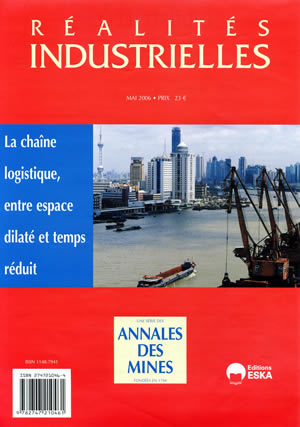
Editorial
By François Valérian
Rédacteur en chef des Annales des Mines
After twenty years of supply chain management, what are the assessments and prospects?
By Pascal EYMERY
Partner d'Accenture, dirigeant du centre d'expertise en supply chain management
Management of the supply chain, which has gradually been recognized as a strategic know-how, has entered a new, more complicated era over the past two decades. Globalization of the economy, the growth of service-related activities and the rise of information technology have deeply modified firms’ relations with their suppliers, customers and partners. This has led to redefining supply chain management. A linear, stable, localized view of the supply chain has been replaced with a mobile logistics of open networks that is to be continually reinvented.
Why has managing the supply chain become so hard ?
By Philippe-Pierre DORNIER
Professeur à l'ESSEC, Président directeur général, Newton Vaureal Consulting
In a globalized, ever more complicated economy, the observation nonetheless has to be made that the performance of the supply chain is stagnating after years of successive improvements. Supply chain management is caught up in a series of disequilbria that have turned out not to be temporary and are becoming permanent. We must learn how to shift from organizations with their main credentials in management to organizations capable of bearing up under a fast pace of structural change.
Profits: On the proper use of globalization
By Jon BUMSTEAD, Excel and Malcolm WHEATLEY
rédacteur professionnel
Even though the low manufacturing costs of products from countries located half way around the world might attract firms, the long waiting periods for delivery are an impediment menacing any hoped-for profits. The textile industry, for example, prefers acquiring supplies from places nearer the domestic market and paying higher manufacturing costs than to put up with the approximately sixteen weeks for merchandise to come from China. New strategies, such as those based on “hybrid” or “mixed” freight, might reap profit from a globalized chain of low-cost supplies — without losing the opportunities provided by national or nearby suppliers.
Direct sourcing in the Kingfisher group
By Patrick GENTINE
Directeur de la Supply Chain Groupe Kingfisher
Propos recueillis par François Valérian
Kingfisher, which ranks third worldwide in the home improvement business, has adopted a “Cost Price Reduction” program. The handle on cutting costs: harmonizing product lines, developing brand names related to the group and, above all, “direct sourcing”. Obtaining supplies from the source now accounts for slightly more than 10% of the purchases made by the group’s European outlets. Kingfisher’s four offices in China (the biggest office), India, Poland and South Africa have the assignment to capture new markets, whether importers or wholesalers.
Re-examine supply chain paradigms
By Olivier VIDAL
Partner d'Accenture, en charge du Groupe de compétence Supply Cain pour la France et le Benelux de 1994 à 2005
Globalization, relocations, flexibility, market feedback, the concentration of investments, ceaseless technological innovations, reduction of the time for bringing products to the market, competitive labor costs, projections of the impact of energy costs on transportation, the increasing importance of sustainable development… managers do not lack reasons for keeping the supply chain at the center of their preoccupations. A recent study proved that the performance of a firm’s supply chain is correlated with the performance of its stock. It should convince top-ranking corporate executives to devote attention to the supply chain.
The challenge of integrating transportation in an agile supply chain
By Roland DACHS
Vice-Président Supply Chain de Crown Cork
The world of logistics has not yet fully integrated the interface with transportation, an essential link in the operation of the supply chain. The changes under way are long. Transportation has to work under a series of restrictions (trends in fuel costs and regulations about work time or the environment). The impact of these restrictions is often poorly understand and, unfortunately, seldom taken into account in current strategies.
Who are the men and women working in the supply chain ?
By Joseph BEAURAIN
Consultant
The quest to improve economic performance, technological revolution, an infinite diversification of techniques and the growth of international transactions have forced firms to be more responsive and flexible, whence a challenge for supply chain logistics. From the self-learned employee working in the field to the engineer with a university diploma, jobs on the supply chain have changed in surprising ways. The persons working there — salespersons or entrepreneurs more than technicians — now see their jobs as being strategic. They see their future beyond logistics. Has the supply chain become too important to be left in the hands of logisticians?
The information system, the supply chain’s nervous system: From integration to modularization
By Si-Mohamed SAID
Global Marketing Director - SAP AG
In recent years, several software packages have been released for managing and optimizing the supply chain: ERP (Enterprise Resource Planning) and Progiciel de Management Integré (PGI). By completing the information system with the supply chain, they now form a “nervous system” that is more flexible and capable of reacting in live time to changes in a network. The firms (Valette and Blédina are cited as examples) that have quickly adopted this software have turned its advantages into a cutting competitive edge.
Should the supply chain be redesigned for customer services?
By Angélique REGAL and Pascal EYMERY
Accenture
Several concepts of supply chain management were worked out for mass production or distribution, contexts with a regular, massive stock flows. Statistical laws were applied so as to design simplified approaches. Nowadays, services are growing, and their supply chain often has quite special characteristics related, in particular, to the sporadic volume of service-related activities. This forces us to leave the paths well trodden by classical activities in production and distribution.
Miscellany
Is space a factor of European integration for managing security?
By Bertrand de MONTLUC
conseiller au Centre d'analyse et de prévision du ministère des Affaires étrangères (Paris)
and Florent PERACHE
diplômé de l'Institut d'études politiques
Policies related to the aerospace industry open new areas for European unification in matters of research and top-notch technology, as well as in security. Although this policy area still lies in the hands of member states, we observe the slow emergence of a process of European governance through, in particular, the development of joint programs such as Galileo and GMES.
Pharmaceutics, a public good: Rendez-vous du Club des Annales des Mines, a meeting held on 8 December 2005
By François BOISIVON
Avec la participation de :
Jean-François BERGMANN, professeur de médecine interne, premier vice-président de la commission d’AMM
Marc de GARIDEL, directeur général d’AMGEN France, et président du Comité Biotechnologie du LEEM
Noël RENAUDIN, président du Comité économique des produits de santé
Débat animé par Jacques BIOT, Président de JNB Développement SA
The topic of expenditures on pharmaceutical products recurrently crops up in debates about public finances. How to move beyond observations about the difficulty of striking a balance between health, doctors and patients? Questions related to industrial strategies and worldwide competition complicate matters even more. Points of convergence are possible between differing viewpoints however.