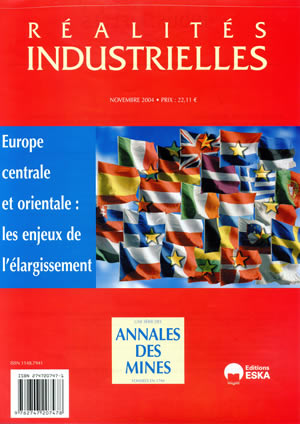
Introduction : les défis industriels de l’élargissement de l’union européenne
By Jean-Luc Delpeuch
Ingénieur général des Mines, Directeur de l’École Nationale Supérieure d’Arts et Métiers (Cluny)
Les élargissements précédents
Previous “enlargements”: Lessons from the past
By Jean-François Drevet
Président du Comité du personnel de Bruxelles
Since the signing of the Treaty of Rome, “little Europe” has grown through three successive expansions in a little more than thirty years (1962-1995). The European Community has also deeply changed — from a customs union to a single market and then a monetary union — but without measuring up to the founding fathers’ political dreams. To what extent have these expansions retarded or stimulated the process of integration? Recent trends have shown that hesitant or less advanced countries have been slowly integrated over time. However the debate about EU institutions has exposed flaws as well as the EU’s lack of political resolve. How can a bigger EU tackle these problems?
Les outils de l’intégration des PECO dans l’union européenne
The EU’s policy of cohesion: An assessment as the Union grows bigger
By Olivier Louis
Chef de la Mission Economique Elargissement
and Yann Lepape
Economiste régional Elargissement de l’UE
As the EU is expanding and budgetary negotiations are being prepared for the period from 2007 to 2013, it is fitting to briefly review the Union’s regional policy. Three major challenges are looming up in front of the new member states: first of all, the tough choices to be made given wide disparities between regions and the enormous need for investment; secondly, a still limited administrative potential given the funds to be absorbed; and thirdly, very limited budgets that the principle of “cofinancing” might tighten even more.
The Regional Development Fund (FEDER), a tool for making Polish industry competitive
By François Bafoil
CERI-ENSAM
Given the accomplishments over nearly twenty years made by Portugal, Greece or Spain, there is no doubt about how effective the structural funds has proven. Will this hold true for new member states? FEDER, the most important fund, has the assignment of improving competitveness. By drawing attention to institutional aspects and governmental actions, an assessment of the industrial heritage prior to 1989 and of developments during the first decade in the post-Communist era helps us identify the main hindrances to fully using this developmental tool.
L’impact des investissements directs étrangers (IDE)
The impact of foreign direct investments: Opportunities for companies and the position of France
By Serge Krebs
Direction des relations économiques extérieures (DREE)
The trade of applicant countries used to turn eastwards but is, since the liberalization of their economies, shifting toward the West: the three-to-one ratio has been reversed. This reorientation is, of course, asymmetrical since the proportion of trade of the fifteen older members with the new ones is increasing even though it is still rather limited overall. During the past few years, France has acquired new shares in these markets, where it used to be nearly absent. But it is still lagging somewhat behind its major competitors. Its position in these new marketplaces remains far below what it should be.
Foreign direct investments, a crucial factor for integrating eastern and central Europan countries in the EU economy
By Olivier Louis
Chef de la Mission économique Elargissement
and Yann Lepape
Economiste régional Elargissement de l’UE
Foreign direct investments have been growing continuously since the start of the transition toward a market economy in the formerly Communist lands of central and eastern Europe. The stimulus imparted to these economies by foreign investments can be observed in three ways. For one thing, these countries are catching up in terms of productivity. Furthermore, their economies are specializing. Finally, European industry’s economic geography is becoming a winning game for all. The question is open whether such investments will continue flowing; and the obstacles should be pointed out that these countries will have to overcome in order to sustain economic growth.
International franchises, an alternative to foreign direct investments
By Karine Picot-Coupey
université de Rennes 2, Haute-Bretagne
As firms expand into foreign markets, they are increasingly using international franchises, whereby a firm imparts its experience to local partners who are to repeat it. This holds for eastern European countries. The upsurge in franchises, an interesting alternative to foreign direct investments, is all the more noteworthy in that they hardly existed in eastern Europe prior to the early 1990s.
Foreign direct investments in Bulgaria: Trends and impact
By Vassil Kirov
Institut de Sociologie, Académie des Sciences en Bulgarie
Not until 1997 did the political and economic stabilization of Bulgaria positively stimulate foreign investments. Despite increasing investments — In 2000, they already accounted for 8% of the GNP — Bulgaria is still less attractive than central Europe. But the long-term prospects for foreign direct investments are favorable, especially since the country is scheduled to join the EU on 1 January 2007.
Industrial policies in central and eastern Europe
The revival of the automobile industry in central and eastern Europe
By Jean-Joseph Boillot
ancien Conseiller régional pour l’Elargissement
and Yann Lepape
Economiste régional Elargissement de l’UE
In the long run, central and eastern Europe has a hidden potential of four million new vehicle registrations per year. These prospects underlie the aggressive sales campaigns launched there by manufacturers of automobiles and auto parts. In this region, which is strategic in the middle run, the dice have not yet been cast. Has a competitive, durable pole emerged? On a pan-European level, is this industry’s economic geography shifting or has it undergone a quake?
Infrastructure networks and development in central Europe
By Gilles Lepesant
Géographe, Chargé de recherches, CNRS
Managing an increase in traffic overland and redistributing it between different forms of transport are two related challenges for the EU’s new member states. These countries also have to deal with: the restructuring of transportation firms, problems of road safety, and incomplete local and regional transportation networks. By focusing on Poland, the major ways of integrating these new members in the EU’s transportation system are presented; and changes at the territorial level are analyzed.
Adapting human resources
Changing and adapting human resources: A challenge for foreign investors
By Rachel Guyet
Institut d'études politiques de Paris
Systems of employment and training in central and eastern Europe have changed significantly over the past twenty years, not only at the level of institutions but also in firms. Foreign investors still have to deal with behavior patterns inherited from forty years of Communism. Misunderstandings and conflicts can often be set down to a lack of knowledge by both parties and a lack of preparation on the part of investors. Preparation is the key to an investment’s success or failure.
The European Social Fund, a tool for adapting qualifications?
By Fabienne Beaumelou
RACINE
To help new member states adopt the Community’s acquis, the European Commission has, since 1998, implemented programs for “twinning” current members with applicants. The aim is to facilitate transfers of experience and strengthen institutions not yet ready to meet up to EU obligations. One particular point has special importance: participation in the structural funds for improving the Union’s economic and social cohesion. Can new member states’ public administrations be taken out from under the sway of politics? Can they become tools in the service of political officials? Can they boost initiatives and improve qualifications?
“Management and technology”, a French-speaking curriculum at the University of Lodz
By Jan Krysinski
Recteur de l'Université Polytechnique de Lodz, Pologne
The admission of Poland in the EU and the stronger development, since 1991, of cooperation between Lodz University’s Engineering School and France were factors in the decision to draw up a French-speaking curriculum centered around “Management and technology”. Despite many fluctuations, it is operating and proposing new openings. A wide range of scholarships enable students to continue their education in France; and nowadays, a growing number of “English-speaking” students are learning French in order to be able to study in France.
Conclusion
The impact of the EU’s expansion on its older members: Dare to think like a leading actor in the 21st century
By Jean-Joseph Boillot
ancien Conseiller régional pour l’Elargissement, auteur de « L' élargissement de l’Europe », un défi économique pour tous (La Documentation française 2003)
and Olivier Louis
Chef de la Mission Economique Elargissement
Owing to its recent expansion, the EU has increased by a third in size. It is less and less a set of countries as it changes into a space structured around a few geographical basins reaching beyond old national borders — somewhat in the likeness of the American economy. The optimal management of these basins with their know-how, products and reputations will increasingly lie at the center of competition in this bigger Europe. The slogan “Think locally, act globally” fully fits Europe; otherwise the continent would, if the current “enlargement” were to fail, become the soft underbelly of globalization.