
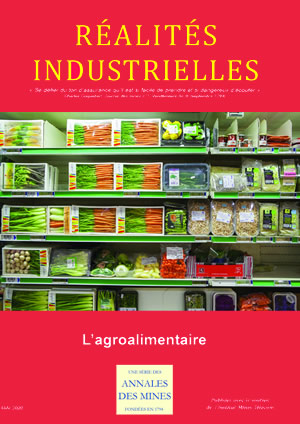
Introduction: Jean-Marc CALLOIS et Serge LHERMITTE,
Agribusiness, an industry unlike the others
The complicated relation to food
By Christine CHERBUT
INRAE
Laden with a complex combination of biological, technical, social and cultural aspects, food is associated with ideas and beliefs that have but a distant relation with its organoleptic, nutritional or health-related properties or its environmental, economic and social impact. As part of the identity of the persons who eat it, food corresponds to their world-view and places them in a group whose members share the same values. The food question centers on managing the ambivalence between pleasure and anxiety. Claude Lévi-Strauss has described this complicated relation: “It is not enough for food to be good to eat, it must also be good to think.”
Food systems and agricultural resources: Determinants, effects and values
By Gilles TRYSTRAM and Hiam SERHAN
A food system is the way that people and societies are organized to produce and consume food. Food systems have evolved toward a “cohabitation” between, on the one hand, an agro-industrial system that, undergoing globalization, offers standardized foodstuffs and, on the other hand, alternative systems that claim to use short supply chains with socially inclusive and environmentally friendly practices and a concern for resources. Scientific, technological and organizational innovations have affected the evolution of the dominant agro-industrial system and helped develop a diversified, low-price offer of food in compliance with irreproachable safety standards. However these innovations have many effects on health, the environment and natural resources that are a cause of concern. In effect, food accounts for 30% of greenhouse gas emissions; and its carbon footprint is 23%; its impact on water is 23%; and on energy 9%. In addition, 25-30% of processed foodstuffs are wasted; and highly transformed energy-intensive foodstuffs cause health problems. Furthermore, the large distance separating production zones from processing centers and points of consumption has modified the relation of food to: the resources needed to produce it; its functions and value; and the physical and economic access to groceries. Faced with the effects of their activities, food systems are now turning toward the production of offers that protect health and biodiversity, are accessible and culturally acceptable, and optimize the utilization of resources. While the industry has made progress in saving water and energy, and reducing losses of resources, a large share of sustainability is now constructed outside the food chain’s specific finality. The bioeconomics of the value derived from byproducts is apparently making this ecosystem sustainable, since it presents the food industry with the possibility of profiting by producing energy (via materials, molecules or synthons) in competition with fossil fuels.
The variety of forms of organization in agribusiness: The logic? The consequences?
By Claude MÉNARD
Centre d’Économie de la Sorbonne (CES)
Recent developments in organization theory help us think about a reality that economists and decision-makers have much underestimated, namely: the variety of the forms of organization of business activities and their underlying motivations. After focusing on the endogenous determinants that enable us to set in order the apparently prolific list of organizational forms, the technological and institutional components are discussed that have shaped this complex landscape and account for its evolution. Discussion then turns to the consequences of this variety of organization forms on public policymaking. The underlying message is that the variety of forms of organization in agribusiness is subject to deep, resilient forces that force us to redesign public policies.
The competitive edge in agribusiness
Is French agribusiness internationally competitive? Pinpointing the problem?
By Carl GAIGNÉ, Karine LATOUCHE and Stéphane TUROLLA
UMR Smart-Lereco, INRAE & Agrocampus Ouest
French agribusiness sales have not grown as fast, on neither domestic nor international markets, as have the sales of major foreign competitors. The reasons for this are set in a new light. Recent studies in international economics remind us that labor costs are but one factor explaining France’s slack in competitiveness. Among the other factors are: the absence of productivity gains, the lack of a competitive edge due to factors other than prices, and the rather high costs of access to foreign markets.
Agribusiness: Innovation for the “food transition”
By Didier MAJOU
ACTIA
Consumer expectations are changing significantly along with lifestyles and patterns of consumption and distribution, and under the impact of the media and product-rating systems. Firms have to plan how to handle new demands that suddenly crop up in the marketplace. They have to cope with the complex challenges of innovation while designing, proces-sing, preserving and wrapping products. For health reasons, food products are being redesigned or custom-made to respond to the needs of specific groups of consumers. Packaging must be improved while still seeing to safety. Between innovation and tradition, food companies must know how to benefit from digital technology: the use of sensors in situ, interoperability and the processing of their existing stock of data in order to perfect business processes. Smart equipment, such as cobots and powered exoskeletons, will considerably relieve the fatigue of chores and tasks. From the start, these creative processes must be placed in the perspective of ecodesign, which will be a source of innovation and differentiation through a positive approach to the environment.
Digital technology’s contribution to a transparent food supply
By Stefano VOLPI and Maxine ROPER
Connecting Food
Given successive scandals since the 1990s, consumers are ever warier of foodstuffs. The issue for producers, manufacturers and brand names is not just to make people want to buy their products because they are good. They must convince consumers that their products are not dangerous, that they are healthy and actually correspond to what is written on labels. To keep their share of the market throughout the coming decade, brands will have to win back consumer confidence. To do so, they must control ‒ continually, in real time ‒ the quality of their products all along the production chain. Given the proliferation of certifications of all sorts, they must see to it that all stakeholders along the chain actually comply with certification standards. As the world undergoes its third industrial revolution, digital technology can help improve traceability and improve the transparency of food chains. The various solutions already available (and used by some businesses or consumers) are explored…
Human capital: Strong recruitment needs as jobs and processes change
By Caroline COHEN
Association nationale des industries alimentaires (ANIA)
How to be competitive, sustain the production capacity, conserve natural resources and measure up to consumer expectations about the origin of raw materials and processed products? How to speed up the digital transformation and integrate artificial intelligence? Food companies must address these questions. With organizations, jobs and processes in the throes of change, the food industry has to adapt to changing consumption patterns and to technological and environmental trends. Human capital ‒ the women and men who now work or will be working in this industry ‒ is a major driving force behind long-term business growth. This capital has to be attracted, recruited and made loyal; but employees must be trained differently.
Local supply chains to consumers for creating a virtuous circle for farmers
By Dominique SCHELCHER
Système U
The question of farm incomes is inherently tied to the internationalization of the food market and changing consumption patterns. Consumer behavior is now paradoxical. Although consumers want quality products with, by implication, more income going to producers, they are not always ready to spend more. For this reason, the solution is a gradual evolution of habits ‒ a transition that entails new distribution channels and a “territorialization” of supply chains. While the first positive effects of the EGalim Act in France are now being reaped, our responsibility as a distributor and stakeholder is to launch local, transparent initiatives, like the three-party contracts signed with suppliers, and to take part in consolidating new distribution channels and industries (in particular organic foods).
Excellence in health and sanitation, an obligation and a factor in international competition
By Carole LY
FranceAgrimer
To prevent the spread of diseases coming from animals or plants, or conveyed by pests, the exporters of agricultural produce must follow health and phytosanitary regulations. The existence of an effective sanitary system in Europe and France facilitates negotiations with third-party countries. However satisfying European sanitary and phytosanitary requirements no longer suffices for exporting outside Europe. As regulations swell in number and complication, firms are forced to adapt. Their ability to satisfy requirements internationally will make them more competitive and reassure consumers.
The systemic transformation
Toward sustainable food systems
By Bernard CHEVASSUS-AU-LOUIS
Humanité et Biodiversité
Can the food systems set up in developed countries during the 20th century reach the goals of sustainable development? Can new systems be designed that rely more on local resources and pay more attention to biodiversity? What are the principles and, too, limits of an environmentally friendly agriculture? How to help these new systems develop while avoiding “ parochialism ”?
Relocalizing food production systems? From localism to a territorial bio-economy
By Jean-Marc CALLOIS
Ministry of Agriculture and Food
What is lurking behind the fad for a “local” food supply? The reality and relevance of this going back to the roots are examined; and the various arguments, pro or con, about relocalization, examined. This trend, though evident, does not represent a massive shift. Relocalization is heterogeneous, the reflection of quite different underlying models. Rather than striving to massively relocalize the food supply, public policies should focus on developing the full potential of adding value locally to bioresources.
Dairy cooperatives’ local strategies
By Damien LACOMBE
Sodiaal Cooperative
Since its creation at the start of the 1990s, Sodiaal Cooperative has pursued a major goal: create a maximum of value for redistribution to its members while contributing to the growth of local economies and taking full advantage of local resources in areas well suited to dairy farming. This ongoing quest implies developing new products, brands and market segments, and reinforcing the cooperative’s positions on value-adding market segments. To do business as usual, cooperatives must coordinate their business activities with public policies.
Bel, pioneering a sustainable, profitable model co-constructed with stakeholders in the dairy industry
By Béatrice DE NORAY
CEO Bel France
For more than three years, Bel has been working with other stakeholders in the dairy industry (producers, distributors, partners, experts and consumers) as it has deployed a pioneering model that, profitable and sustainable, forms a pillar of Bel Group’s goal of “healthier food responsible for everyone”.
Harmony, Mondelēz International’s pioneering program for a sustainable wheat industry in France
By Mickaël POURCELOT
Senior consultant, Agrosolutions
Cécile DOINEL
Coordinator, Qualité Europe du Programme
Caroline DIZIEN
Senior consultant, Agrosolutions
and Gildas MEVEL
Manager, Agrosolutions
Mondelēz International, the world’s leading cookie-maker, launched Harmony in 2008, a program for the sustainable production of wheat by its French and European farm partners. Harmony’s charter lists 34 good farming practices for reducing the environ-mental footprint of the wheat used to make the cookies of the Group’s various brands. Thanks to a proven methodology and state-of-the-art digital technology, the environmental and economic results of wheat fields under the Harmony program can be compared with local and national statistics over a three-year period. Since the program started, some practices recommended in the charter (for instance, about choosing the varieties to plant, managing the application of fertilizers or rotating crops over long periods) have proven their mettle.
Coordinating all links in the production chain
By Dominique AMIRAULT
FEEF
Agribusinesses are playing a pivotal role in a production chain with three links: the “upstream” link of farmers and producers, the “midstream” where products from the first link are processed, and then the sales and distribution channels “downstream”. There is a disequilibrium between sales downstream, which is concentrated, and upstream producers who are dispersed. The development of environmentally responsible labels and product lines and of contractual relationships respond to consumer expectations and reinforce coordination between all links in the chain.
Logistics in the French cereal industry, a systemic issue
By Jean-Marc BOURNIGAL and Nicolas FERENCZI
Association générale des producteurs de blé et autres céréales (AGPB)
For the French cereal industry, which collects and processes 64 M tonnes of grain a year, logistics is a key factor for honing its competitive edge. Thanks to its infrastructure and organization for collecting, storing and transporting cereals (by road, river or sea), France has a good track record. Given, however, the advances made by competitors and the slack of investments in certain infrastructures, genuine efforts must now be made to optimize logistics operations and costs. The advantages brought by digital technology, the increasing segmentation of ever more demanding markets, the introduction of ever more restrictive environmental policies and the growing awareness of the importance of new forms of organization represent opportunities and provide leverage for making the cereal supply chain more competitive.
European agriculture and “protein sovereignty”
By Michel BOUCLY and Pierre-Marie DÉCORET
Groupe AVRIL
The European Union is, along with China, the only major agricultural power that depends on the rest of the world to satisfy its demand for protein-rich inputs. The EU produces only 35% of what it consumes, a shortage offset by massive imports of GMO soya from the Americas. By comparison, France covers 63% of its needs thanks to its yields of oil- and protein-rich cereals. Since the end of World War II, this protein shortage has represented a risk for agriculture and the food industry. However the shortage might become critical in the coming decades owing to a steadily strong demand and the scarcity of sustainable protein-rich resources. Means exist for gaining protein sovereignty. La Ferme France (in particular the production of oil- and protein-rich cereals) has long pursued this goal and is still actively doing so. It is time for political authorities who advocate the protein sovereignty of France and Europe to impart a fresh impetus to these efforts.
Bioproduction in agribusiness
By Cédric SIBEN
Conseil général de l’Économie
Bioproduction refers to the production of substances (including chemicals and foodstuffs) that use living organisms (enzymes, proteins, genetic material, etc.) in at least one phase of the manufacturing process. The word derives from bios [in Greek: “life”] and productio [in Latin: “lead forward”]. This “biotechnology” is not to be confused with the production of organic foods, which is subject to tight regulations about farming practices (e.g. the use of pesticides) or manufacturing processes (e.g., the addition of food supplements).