
Introduction
By Serge CATOIRE
Engineer from the Corps des Mines, Conseil Général de l’Économie
Crossborder cooperation
The principal issues of crossborder cooperation
By Jean PEYRONY
Director of the Mission Opérationnelle Transfrontalière (MOT)
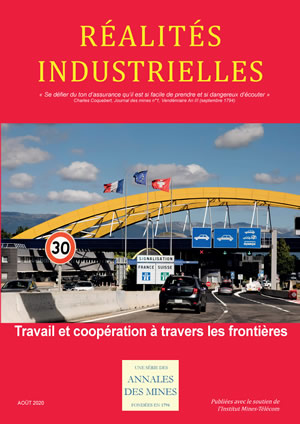
This discussion of issues related to the opening of borders in Europe and crossborder cooperation presents an inventory of public policy responses and of the situations in French border areas. The advances due to the European Commission’s proposals for the period after 2020 and the Franco-German treaty of Aix-la-Chapelle are described along with a few paths for action.
Crossborder cooperation in the Auvergne-Rhône-Alps Region
By Étienne BLANC
First vice-president of the Auvergne-Rhône-Alps Region
The globalization of exchanges, the construction of the European Union (which has enshrined the freedoms of circulation and of establishment within the EU as fundamental principles) and the ease of mobility on the planetary scale have considerably altered the very idea of borders. France, with its 4 176 km of land borders and a coastline of 3 805 km, has felt the impact of this trend, which started in the 20th century. National or international border policies directly or indirectly affect ten million French citizens. The Auvergne-Rhône-Alps Region, bordering on Switzerland and Italy, soon enough set up arrangements for cooperation and established ties with several structures created by the state and, too, by local authorities in border areas. A panorama…
Crossborder issues in the Jura Arc
By Alexandre MOINE
Professeur de géographie, Laboratoire ThéMA UMR 6049, CNRS, Université de Franche-Comté
Borders are powerful vectors for organizing geographical space. In the Jura Arc, despite loose-knit urban areas, borders cause problems that have made cooperation indispensable. Trends in these border areas bring to light cogent differences related to the coherence of rural and urban planning on both sides of the border. Besides the need to support political authorities at various levels, this analysis points to the lack of a strategic vision of dynamic forces grounded in proximity, knowledge of each other and connections between local stakeholders, in particular citizens, firms and “civil society”.
Successes and difficulties in cooperation along the border: An operational view from the Grand East Region
By Philippe VOIRY
Prefecture of the Grand East Region
Border cooperation is a necessity for turning discontinuity into a driving force for growth. To realize this potential, we must be careful lest the intuitive notion of a border, so deeply rooted in the human mind, interfere with the vision we should have of the border as a line between states, at least in the European Union. This line is but a limit between two political systems that have been built differently and should now be connected. As the health crisis has shown, movements across borders between EU member states could not be filtered without incurring devastating economic consequences. Crossborder cooperation is a dimension in the construction of Europe, a direct continuity between populations. It thus contributes to realizing European sovereignty in response to global challenges.
The Lyon-Turin connection
By Alain BONNAFOUS
Professor emeritus at Lyon University
and Lionel CLÉMENT
Economist of transportation, Transae
The Lyon-Turin rail connection is part of the TransEuropean Transport Network (TEN-T), a program for developing EU transportation infrastructures. The tunnel at the foot of Mont Cenis, a section on this connection, has monopolized attention given its gigantism and cost. The European Union has supported this construction site by providing 40% of its finances. However this tunnel has triggered radical criticism, both environmental and economic. The Italian government’s recent position leads us to think that the tunnel will be built as planned. However its economic efficiency will depend on many conditions that, yet to be satisfied, are mainly related to the coherence between the program for operating the rail line (for freight and high-speed passenger trains) and the construction program that will allow for this.
The Léman Express: From crossborder collaboration to local effects
By Giuseppe PINI
Lausanne University
Delayed, redesigned, even formally abandoned for historical and economic reasons down through the 20th century, the interconnection between the Swiss and French rail systems via the CEVA line (Cornavin, Eaux-Vives, Annemasse) was finally inaugurated in December2019. The CEVA section was the missing link in Greater Geneva’s crossborder regional express network (RER). It entailed considerable investments and close cooperation between Swiss and French authorities. The RER has made the agglomeration more accessible, improved connections between means of transit and promotes sustainable mobility. Its operation should, over the next ten to fifteen years, have a considerable impact on local areas with respect to housing construction, population growth, the creation or transfer of jobs toward more accessible localities, the reorientation of pendulum movements, and the development and specialization of localities.
Eurotunnel, a unique firm that spans a natural obstacle between two countries
By Michel BOUDOUSSIER
Eurotunnel
To operate the Chunnel (the tunnel under the English Channel), a new solution for this 20th century construction site had to be invented at a time when plans for a European development of railroads were not yet in the pipeline. This solution hinged on Eurotunnel, a private firm that corresponded to a specific form of international cooperation through a single company. In the light of its activities and economic events, it is worthwhile understanding how this solution worked and evolved. The way that responses were formulated to challenges might serve as an inspiration in the future. In the coming years, new challenges will arise, such as the energy transition. In the meantime, the general context will have been transformed as a result of Brexit and the changes constantly made in railroad regulations.
Seine-Escaut, an industrial and territorial partnership at the service of European public policies
By Nicolas BOUR
Voies navigables de France (VNF)
Economic agents and local authorities in six European regions (Normandy, Île-de-France, Grand East, Hauts-de-France, Flanders and Wallonia) have been working together for more than twenty years to build the first multimodal network of inland navigation in Europe. This network comprises 1 100 km of wide-gauge waterways that connect five big seaports (Le Havre, Rouen, Dunkirk, Antwerp and Zeebrugge) and will benefit three major metropolitan areas (Paris, Lille and Brussels).
Cerdagne Hospital, the first example of the creation of a crossborder public hospital service in Europe
By Xavier FAURE
Project director at ARS Occitanie, president of the board of
Francis DECOUCUT
Honorary hospital directors, assistant directors and board members of
Jean-Jacques ROMATET
Directeurs d’hôpitaux honoraires, respectivement anciens directeurs adjoints et membres du bureau exécutif de l’hôpital précité
and Felip BENAVENT
Head of the Vall d’Aran and Pyrenees sector in the Catalonian Health Service (Catsalut)
Since 2014, Cerdagne Hospital is a unique example of a crossborder hospital, a public health service created for two populations, Spanish and French. This new form of cooperation between states reaches beyond national health programs and has been backed financially by the European Union. Thanks to it, the inhabitants of a landlocked mountainous area have local access to medical care of a good quality. This project has come out of the determination to offer broader access to health care to persons distant from urban centers and thus contribute to more equality in the field of health. It draws our attention to the difficulties inherent in any innovation, in this case:the organization of health by two nations that, for want of a more integrated EU legal framework, raised many legal and regulatory obstacles.
Crossborder cooperation in universities
By Françoise BOUTET-WAÏSS
Inspector general of Education, Sports and Research
Created in 1990, the EU’s Interreg Program has reinforced crossborder cooperation between universities, specifically in education, research and extracurricular activities. The natural basis for this crossborder cooperation between universities is territorial and the sharing of a language. The fullest successes have resulted from strong political support, reflected in the creation of an operational legal structure. The most significant example comes from Strasbourg with EUCOR, the European Confederation of Upper-Rhine Universities, the first such group based on crossborder regional cooperation among universities. The obstacles ‒ language barriers, socioeconomic and regulatory differences, different administrative organizations and the political climate (Brexit) ‒ have been overcome thanks to stakeholder involvement and financial backing from the EU and local authorities.
Crossborder workers
Crossborder workers in France and the EU: Living in France and working outside the country
By Pierre BUI QUANG and Florian LE GALLO
Department of statistics and international relations, Bank of France
In crossborder areas, the free circulation of labor in the European Union has made it easier to search for a job on the other side of the border. In 2018, 2.1 million Europeans, including 450,000 French residents, were working in another country than their land of residence. That same year, French wage-earners abroad received €22 billion in wages. This pay is a resource for their country of residence. As the champion of crossborder workers, France stands out in that this labor exchange is one way: very few nonresidents come to work in France ‒ unlike Germany, where the number of nonresident wage-earners is as high as that of residents who work outside the country. This situation can mainly be set down to the economic motivations that shape crossborder labor patterns and are reflected in outflows, in particular toward Switzerland and Luxembourg.
The crossborder jobs of French residents: Context, statistics and trends by bordering country
By Elena MIRONOVA and Sophie VILLAUME
Insee
Many residents of border areas in France work on the other side of the border. Crossborder commuters are concentrated in certain areas, where they represent 50% of the active population. The large majority of them go to Luxembourg, Switzerland and Monaco, counties with an attractive, growing labor market and high wages. More French residents are working in these ever more attractive countries. Despite its job offerings, Germany attracts fewer and fewer workers from France; and the number of wage-earners crossing the border to work in Spain is falling even as the number crossing to Belgium is rising less than in previous years. In Luxembourg, Monaco and, to a lesser extent, Switzerland, wage-earners from France mainly satisfy labor needs in the tertiary sector, where the proportion of French residents is especially high. These countries offer skilled jobs, and the proportion of white collars among crossborder employees is rising. In Belgium and especially Germany however, a large part of these crossborder commuters are workers employed in industry; but their number is receding to the benefit of more qualified jobs.
The European Metropolis of Lille: Constructing an employment policy in a crossborder setting
By Bruno CASSETTE
Managing director of services, European Metropolis of Lille (MEL)
Simon JODOGNE
Assistant director of Governance and Territorial Dialogs, European Metropolis of Lille (MEL)
and David VAILLANT
Head of the strategic mission Economic Development and Employment, Metropolis of Lille (MEL)
The European Metropolis of Lille (MEL) suffers from high rates of structural unemployment, especially in the northeast (Roubaix-Tourcoing) near the border with Flanders, which is experiencing full employment. Since the start of the century, the metropolitan area has fostered policies for favoring jobs through urban development and its economic, social programs. In 2018, MEL went a step farther by looking across the border with Belgium to try to understand the socioeconomic underpinnings of the Flemish system, its operation and performance, the aim being to reinforce its own employment policies. This metropolitan strategy completes a set of crossborder arrangements and actions for debunkerizing the labor market and further integrating the Eurometropolis of Lille-Kortrijk-Tournai.
Crossborder workers in Switzerland: The persistent gap between research and public opinion
By Giovanni FERRO LUZZI
Geneva University & Haute École de Management, HES-SO
Vincent FROMENTIN
Université de Lorraine et Centre européen de recherche en économie financière et en gestion des entreprises (CEREFIGE)
and Sylvain WEBER
Neuchâtel University & Haute École de Management, HES-SO
Crossborder workers represent a major part of the Swiss labor force: more than 25% of the active population in some cantons. This situation has, of course, created resentment, and Swiss residents often see these wageearners as a threat. According to a public opinion poll, crossborder workers are said to be responsible for serious problems, such as unemployment and wage pressures ‒ in contradiction with the findings of all scientific studies on this topic. Although statistical analyses detect scant or even no effects, their results cover up effects that appear when the statistics are differentiated by level of job qualification: the impact thus turns out to be negative on some workers. A few emblematic cases reported in the media might shape public opinion, but they are not normal.
Crossborder work in the Grand East Region
By Édouard JACQUE
Representative delegated to crossborder workers in the Regional Council of the Grand Est
Grand East is the region in France with the longest borders (with four countries). Europe is a daily experience there; and a major challenge is to lift the bureaucratic barriers that subsist (or those that emerge or reemerge) in each country. Health, transportation, education, the economy and taxes are subjects of everyday concern to citizens. Our association’s legal approach to these crossborder topics is close to the community and has a high level of expertise. Above all, our online platform seeks to address existing or emerging complexities, which will persist in a knowledge society ‒ fortunately so, since Europe should not become a flavorless normative production unit. On the contrary, its diversity is a chance, evidence of this being the reservoir of growth observed over the past few years in crossborder areas.
A crossborder new deal
By Christine BERTRAND
President of MEDEF in Meurthe and Moselle & delegate MEDEF Grand Est
At the end of 2018, crossborder exchanges of labor represented an outflow from Lorraine in France: of 100,300 people who went to work in Luxembourg; 16,300, to Saarland or Rhineland-Palatinate; and 4,000, to Wallonia. This outflow is predicted to grow by from 25-30 thousand during the next 12-15 years. These jobs are important for Lorraine, given the wave of deindustrialization that followed the steel industry crisis; but serious problems have cropped up owing to the distortions related to social security and taxes. According to demographic projections, economic issues, now important, will become vital by 2030. The firms that are the lifeblood of Lorraine’s economy urgently need concrete solutions; they cannot wait. For this reason, employer associations (MEDEF 54 and 57) and the major trade association (UMM Lorraine) seek to take part in this debate by making realistic and realizable proposals. If no measures are soon taken, Lorraine might experience a labor deficit that would jeopardize the local economy.
Life and work across the Irish border through Brexit
By Katy HAYWARD
Reader in Sociology at Queen’s University Belfast and a Senior Fellow in The UK in a Changing Europe think-tank
Changing the status of the Irish border to an external boundary between the UK and the EU was always going to be difficult to manage. Both the UK and the EU shared the objective of avoiding a hard border but finding the means of doing so proved to be a complex technical and diplomatic challenge. Whilst the withdrawal negotiations continued, concerns grew among those who would be most directly affected. Despite a history of conflict and underdevelopment, the Irish border region had become one of the most successfully integrated in the world. This only increased the potential price to be paid for Brexit by those living and working there. Successful cross-border development depends on the conditions for, and habits of, cooperation fostered ‘on the ground’. The Protocol on Ireland/Northern Ireland in the Withdrawal Agreement brings some assurance about maintaining the conditions of north/south cooperation. Nonetheless, the UK/EU border problem that falls on Northern Ireland will persist as a topic in perpetual need of political sensitivity and accommodation.
Miscellany
Financial catastrophes are sometimes more endogenous Nuclear Swans than exogenous Black Swans
By Alexis BONNET and Marko LEHTIMAKI
Methodology Asset Management
There are two types of financial crises: 1) Exogenous types arising first in the real economy and then transferring to the financial markets, and 2) Endogenous types arising within the financial markets themselves (and then potentially transferring to real economies depending on their severity). In the current paper we examine the nature of the endogenous financial crises, and their common origins in over-reliance on financial models, and implementation via financial derivatives.