
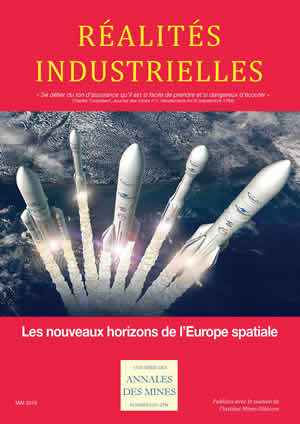
Préface
By Frédérique VIDAL
Ministre de l’Enseignement supérieur, de la Recherche et de l’Innovation
Foreword
By Jacques SERRIS
Engineer from the Corps des Mines, Conseil Général de l’Économie
1 – Strategic spatial issues of the 21st century
European intergovernmental policies
By Géraldine NAJA
European Space Agency (ESA)
Politically, economically and industrially complex, Europe has many institutional dimensions: national, regional, intergovernmental and the EU. However this complexity and overlapping of levels of policy-making and implementation represent a treasure for Europe. It is even more relevant in space policy since, from the start, space has been an issue conducive to European integration, a highly strategic policy field. Given the two historical superpowers in space (the United States and the former USSR), European states and their firms have no other choice than cooperation. This cooperation is organized around an intergovernmental organization, the European Space Agency (ESA). Europe has gradually drawn up a coherent policy and a spatial program capable ‒ through the ESA, national agencies and, more recently, the European Union ‒ of turning the space industry into a top-ranking player. ESA, a pioneer of European integration, has adjusted to the political and institutional changes in Europe and will have to continue adapting in the future.
European Union Space Policy
By Pierre DELSAUX
Deputy Director General at the European Commission Directorate General for the Internal Market, Industry, Entrepreneurship and SME’s
Europe has achieved many successes in Space, thanks to the fruitful collaboration of Member States, the European Space Agency (ESA), the European Organisation for the Exploitation of Meteorological Satellites (EUMETSAT) and the European Union. Copernicus and Galileo/ EGNOS the two Union flagships are the result of this synergic cooperation. They are both fully operational and deliver world class services for Earth Observation and Satellite Navigation. Building on these successes, on 26 October 2016, the European Commission adopted the Space Strategy for Europe setting up a common vision and identifying a number of concrete actions to achieve its objectives. This was enriched by an intensive political debate and orientations provided by Council and Parliament. In view of the political changes at the horizon with the forthcoming elections, it is mandatory to ensure that Europe’s successes in Space are ensured. As a result, last June this Commission adopted important proposals that will shape the future of Space in terms of programme components, research and innovation needs and investment ambitions.
France’s place in space
By Jean-Yves LE GALL
President of the Centre National d'Études Spatiales (CNES)
France has always been the third power in space and is now the driving force behind spatial Europe. This prominent role has been grounded on a partnership between the country’s National Center for Space Studies (Centre National d'Études Spatiales, CNES) and industry. Thanks to this partnership, these parties have become leading world actors in space launchers, satellites and applications. The new firms that have emerged in the United States (the major ones with their roots in the Internet) might upend this position. This phenomenon, called “new space”, is apparently challenging fundamentals in this sector. The twofold trend, digitalization and globalization, affecting the space industry tends to strongly reducing the costs of owning spatial systems and to lead to the arrival on this market of newcomers, that are public as well as private, and, for France, that are both clients and rivals. The CNES has responded by pursuing scientific excellence and developing its ecosystem and international cooperation. The space industry is supported by public authorities whose role has ultimately (and somewhat paradoxically) been bolstered by this “new space”.
The evolving context of American space programs
By Xavier PASCO
Director of the Fondation pour la Recherche Stratégique
Given its still unequaled investments, the United States remains the world’s top-ranking spatial power. This position rests on two pillars: the exploration of space by human beings and the development of the armed forces in space. In fact, military expenditures have recently grown owing to a gnawing feeling of vulnerability to China’s rising power and Russia’s maintenance of its military capacity. In parallel, a new ‒ business-oriented ‒ space industry is emerging, symbolized by Space-X or Blue Origin in launchers. Applications drawn from the space industry are also evolving, as investors see the glimmer of new outlets in information technology. However government support is indispensable to the success of a still uncertain industrial wager.
China, Russia, India, Japan: A typology of their ambitions in space in 2019
By Isabelle SOURBÈS-VERGER
Director of research at the Centre National de Recherche Scientifique (CNRS), Centre Alexandre Koyré
The activities in space by the major members of the “space club” are studied in relation to the superpower in this field: the United States. If we exclude Europe, Western experts usually rank China in second place followed in order by Russia, India and Japan. This ranking corresponds less to criteria related to these countries’ actual performances in space than to their importance on the international scene and, implicitly, to the perception of each of them as a potential competitor of the United States. Since activities in space are a sign of power, it is worthwhile comparing these players’ ambitions and seeing whether a typology can provide a new framework for interpreting the various ways that space is now being occupied.
Small satellites, small launchers: Opportunities for newcomers in the marketplace?
By Florence GAILLARD-SBOROWSKY
Fondation pour la recherche stratégique
According to many commentators, the space industry is entering a new era ‒ “new space” ‒ characterized by the intrusion and multiplication of private firms that are opening the “access” to space thanks to new innovative systems. Small satellites and small launchers are the main components at the origin of this approach, which has come out of several trends: the miniaturization of electronic devices, the development of standardized parts, and the commercialization of launching services with the goal of drastically cutting the costs of placing satellites in orbit. This new technological and industrial approach has an impact on the concept of power in space and apparently opens opportunities for newcomers to the space market. Nevertheless, we ought to realistically judge the changes under way and the concrete possibilities thus opened.
The French state’s role in spatial Europe
By Patrice BRUDIEU
Head of space policy, Direction Générale de la Recherche et de l’Innovation, MESRI
Space is in the throes of change. More than ever, the state must play a major role in four basic ways: its autonomy and capacity for ensuring essential governmental functions; its support for industry both up- and downstream in the production process; legislative and regulatory controls; and sciences and exploration.
2 – The industrial offer dans new markets
The French space industry’ key figures
By Anne BONDIOU-CLERGERIE
Director of R&D Espace et Environnement, GIFAS
Given that the three major European firms in space technology (along with a chain of suppliers, small and medium-sized businesses, and innovative startups) are implanted in France, the French space industry is growing. It has created jobs for several years now and contributed positively to the balance of trade. It has asserted its position as a top-ranking player in the marketplace while developing its capacity for serving institutional markets, both civilian and military. This balance is hard to maintain in a competitive, fast evolving environment. Nonetheless, the space industry has managed to innovate in order to adapt its activities involving launchers (with the Ariane 6 program) and even satellites (high-speed data transmission and constellations of satellites). Meanwhile, the French space industry has carried out world-class missions (meteorology, science, environment) and has significantly contributed to defense, the EU’s major policy fields and prosperity.
New space
By Jean-Jacques TORTORA
Director of the European Space Policy Institute (Vienna)
Born in the United States under NASA’s midwifery, “new space” is an approach motivated by the quest for efficiency. With its promises of making space accessible to a large number of persons thanks to the magic wrought by a few bold entrepreneurs, it has attracted the attention of the public and governments around the world. This overview of the basic aspects of this phenomenon places it in the perspective of European initiatives during the past two years. Even though a definitive assessment cannot yet be made, the space industry has been galvanized by private investors’ sudden interest in it. Furthermore, new space radically opens new prospects. Europe will probably have to modify its legal and regulatory framework, in particular, about the articulation of customer/supplier relations with its institutions and the industry. The objective will be to profit from this new potential and endow its industry with the means for coping with a virulent strain of competition.
What future for the French space industry? A prospective analysis based on the theory of strategic disruption
By Éric JOLIVET
Toulouse School of Management, Toulouse I University, Capitole
and Grégory PRADELS
Aerospace Valley, Pôle de compétitivité Occitanie et Nouvelle-Aquitaine
The American firms SpaceX, Planet and OneWeb are, each in its field, jostling the traditional space industry (long deemed to be stable and hard to rival) and contributing to what is called “new space”. The theory of technological disruption helps us understand some of these changes, in particular: how newcomers to the market manage to unseat the giants, sometimes by using the technology invented by the latter. The goal is to modify standards of performance so as to turn the advantages held by traditional firms into costs and obsolete assets. This economic force is now at work in the space industry, and French firms, which have held a prime position, are in danger. A few probable scenarios are discussed along with the possible strategies for coping with such a fast changing environment…
Where is the European satellite-launching industry headed?
By Alain CHARMEAU
CEO of ArianeGroup (from 2014 to 2018)
For centuries, humanity has dreamed about exploring the universe. Meanwhile, the adventure into space is actually occurring. Autonomous access to space is an issue not only strategic but also political, societal, economic and industrial. The European space industry, incarnated by the Ariane rocket family, has managed to keep its place as a world leader thanks to its ability to adapt to market trends. The current trend is toward becoming ever more competitive, productive and cooperative ‒ the indispensable levers for survival, the upkeep of know-how, and the preservation of jobs. This industry’s assets? A prestigious legacy, a capacity for anticipating trends, and the member states’ determination to pursue this adventure. Crucial decisions about the evolution (by 2025) of Ariane 6 and about the future (beyond 2030) of European launchers will have to be made during the coming ministerial level meeting of the European Space Agency’s council.
New industrial chains, the example of OneWeb
By Nicolas CHAMUSSY
Director of Space Systems in the Airbus Defence & Space Division and president of Airbus Defence and Space SAS (ex-Astrium)
In 2015, Airbus Defence and Space obtained a contract for nine hundred satellites from OneWeb. This first project for a megaconstellation of satellites has opened a new chapter in the space industry’s history. Institutional support under a state-run investment program was at the origin of the industrial capacity for executing this contract. Since the objectives with regard to unit costs, the pace of production and the miniaturization of satellites are so ambitious, engineers have had to overhaul the processes of design, integration and testing. A “factory of the future” for tomorrow’s space industry has been built in Toulouse on the campus of Airbus Defence and Space. The first satellites for OneWeb are being placed in orbit, thus proving beyond any doubt that the French space industry is a pioneer in the evolving market for satellite constellations.
The German firm OHB, a new player in the space industry
By Alain BORIES
OHB
The emergence of OHB, a small firm typical of the German Mittelstand, as a third major contractor in the European space industry, has surprised more than one. However this firm’s development is a success story about a family of entrepreneurs who, enthusiastic about space, are convinced that they can upend business models. A telling of this family saga… the story about the founder was told in the book, A Pioneer of Space Flight.
How Luxembourg becomes Europe’s commercial space exploration hub
By Marc SERRES
CEO of the Luxembourg Space Agency and Vice Chair of the ESA council
During its short history as an independent nation, Luxembourg had to reinvent itself continuously, adjusting to changing conditions beyond its control and taking advantage of new opportunities, in order to open up new spheres of value creation and national development for the benefit of its citizens and residents. The most prominent example is certainly the transformation, within a generation, of its economy based on world leadership in technology and production of steel and steel-based products to one of the planet’s most significant financial centers. Luxembourg, known for its fruitful utilization of radiofrequencies since the 1930’s, now aims at becoming Europe’s commercial space exploration hub.
The reality and prospects of a spatial IoT
By Paul WOHRER
Fondation pour la Recherche stratégique
Several observers see the Internet of things (IoT) as a natural evolution of the Internet. In the near future, billions of devices performing numerous tasks will be connected to the Net. Despite their lower capacity but thanks to their lower costs, small satellites seem to be ideal relay stations for enabling connected devices to talk together, especially in places poorly equipped with land lines. Several startups have been set up to profit from being the first newcomers on this potential market, which does not yet exist even though several satellites have been launched. The race toward the IoT has brought the market for small satellites to maturity, but it might never be economically decisive for these startups. If it becomes a viable market, this breakthrough technology could deeply alter the existing space industry.
The development of space applications: Boosters
By Christèle DONADINI
Ministry of Higher Education, Research and Innovation
Space, now indispensable for our everyday lives, offers responses to several societal issues, such as understanding the climate, forecasting the weather or traffic, or providing the Internet to everyone. Meanwhile, the space industry must cope with a disruption in several fields of activity: observation of the Earth (for-free access to data), telecommunications (the multiplication of satellite constellations) and geolocation (the operation of Galileo). These changes are upending the traditional value chain as more and more players stake out strong positions upstream, where nearly 60% of the income is generated. France has a position as a leader in space industry infrastructures and might very well take the first place in the field of applications. By opening the space industry to other sectors of the economy (starting with digital technology), COSPACE has set up structures called Boosters with the objective of combining data from space and digital tools so as to accelerate the development of innovative services in new uses and in the underlying business model.