
September 2009
abstract
Gérer & Comprendre
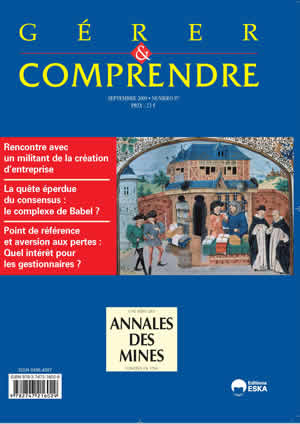
Issue 97
Editorial
By Pascal LEFEBVRE
TESTIFYING
Meeting with an activist founder of firms
Entretien avec Yvon GATTAZ (25 février 2008)
By Bernard COLASSE and Francis PAVÉ
A career running from the founding of the company RADIALL right after WW II till the creation in 1987 of the Comité d’Expansion Économique in Seine-Saint-Denis, not to omit his presidency as of 1981 — shortly after the Socialist, François Mitterrand, came to power — of the the French national employers’ association (Conseil National du Patronat Français)… For more than fifty years now, Yvon Gattaz has tirelessly defended his conception of firms with a human dimension.
OVERLOOKED…
Interactions between regulators and the regulated: Thoughts drawn from a firm classified Seveso II, high threshold
By Michèle DUPRE
Sociologue, MODYS, Lyon Julien ETIENNE
Politologue
CURAPP
Amiens
and Jean-Christophe LE COZE
Ingénieur d'études, INERIS, Verneuil-en-Halatte
The findings of a study on the risk management of major accidents in the French chemical industry are presented. As previous studies have shown, interactions between regulators and the regulated play an active part in deploying risk-prevention measures. However few studies are available about these interactions, apart from the inquiries conducted following accidents.
The vices and virtues of specialized work
By Jean-Louis PEAUCELLE
professeur de sciences de gestion à la retraite
Specialized work is the reference mark of the “good organization” according to Taylor’s principles and Adam Smith’s theories. When examining real situations in the world of production however, we observe that versatility is wanted and organized, not only for humanistic reasons but also in order to meet up to classical requirements of profitability when work flows vary.
TRIAL BY FACT
The shadow cast by the tools of human resource management: The annual interviews to be conducted in a shipping firm
By Lionel HONORE
Professeur des Universités, Sciences Po Rennes
The national agreement of December 2003 makes it obligatory for a firm to propose, every two years, a “progress interview” to its employees with at least two years of seniority. Employee interviews, whether of a “progress” type or for evaluation purposes, were already a current practice in many firms, but not in the shipping firm under consideration. In fact, these interviews are the first modern tool for managing human resources to be used for a special population: officers in the merchant fleet.
IN QUEST OF THEORIES
The desperate quest for a consensus: The Babel complex? A plea for a dissident voice
By Myriam MONLA
Docteur en philosophie, professeur chercheur a Advancia
Is thinking “like a single person” evidence that we are thinking right? The idea of a consensus too often hides conformism while not recognizing personal differences! Might a single way of thinking not hinder the development of talents and innovation?
The point of reference and loss aversion: Of what interest for managers?
By Olivier L’HARIDON
Greg-HEC & Université Paris IV
and Corina PARASCHIV
Greg-HEC & Université Paris V
The concepts of a “point of reference” and “loss aversion” are two essential points in prospect theory, the widest recognized model of individual decision-making in risky situations. How can managers use these ideas to improve their understanding of how both managers and consumers behave?
Mosaics
Why did the creator make economists?
On Pierre Noël Giraud’s La mondialisation, émergences et fragmentations (Éditions Sciences Humaines, 2008).
By Claude Riveline
Crossing the Atlantic in 82 years
On Walter Lippman’s Le public fantôme (1927, translated into French and published by Éditions Demopolis, 2008).
By Francis Ginsbourger
Ethics and ethics…
On Alain Badiou’s L’éthique, essai sur la conscience du mal (Éditions Nous, 2003).
By Michel Villette