
June 2005
abstract
Gérer & Comprendre
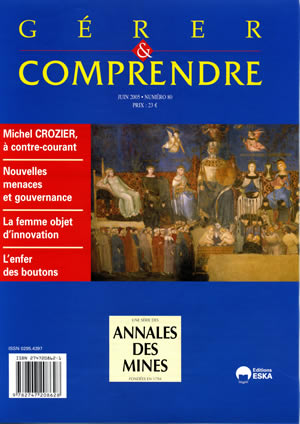
Issue 80
Editorial
By Francis LEFEBVRE
Secrétaire général du Comité de rédaction
TESTIFYING
Michel Crozier, a sociologist in a countercurrent
Propos recueillis par Dominique Vellin, Ecole des Hautes Etudes en Sciences Sociales
Interview with Dominique Vellin
Michel Crozier, 82 years old, has just published the second volume of his memoirs. This provided us with the opportunity for a meeting to ask him about a few special moments in his intellectual itinerary and about his view of the social sciences as they have evolved in France over the last few decades.
OVERLOOKED…
New menaces and governance: Barriers to overcome, paths to open
By Patrick LAGADEC
Directeur de Recherche à l'Ecole Polytechnique
Our times are a period of ruptures in relation to risks and collective security on all fronts: the environment, climate, public health, technology, social trends, geostrategy and violence. The events 11 September haunt our mind; but they do not represent the only threat. We must address these vast, tangled questions, which often seem beyond the scope of thought, in order to protect ourselves, of course, but also, with nobler ambitions, to draw up collective projects in this tormented world where the unintelligible mixes up with the menace of a sudden collapse or a positive, inconceivable rebound. To do this, we have to recognize the new horizons of risks and, above all, overcome the deep, multiform resistance that often blocks our thinking, actions and visions
The paradoxes of “emerging indicators”: The case of forest management in Belgium, France and Luxembourg
By Benoît BERNARD
CITA-FUNDP - Université de Namur
Indicators clarify the objectives to reach and the ways to reach them. They also enable public managers to account for their acts, which user-consumers can then evaluate. However the public utility of “emerging indicators” must be assessed in the light of their paradoxical effects, which might leave a tepid impression about their usefulness for collective actions. The so-called “emerging indicators” draw their force from the delicate course they steer between being opened and closed. They are both unquestioned (so that actions can be pursued) and, nonetheless, questionable (so that actions can change direction).
WHILE READING
Women, the subject of innovation
By Hervé DUMEZ
CRG -Ecole Polytechnique
The theorists of innovation usually talk about computers, automobiles, aeronautics, medicine or biotechnology. Teresa Riordan, a scientific journalist specialized in the study of patents who writes for the New York Times in particular, has taken up the challenge of writing the missing book about innovation in techniques in relation to women and their bodies. The result is a gripping surprise with an original, discrepant view of innovation, of its nature and processes.
OTHER TIMES, OTHER PLACES
The metamorphosis of a public transportation firm in Hanoi
By Docteur Walter Molt
Expert auprès de Hanoï public Transport
Privatization is usually presented as the solution to problems in public transportation. The history of Hanoi Public Transport tells a different story. Take notice, however, that competition with the private sector will be necessary to keep the public enterprise on the road to success.
Mosaics
Globalization in the feminine gender
On Claudie Bert’s S'expatrier en famille.
By Claude Riveline
Management under consideration
On Gilles Garel and Éric Godelier’s (eds.) Enseigner le management: Méthodes, institutions, mondialisation.
By Frédéric Kletz
Communicating in Europe
On Fritz Nies’ (ed.) Europa denkt mehrsprachig [Europe thinks in several languages].
By Dominique Tonneau
OTHER TIMES, OTHER PLACE
FROM THE CONCEPT OF INTERCHAN-GEABILITY TO ITS REALIZATION: Rifles during the 18th and 19th centuries
By Jean-Louis Peaucelle
IAE Université de la Réunion - Laboratoire GREGEOL-FACIREM
The interchangeability of mechanical parts was a keystone in the development of modern industry. It was not put in place till the 19th century, following several innovations. To achieve what initially seemed to be but a supplementary quality required of products, work methods had to be changed; new tools, introduced; new machines, built; hydraulic energy, put to use; strict controls, set up. These transformations affected social relations. Home work disappeared; and polyvalent worker-farmers began specializing. Machine adjustments and maintenance became identified activities performed daily at the workplace, independently of the hierarchy. All these characteristics of modern industry emerged during the quest for interchangeable parts, a story told herein…
TRIAL BY FACT
The push-button inferno: Thoughts about an ordinary man-machine interface
By Christian Morel
Machines — those we use day after day — tell us something. But we poor human beings do not always understand what they are saying. Who is to blame? Is this to be set down to the incomprehensible jargon that engineers taught the machines when they were invented? Or to the ergonomists and designers who pay little heed to our expectations? Or to users’ slight patience with their mechanical servants or, more simply, to the consumer’s intellectual sluggishness? Whatever the explanation, this incommunicability between living and nonliving beings often turns into a nightmare! A push-button inferno is opening its maw in front of us.