
June 2003
abstract
Gérer & Comprendre
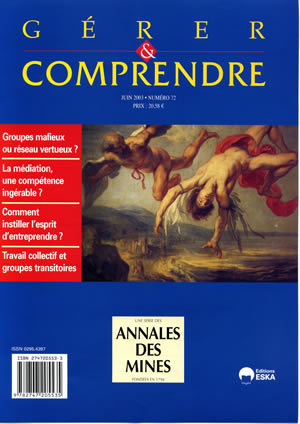
Issue 72
Editorial
By Francis LEFEBVRE
Secrétaire général du Comité de rédaction
OVERLOOKED
Mafia-like groups or a virtuous network ? The fight against corruption in an argentinean company
By Philippe d'Iribarne
Gestion & Société - CNRS
The question of ethics has special pertinence in Argentina, a developed country in the throes of an unprecedented economic recession and a moral crisis. Sapped by corruption, society apparently lacks practical norms that, embodied in morals and the law, can provide it with an acceptable conception of good and evil. Everyone is torn between moral bearings (in particular honesty) and membership in close-knit groups whose relations with nonmembers are governed by the law of silence and a not so scrupulous defense of interests. To sure up its development, a major French firm's local subsidiary has had to try to help its members overcome such inner conflicts and doubts.
TRIAL BY FACT
Mediation, an unmanageable skill ?
By Damien Collard
CRG
For the theorists of organizational learning, the organization is learning when the beliefs, values and ideologies that shape individual and collective cognitive representations come under question and when the organization's members are able to assess the premises underlying their decisions. Tested against reality via a study requested by the French railway system (SNCF) about the effects of the program "New services, young jobs", this theory has encountered evidence of positive repercussions on the organization at the le vels of both various parties' beliefs and managerial practices.
Instill the entrepreneurial spirit in big compagnies and organizations Does it amount to taking a magic potion or drinking a brew of germs ?
By Alain FAYOLLE
Maître de Conférences - CERAG - EPI - INPG - ESISAR
The concept "intrapreneuriate" taps values related to a sense of risk, a sense of responsibility and the willingness to change. It values behaviors such as accepting risks, taking initiatives, assuming responsibility and working on a team. It advocates placing people in specific situations (in-house start-ups, projects, etc.). But who will transmit these values and attitudes? How to prepare persons who want to experience such entrepreneurial situations? How to develop good behaviors coherently without causing ruptures or exclusions ? Nothing can replace an increasing number of meetings and exchanges with those who create companies.
OVERLOOKED
On the difficulty of popularizing in-house a successful pilot project
By Jean-Pierre SEGAL
Gestion & Société
and MOSAICS
Admiring our technological feats and big projects, France's European neighbors are surprised by this modern avant-garde's coexistence with what they see as archaisms. Why do exemplary successes, for which their creators gain admiration and recognition elsewhere, more often arouse sourness and scepticism in the homeland instead of stimulating people to draw inspiration from them? Torn between some employees' deep-seated refusal to discuss the positive aspects of an outstandingly successful pilot project based on the personnel's skills and their ability to implicate themselves to an innovative procedure, the firm under study herein illustrates a situation that the advocates of modernizing "public services" will see as being paradoxical. What are the prospects? Will we, once again, observe a so typically French quirk that leaves people outside the country perplexed ?
Mosaics
Oceano vox
À propos du livre de Richard Henry Dana : « Deux années sur le gaillard d'avant », traduction et présentation de Simon Leys, Paris, Payot & Rivages, collection Petite Bibliothèque Payot / Voyageurs 2002 (637 pages)
By Hervé LAROCHE
ESCP-EAP
L'industrie en quête d'architectes
À propos du livre d'Annabelle Gawer & Michael A. Cusumano : « Platform Leadership : how Intel, Microsoft, and Cisco drive industry innovation », Cambridge, Mass., Harvard Business School Press, 2002
By Blanche SEGRESTIN
ENSMP
L'empire des contremaîtres
À propos du livre de Philippe Lefebvre : « L'invention de la grande entreprise. Travail, hiérarchie, marché (France, fin XVIIe - début XXe) », Presses Universitaires de France - PUF, coll. Sociologies, Paris, 2003 (310 pages)
By Éric GODELIER
École Polytechnique
Rétablir la confiance entre entreprises et investisseurs
À propos du livre de Jean-Yves Léger : « La communication financière : bâtir et mettre en œuvre une stratégie de communication financière », Paris, Éditions DUNOD, mars 2003
By Dominique JACQUET
Paris X Nanterre
WHILE READING
Have you read françois chadeau ? Marcel Dassault's itinerary reviewed
By Michel Villette - ENSIA
During the period between the two World wars, a few major businessmen sprouted who would fully bloom in the 1950s and 1960s, men who have marked capitalism's development in contemporary France. Among these mythical individual success stories are Marcel Bleustein Blanchet, who invented modern advertising, and Sylvain Floirat, who founded UTA and then moved on to the mass media. But one figure unquestionably stands out above all others: Marcel Dassault, the escapee from Buchenwald and pioneer in aeronautics who built an industrial empire and became an atypical politician. François Chadeau retraces Dassault's itinerary in a book that will serve as a reference work on the ecology of firms. A must on our reading lists !
IN QUEST OF THEORIES
What does collective work become in transitory, crosscutting groups ? A simmelian analysis
By Régine Bercot
and Frédéric de Coninck
directeurs d'études, LATTS
Most sociological and ergonomic studies made of cooperation in work have focused on cooperation in stable work teams and among persons who know each other. What to say about the future of such teams and of their way of working together at a time when wage-earners are involved in more and more cross-cutting groups ?