
December 2002
abstract
Gérer & Comprendre
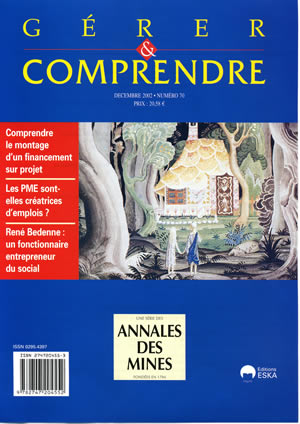
Issue 70
Editorial
By Francis LEFEBVRE
Secrétaire général du Comité de rédaction
OVERLOOKED
Understanding how plans for a European superhighway are funded
By Michel LYONNET du MOUTIER
Professeur associé à Paris X-Nanterre Responsable du module Financement de projet à l'ENPC
The techniques for funding infrastructure projects assign risks to the organizations most capable of managing them, and they normally do this at the lowest cost. They imply a delicate handling of multilateral negotiations, conducted in parallel over several months with a dozen parties in a multinational and multicultural context. The analysis of funding a European superhighway project enables the author — who is involved in this operation — to confirm the analytical grid of the positive theory of agency about a seldom studied form of organization and to validate theoretical hypotheses worked out from this theory’s central postulates.
Are small businesses responsible for the fact that growth does not create many jobs?
By Bernard GIRARD
Consultant associé du Cabinet ASG Conseil
A characteristic of the French economy is that growth creates relatively few jobs. This can be set down to the weight of small and medium sized-firms, which now employ nearly 90% of private-sector wage-earners. These businesses must bear up under strong pressures that stunt their growth and make them want to remain small. Even those firms that do not feel such pressures usually pursue Malthusian policies. This argument runs counter to all the studies that see small firms as the driving force in job creation.
TRIAL BY FACT
Intercultural management, a factor in the success of international acquisitions and mergers?
By Christoph BARMEYER
Maître de Conférences
and Ulrike MAYRHOFER
Maître de Conférences-IECS Strasbourg
Since ever more acquisitions and mergers are taking place in Europe and the world, the process of integrating cultural differences in crossborder operations must be brought under scrutiny. According to studies, many international alliances fail because of cultural differences between partners. The analysis of the integration process implemented by EADS (European Aeronautic Defense and Space Company) shows that intercultural management is a key factor in making international acquisitions and mergers successful.
The surest way to make mistakes in the social sciences
By Michel FREYSSENET
Directeur de Recherche CNRS Co-Directeur du GERPISA, Réseau International
What has happened to our finely hewn theories, which we used to hold and cherish ? Blown in the wind ? theories about the end of work, lean production, the new economy and so many others, already forgotten. Some of them came from Japan; others, from the United States. They were a heyday for smart publishing houses, as well as for white-collar conquistadores and state-of-the-art human resourcers. A few Cassandras grimly talked about people being blind or infatuated, or even about the nonscientific nature of these theories. True enough, they were right !
Management as narrative
By Yves-Frédéric LIVIAN
Professeur, IAE Université Jean Moulin - Lyon III
and MOSAICS
A short introduction to a narratology of human resource management themes ? Once upon a time, there was a perfect firm with a marvelous manager, valiant wage-earners and heroic white-collars. Their exploits were the stuff of the tales of many a noble consultant and communicator. It didn’t matter that the tales gleamed so brightly no one could see through them — words wreakmagic. We rewrite the past for current purposes, we create a fallacious consensus, and in more general terms, we prepare people to accept a social policy. The players in this game (researchers, consultants, practicians) might be interchangeable — this warning signal should not go unheeded.
Mosaics
De la conception comme conversation
À propos de l'ouvrage collectif coordonné par Hervé Dumez « Management de l'innovation, management de la connaissance » (Éditions L'Harmattan, Paris, 2001)
By Stéphanie DAMERON - CREPA
Université Paris-Dauphine
Au service du public
À propos du Livre de Philippe Warin « Les dépanneurs de justice : les "petits fonctionnaires" entre qualité et équité » (L.G.D.J. Collection droit et société 2002)
By Vincent Mangematin
INRA - Université Pierre Mendès-France, Grenoble III
La tête de l'emploi
À propos du livre de Jean-François Amadieu « Le poids des apparences - Beauté, amour et gloire » (Odile Jacob, Paris 2002)
By Hervé Laroche
ESCP-EAP
TESTIFYING
A civil servant and entrepreneur in the social sphere
Entretien avec René BEDENNE
By Frédérique PALLEZ and Francis PAVE
Modernizing the civil service does not just mean adapting structures and procedures to current requirements. Nor does personnel management simply mean career management. René Bedenne understood this early on, when placed in charge of social services at the French Ministry of Finance. Overturning obstacles and upsetting conformism, he started out by creating holiday camps for employees' children. Then, in the middle of a housing crunch, he founded a public housing company in response to the personnel's needs. As a civil servant and an entrepreneur, he broadened his actions by founding ATSCAF, an association for the Ministry in the fields of tourism, sports and culture.