
September 1996
abstract
Gérer & Comprendre
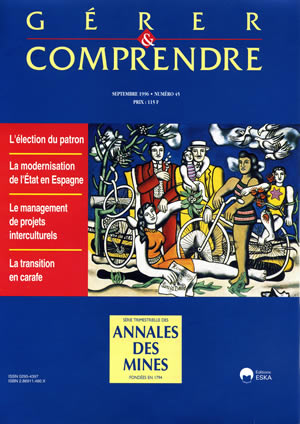
Issue 45
Éditorial
By Pascal LEFEBVRE
TESTIFYING
Electing the boss: A dead end or an example to be followed?
By Jean-Claude Seys
A nearly bankrupt firm, a CEO called to the rescue, a "resigned" board of directors, a threatening takeover bid, unusual ploys to fend of attacks, the savior's triumph following incredible but flawlessly legal maneuvers during electioneering - this could be the script for a fictional film with the title, The president's rodeo! In reality, that was done to put MAAF, a mutual insurance company, back on its feet.
Modernizing the spanish state
Entretien avec Maria José Gomez
By Frédérique Pallez and Francis Pavé
In 1975, General Franco died. Spain staggered up from under the yoke of a long dictatorship. Its future was not clear, its institutions were uncertain. Twenty years later, the country is democratic and solidly European. Its economic development has been called a miracle. To stimulate and support these political and economic changes, the structures of the Spanish state had to be modernized as progress was gradually being made toward an exemplary regional organization.
TRIAL BY FACT
Strategic planning in hospitals: The interplay between resources and requirements
Jeu de ressources, jeu de contraintes
By Annick Valette
A 31 July 1991 act forced hospitals to adapt to their health, demographic and geographical environment and to competition therein. But did the hospital of the 1980s undergo thoroughgoing changes only under pressure from administrative requirements? Did the new law really turn hospitals into strategists? More generally, how does the strategic behavior of organizations in a regulated environment evolve?
Managing intercultural projects: Between the dreamed-of melting pot and the nightmarish tower of babel
Entre le rêve du melting pot et le cauchemar de la tour de Babel
By Sylvie Chevrier
Managing intercultural projects is part of everyday business in big companies. According to the empirical analysis of several international teams, such projects lie somewhere between the dream of a Melting Pot and the nightmare of a Tower of Babel. To lead such projects to success, managers must overcome barriers to intercultural cooperation; but they can also profit from certain advantages.
Mosaics
Knowing everything about public research programs
On La gestion stratégique de la recherche et de la technologie by M. Callon, P. Larédo and P. Mustar
By Vincent Mangematin
Learning to combine expertise and democracy
On Le syndicalisme au futur by J.P. Durand, ed.
By Marie-Hélène Gazeau
Is caution the boss's privilege?
On La stratégie Nestlé by H. Maucher
By Michel Villette
Dignity's wellspring
On Vous serez tous des maîtres, la grande illusion des temps modernes by P. d'Iribarne.
By Michel Berry
Contrasting views of the market: L'inscription sociale du marché by A. Jacob and H. Vérin, eds
By Rachel Beaujolin
LIVE
A letter from norway: About training at ena
À propos d'un stage à l'ENA
By Astrid Forberg-Ryan
Why undergo training at ÉNA (the French National School of Administration) when you are Norwegian? Undoubtedly because the training of the French administrative elite, owing to its prestige, rites and myths, intrigues foreigners. But foreign students do not have an easy time fitting into the logic of the selective exams where, for French students, careers are at stake.
The transition's breakdown
By Godefroy Beauvallet
Despondent barroom philosophers are surprised that bankers in high finance can, from their luxurious offices in the City, decide to rain manna down on eastern European lands without knowing anything about the hardships of everyday life there. What a big mistake! A banker is, nonetheless, a person and, as such, a brother to suffering humanity - as proven by the ERBD's carafes edifying saga.
IN QUEST OF THEORIES
The transactional firm
By Frédéric Fréry
Many and varied studies have been devoted to transactional firms, these intermediate organizations between the market and the hierarchy. Such firms raise questions about the principle of integration. But how have these hybrid structures come into being? How do they operate? What repercussions will they have? Such questions provide highly promising ways to develop management.