
Introduction d'Aurélien PALIX
Culture: a plural industry in its own right facing the challenges of globalization
Back to the cultural industries
By Xavier GREFFE
In this text, we describe the evolution of a concept born from the mediatization of artistic and cultural activities, initially face-to-face, towards creative economy, under-lining how at each stage the underlying economic model has changed (subsidy/sponsorship; price; subscription).
Cultural industries and public policies: a unifying concept, a fruitful ambiguity
By Jean-Baptiste GOURDIN
Directeur général des Médias et des Industries culturelles, ministère de la Culture
The concept of cultural industries was initially developed by critical theories approaches while being absent from the Ministry of Cultural Affairs’ founding decree. It gradually instated itself in public administration and public action, to the extent of becoming an umbrella term for the entreprises in the sector and a status quo in cultural policies. Highlighting the common characteristics shared by actors of the cultural economy, the concept of cultural industries is a new way, both intellectually and operationally, to renew the field of cultural policies. It seeks to go beyond the traditional paths and to develop transversality. The term and the definition remain however full of ambiguities due to its scope, tensions and for the consequences, especially when it is linked to public intervention.
Analysis of the international situation of cultural and creative industries
By Ernesto OTTONE R.
Sous-directeur général pour la culture de l’Unesco
The cultural and creative industries (CCIs) constitute a real lever for the economic development of countries and contribute to promoting the creativity of societies and offering opportunities to imagine new futures. Before giving a global overview of CCIs, it is important to be aware of their heterogeneity with regard to their size, their sector of activity, their geographical location and the governance frameworks in which they evolve. Today, CCIs are undergoing profound transformations that are challenging their development and, for some, their sustainability. The Covid-19 pandemic has shaken the cultural sector through the sanitary measures put in place to slow down the spread of the coronavirus. This crisis has also led to an increase in the weight of digital platforms, with the emergence of alternative cultural practices structurally shaking the value chain of the CCIs, some of which hardly benefit from it. Faced with these challenges, it is essential to work towards the creation of an environment conducive to creativity, artistic innovation and the diversity of cultural expressions, while providing the best possible support to the sector’s digital transition and protecting fundamental freedoms.
Cultural and creative industries: a lever for promoting the cultural exception and the Francophonie
By Gaël de MAISONNEUVE
Délégué aux Affaires francophones au ministère de l’Europe et des Affaires étrangères
Cultural and creative industries contribute significantly to social cohesion and employment of youth and women. The Francophonie plays an essential role in the development of these industries, whose deployment in Africa is hampered by technological obstacles. By prioritizing initiatives that promote the use of new technologies, the main players in the sector support cinema, TV, radio and literature accessible online in the countries of the South, and work to increase the online visibility of French-language cultural content. To this end, the President of the Republic, Emmanuel Macron, has called for projects that will raise the profile of French-language creation: the États généraux du livre en langue française and the World Congress of French-language writers, which were held in September 2021, as well as the opening, in 2022, of the Cité internationale de la langue française at the Château de Villers-Cotterêts.
French cultural industries and the power of influence
By François CHAUBET
Professeur d’histoire contemporaine à Nanterre
French cultural diplomacy, historically built around a policy of language dissemination at the end of the 19th century, has long been reticent in the use of cultural industries, with the exception of book and film industries. The later have indeed benefited from various aids for export or for their protection. The 1980s marked a change in the attitude. The search of a more tangible cultural influence, partly économic, has been affirmed with the creation of the audiovisual attachés within embassies. Around sports tourism or an active policy of museum expansion abroad, french cultural diplomacy tries to combine now culture and economy more harmoniously.
French CCIs to conquer the international market
By Christophe LECOURTIER
Directeur général de Business France
The French cultural and creative industries (CCI) are booming, in France and around the world. Given their own nature and since they contribute to the international influence of our country, they are also a determining factor in the attractiveness and general stimulation of our exports. However, the export potential of these companies suffers from their small size, their low propensity to grow and their still insufficient investment in digital technology. Nevertheless, the entrepreneurial dynamism of the sector, the measures taken by the government and the extension of export support by immersion suggest a renewed boom in our CCIs after the parenthesis of the health crisis.
Cultural industries facing the emergence of digital: focus on certain sectors
Reflections on the cinema’s future facing American streaming platforms
By Jean-François MARY
Membre du collège de l’Autorité de régulation de la communication audiovisuelle et numérique
Can cinema as an aesthetic genre resist the expansion of American streaming platforms around the world? Will the movie theater remain the privileged place in which the seventh art has found a base for its development? There are many uncertainties about the future, but the main issue will be resolved in the coming years.
Video games: a sector in which France is a leader
By Yves GUILLEMOT
Président-directeur général d’Ubisoft
A true social phenomenon, video games are now found in every home in France and touch billions of people around the world. A hybrid and inclusive medium, it creates links between art and technology, and also between people. It can bring together players from around the world in experiences that push the boundaries of creativity and innovation to enrich their lives, ensuring that the time spent in these worlds brings real benefits. This sector creates value over the long term and France has many assets to make its voice heard on the international scene. There are still many technological and societal challenges to be met, together, to fully realize the potential of this industry at the crossroads of entertainment and technology.
The distribution of cultural goods in the digital age
By Denis MOLLAT
Dirige la librairie Mollat
The oldest cultural product, the book, an accessible luxury that has withstood all crises, has nevertheless been facing for a few years now the digital revolution, which is profoundly modifying the economic circuits of distribution, creating new uses among customers. The various periods of confinement have served as a revelation of the strengths and weaknesses of the books’ world. It is because he or she has the means to put technology at his or her service that the bookseller, a key player in the life of the city, will be able to perpetuate his or her business and put his or her irreplaceable knowledge and know-how at its service.
For equal access to books
By Frédéric DUVAL
Directeur général d’Amazon.fr
Online commerce and technological innovation are opportunities for the book industry, and for reading in general. Pitting the distribution channels of cultural goods against each other by overtaxing online sales would widen territorial inequalities in the name of a vain quarrel between the Ancients and the Moderns. Readers and reading would be the big losers.
Staying alive : the new scenes of Live
By Malika SEGUINEAU
Directrice générale du PRODISS
Live performance is faced with the dematerialization of cultural products and shows captation. Online live experiences are proliferating, transforming the link between audiences and culture and creating new uses and expectations. Does ‟screen society” means ‟screen culture”? How does online experience disrupt the fundamentals of live performance, its connection to time, to others, and its outstanding and ephemeral nature? Is the use of digital technology becoming exclusive ‒ or even the norm – as cultural industry is increasingly shifting to platforms? Several ongoing reflections on the matter have been strongly encouraged, and accelerated by the health crisis. Through them, stage actors are engaged in investing new spaces, both physical and digital, while remaining alive.
Digital: an opportunity
The federation and revitalization of the cultural and creative industries in France will require innovation and new technologies
By Thomas COURBE
Directeur général des Entreprises ‒ Ministère de l’Économie, des Finances et de la Relance
The concept of cultural industries can raise some questions. Yet, the diversity of contemporary cultural creation is based on know-how, techniques and new technologies linked to industrial processes. It is also through innovation that dialogue and cooperation among cultural actors will be possible, with important possibilities of synergies. In this perspective, the French government is leading an ambitious action, through the structuring of the cultural industry sector, and the allocation of an unprecedenting amount of public funds in order to support innovation an technologies at the service of French cultural creation and make it a enabler for competitiveness, growth and job creations in France.
Digital technology at the BnF: a global objective
By Laurence ENGEL
Présidente de la Bibliothèque nationale de France
The Bibliothèque nationale de France has been a digital operator for over 25 years. It has mastered every facet of digital technology and exploits its potential to carry out all of its missions – conservation, digitization, entry of digital productions, management of Web heritage, cataloguing, promotion, etc. – leading it to formalize its strategy in a global approach and to update it regularly. As a transversal actor, at the crossroads of all cultural and creative industries, and accustomed to sharing its tools as well as its heritage, it tries to sensitize its partners to a ‟total” vision of a technique that must be mastered in order not to be subjected to it. It is also determined, beyond its resolutely technological orientation, to recall that the physical world is our first destiny.
Perspectives and opportunities for immersive technologies (virtual reality, augmented reality, interactive video mapping) in the cultural sector
By Chloé JARRY and Alexandre ROUX
Lucid Realities
France is one of the most advanced countries in terms of artistic and cultural creation in the immersive realities. French works are presented and awarded in the most important festivals around the world. Cinematographic works, artists’ works, experiences in animation or adaptation of environments or characters from video games, immersive technologies are a new field of cultural creation, at the convergence of many other sectors, and are spreading as much in museums as in the gaming or entertainment sector. Virtual reality is a medium that is taking root in the French cultural landscape and around which a whole ecosystem is emerging. The public authorities have understood this and are banking on this sector, which is at the cutting edge of the cultural and creative industries, to position France as an innovative and creative champion, under the condition that they support training, technical resources and a still fragile network of production companies and studios.
Making culture accessible in all regions through digital technology
By Didier FUSILLIER
Président de l’établissement public du parc et de la Grande halle de La Villette (EPPGHV)
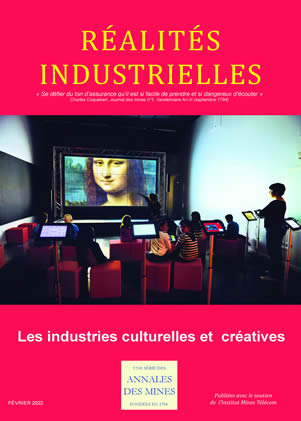
The Micro-Folie program, a true platform at the service of the territories, is a cultural policy device supported by the Ministry of Culture and is coordinated by La Villette in conjunction with twelve founding partners: Center Pompidou, Château de Versailles, Cité de la musique-Philharmonie de Paris, Festival d’Avignon, Institut du Monde Arabe, Louvre, Musée National Picasso-Paris, Musée d’Orsay, Musée du Quai Branly-Jacques Chirac, Opéra National de Paris, Réunion des Musées Nationaux-Grand Palais and Universcience. Each Micro-Folie offers fun and technological cultural content. It can be set up anywhere (in a media library, a village hall, a heritage site, a town hall, a shop, a school, etc.) and its activities, which are free of charge, are aimed at all audiences. As a local cultural network, Micro-Folie helps to animate territories by adapting to their needs, in a warm space offering a multitude of accessible activities.
Training CCI talent: the sum of all challenges?
By Arnaud LACAZE-MASMONTEIL
Enseignant à la direction de la Recherche et de l’Innovation à Gobelins, l’école de l’image
It is not insignificant to conclude this issue focused on CCSI by the topic of training, which is an obvious and essential condition for their dynamism, their future and their sustainability. There are also fertile similarities between CCSI and the field of education, both of which can be described as ‟artisanal-industrial” activities, and are similarly confronted with Baumol’s Law. Training in the creative sectors must therefore meet various challenges, linked more or less closely to these specificities, whether it deals with digital technologies, international strategy, social and cultural diversity, relations with companies or the research area...
Miscellany
Can a mutual bank remain both social and competitive? The case of Crédit populaire du Maroc
By Pr. Rachid M’RABET, Pr. Fouad MACHROUH, Pr. Meriem SEFFAR and Badr FIGUIGUI
Groupe ISCAE
Historically at the service of artisans, small and medium-sized enterprises, Crédit populaire du Maroc, a mutual bank, has been confronted, for several years, with stiff competition and the changing needs of its historical clientele. Like European mutual banks, Crédit populaire du Maroc has been forced to look for new ways to improve its performance and profitability. Thus, the bank is integrating new businesses, developing its financing and investment activities for large companies and becoming a reference player in sub-Saharan Africa. Despite its unique capital structure in Morocco, the banking group has excellent activity and profitability indicators. However, one question remains: has Crédit populaire du Maroc remained true to its original missions of financial inclusion, bankization of the low-income population, financing of small traders and socially responsible banking?