August 2021

Summary

Réalités industrielles

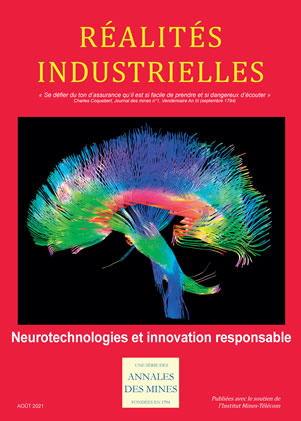
Neurotechnology and responsible innovation

Complete issue
This issue was coordinated
by Françoise ROURE

Introduction de Laure TABOUY et Françoise ROURE

From academic and industrial explorations toward new therapeutic, technical and industrial applications

Neurotechnology at the OECD: The role of the private sector in governance

By David WINICKOFF
Organisation for Economic Cooperation and Development

Emerging neurotechnologies offer significant potential for the promotion of health, well-being, and economy. At the same time, neurotechnology raises issues of (brain) data privacy, the prospects of human enhancement, the regulation and marketing of direct-to-consumer devices, the vulnerability of cognitive patterns for commercial or political manipulation, and further inequalities in use and access. Engaging this challenging terrain, the member countries of the Organisation for Economic Cooperation and Development (OECD) have recently enacted Council Recommendation on Responsible Innovation in Neurotechnology. The Recommendation is the first international instrument in its field. This article discusses the context and content of the Recommendation, highlighting its unique ‟responsible innovation” approach which spotlights the role of the private sector in technology governance.

The convergence of artificial intelligence and neurotechnology: A reality and a desirable future?

By Alexis GÉNIN
Institut du cerveau (ICM)

Big-tech companies and state actors have made neuro-technologies a field of action as strategic as the space race. Indeed, accelerated miniaturization of implantable technologies and the predictive power of artificial intelligence tools are converging to create developments echoing mad sci-fi scenarios. In this context, developers of medical technologies are themselves overtaken by new players for whom the patient is now just another ‟customer” alongside soldiers and busy men craving for performance improvement. Should we follow this techno-centric path and try, with less resources, to mimick United States and China? Or should we really use our deeply rooted biology research and vivid start-up ecosystem to dare to take a different, more efficient path ‒ that of sustainable neuro-technologies?

Learning how to control a brain-computer interface: BrainConquest

By Fabien LOTTE, Aurélien APPRIOU, Camille BENAROCH, Pauline DREYER, Alper ER, Thibaut MONSEIGNE, Léa PILLETTE, Smeety PRAMIJ, Sébastien RIMBERT et Aline ROC
Inria Bordeaux Sud-Ouest, LaBRI (CNRS, Université Bordeaux, Bordeaux INP), Talence

Brain-Computer Interfaces (BCI) are very promising neurotechnologies for numerous applications, that are unfortunately not yet reliable enough. Making them reliable and usable would require improvements not only at the machine level (e.g., algorithms for brain signal analysis) but also at the user level. Indeed, controlling a BCI is a skill that needs to be trained and practiced. Unfortunately, the scientific community still poorly understand how to train that skill effectively and efficiently. This chapter presents the research conducted as part of the BrainConquest project, which specifically aims at understanding, modeling and optimizing this user training in BCI. It notably illustrates the factors that can influence BCI control performances (e.g., users’ personality or their mental states), the type of feedback and training exercises that we can provide to users to train them, or concrete applications that can be achieved following that BCI user training, such as BCI-based assistive technologies control or motor rehabilitation.

Why and how to boost sharing in neuroimagery?

By Michel DOJAT
Directeur de recherche Inserm, Grenoble Institut des neurosciences

Open data and data sharing are of growing importance in our society of digital information. Open data is now a requirement for local communities and local administrations which appears as a commitment of information transparency toward the citizens and may contribute to blast the propagation of bullshit news. For public research and especially in biomedical research, data sharing and data reuse open new perspectives to researchers in term of robustness of published results and production of scientific knowledge. For such an ambitious aim, specific hardware and software platforms should be available to support hard technological constraints to manage and process large mass of heterogenous data under the respect of the ethical and juridical constraints attached to heath data.

Neurotechnology in relation to health, well-being, security and performance

Which strategic brain images could speed up advances in clinical research?

By Jean-François MANGIN
Université Paris-Saclay, CEA, CNRS, Baobab, Neurospin

Brain pathologies are an unparalleled societal problem. Neuroimaging is one of the key components of a personalized medicine for the future, based on the stratification of patients into homogeneous groups, characterized by a signature including typical brain damage. Brain images detect the premise of pathologies at a stage where we can hope to counteract them. They can help clinical research through deep phenotyping, very detailed images contributing to the understanding of pathophysiology, but above all through broad phenotyping, generating the databases that will allow AI to bring out these homogeneous groups. These strategic images will require the mutualization of dedicated infrastructures and eventually the transformation of the clinical imaging park into a large instrument for population monitoring. This transition is similar to the one experienced by the world of physics in the twentieth century.

Neurofeedback: The pervasive development of applications in neurotechnology for managing stress, attention disorders and pain

By Yohan ATTAL
Président de myBrain Technologies

Neuroscientists have made a fundamental discovery: the brain is a plastic organ where connections between neurons are constantly changing. Thanks to neurofeedback, it is now possible to modify the deep structure of brain network dynamics. This revolutionary advancement signals a new era in digital health. Neurofeedback is about to transform the clinical management of mental health and wellness, for example in treating anxiety, ADHD and pain. Neurofeedback allows the user to induce long-term changes in the spontaneous oscillations of the brain without the use of pharmacological components. Many studies, realized under strict protocol with the best scientific standards prove the efficiency of this technique. We will focus on three specific ones: the Melomind for stress management, the Koala for ADHD management and the Beluga for pain management.

Nudge, neurotechnology and neuromarketing: The state of the art and feedback on the an­nounced potentials and their limits

By Éric SINGLER
Directeur général du groupe BVA CEO BVA Nudge Unit

Launched in 2008 with the publication of Richard Thaler and Cass Sunstein’s Nudge: Improving Decisions about Health, Wealth and Happiness , the ‟nudge approach” has spread fast in the world, propelled by a high return on investment (as demonstrated by several experiments). Based on the lessons drawn from behavioral science, it seeks to foster behaviors beneficial to the person and group by using ‟nudges” to propose a set of incentives that respects each person’s freedom of choice. Since the turn of the century, the behavioral and neurobiological sciences have come together into a new discipline ‒ neuroeconomics ‒ for studying the neuronal basis of behaviors and, in particular, better understanding cognitive biases. Findings in these disciplines have been used in ‟neuromarketing” to improve the efficiency of sales campaigns. When laying claim to the power to exercise influence, these approaches raise ethical problems and questions about their limits.

Responsible innovations in neurotechnology: Societal, ethical and legal issues

The task force for a responsible development of neurotechnology in France

By Hervé CHNEIWEISS
Neurobiologiste et neurologue, directeur de recherche au CNRS, directeur du laboratoire Neuroscience Paris Seine ‒ CNRS/Inserm/Sorbonne Université

Because of the central place that our brain occupies in our capacity to be human and to exercise our rights, an ethical and normative reflection has become necessary in view of the rapid development of neurotechnology, devices capable of ‟reading and/or writing” our cerebral activities. The stakes are immense because neurological and psychiatric diseases represent a third of our health expenses and a colossal social burden. In good agreement, public and private investments are also very important and do not seem to be limited in the ambition of their applications to the strict field of health. Well-being is first and foremost targeted, but also the field of work, education or social relations. The OECD has done pioneering work with a ‟soft law” mechanism designed to encourage the responsible development of neurotechnologies in the service of people in the health field, to set out the conditions for their implementation and governance, and to point out the risks. Several reflections and legislative works in progress are already inspired by it.

For a responsible development of neurotechno­logy in France: The task force’s work

By Pascal MAIGNÉ
Ministère de l’Enseignement supérieur, de la Recherche et de l’Innovation (MESRI) et Délégation française au groupe de travail sur les biotechnologies, les nanotechnologies et les technologies convergentes de l’OCDE

Implementation of the OECD recommendation on responsible innovation is, in France, the mandate of a task force representing many stakeholders. The first initiative is to propose to companies in the field to sign a charter for the development of responsible innovation in neurotechnologies which content would be designed with the contribution of all stakeholders. This charter is expected to be used as a dynamic and collective tool beneficial to all. A commitment from private and public actors to respect the right of patients and users to their cognitive freedom and the privacy of their collected data would increase public trust which in turn would favor the development of new economic markets. In addition the task force will pay a particular attention to the other principles of the recommendation such as societal deliberation.

Neuroscience and the law on bioethics

By Claude DELPUECH
Inserm

et Pierre-Henri DUÉE
Comité consultatif national d’éthique pour les sciences de la vie et la santé

None

A simplified ‟vision” transmitted from the skin to the brain: Feedback on the Sixth Sense

By Amaury BUGUET et Rémi DU CHALARD
Artha France

In the 70s, a researcher by the name of Paul Bach-y- Rita brought to light the principle of sensory substitution, according to which the brain can replace one sense by another. This is made possible by neural plasticity, which allows the brain’s neurons to reconfigure themselves through learning. His research led him to imagine a device for the blind, whose goal was to replace sight with touch using a matrix of pins that could draw images captured by a camera on the skin. In 2018, the 6th Sense project started again from this research in order to develop a device with a similar concept, but more advanced and portable thanks to scientific advances since then. It has resulted in the creation of three successive prototypes and blind testers are already able to move around town with the latest one. The project is about to lead to a first final version and hopes to release it at the end of the year.

Is neurotechnology dualistic?

By Bernard POULAIN
Directeur de recherche au CNRS, chercheur en neurobiologie à l’Institut des neurosciences cellulaires et intégratives de Strasbourg

Neurotechnology can register or modify activities in the brain for the purpose of research or therapy. Other applications seek to improve our well-being, make us experience strong sensations, reinforce learning processes or raise our performance. New applications are being made so fast that not enough time is taken to inquire into their ethical aspects, their utility, and the unjustified risks stemming from them for the health, safety, autonomy and freedom of human beings. This is a matter of the uses, right or wrong, of these applications, whence questions about the potential duality of neurotechnology…

The epistemological questions raised by neuro-science and innovations in neurotechnology

By Dr. Françoise ROURE
Chercheur associé au Laboratoire CETCOPRA, Université de Paris 1 Panthéon-Sorbonne Présidente de la section Sécurité et Risques du Conseil général de l’Économie

The neurosciences and new applications in neurotechnology are undergoing unprecedented growth owing to the convergence of biotechnology, information technology (augmented by artificial intelligence) and nanotechnology. Corresponding to this growth is a strong demand for medical devices and for commercial applications. This opportunity for health and well-being lays the grounds, however, for a threat against our conception of neuro-ethics. The epistemological questions raised by neurotechnology must be formulated so as to respect the individual’s mental integrity, the very condition for human dignity and autonomy. The emergence of responsible innovations in this domain will depend on the quality of the answers made to these questions.

The ethical and legal issues raised by research in neurotechnology and for neuroscientists, firms and society

By Laure TABOUY
Université de Paris Saclay ‒ Espace éthique de l’APHP, Faculté de médecine, Paris Digital & Ethics Biotech, Paris

None

The complete issue

Version
française

Retour en haut