
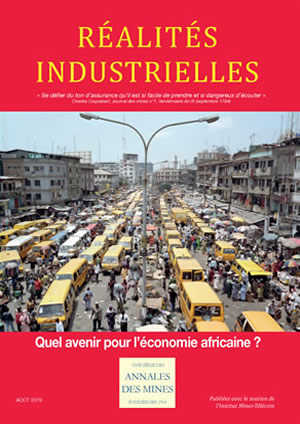
Préface : L’Afrique a repris sa place dans le monde et dessine désormais sa propre voie vers l’émergence
By Rémy RIOUX
Director of Agence Française de Développement (AFD)
Introduction
By Dr. Françoise ROURE
Conseil général de l’Économie
The industrialization of Africa requires a continental approach in association with local entrepreneurs
By Mario PEZZINI
OECD
and Arthur MINSAT
Head of the Africa Unit
Policies for industrializing Africa must take advantage of changes under way on the continent. Major challenges are massive job creation and accelerated industrialization. The obstacles could be lifted that most entrepreneurs have to overcome if policies were adapted for boosting the development of skills in response to labor market needs, backing the clustering of firms and improving the access of, in particular, small and medium-sized companies to suitable financing. Deepening existing partnerships would reinforce capacities, transfer know-how and facilitate funding tied to the continent’s development.
Industry and innovation: For structural change and sustainable local development in Africa
By Dr. Mafini DOSSO
Economist and political scientist, European Commission, Centre Commun de Recherche (CCR/JRC)
The major problems and opportunities of industry and innovation for sustainable development in Africa are pointed out. To cope with the challenges of globalization and pressures on resources, this continent has many possibilities for a structural change and a local development spurred by innovation. Despite contrasting national experiences, manufacturing has had difficulty attaining a critical mass: its part in adding value to the production chain is still not very visible. At the local level, public and private initiatives are evidence of a determination to reinforce local innovation and production. With regard to strategic integration, new approaches to local development, such as strategies for “smart specialization”, open toward the local construction of unique competitive advantages.
1 - A takeoff of industry in Africa?
How entrepreneurs and investors can help unlock Africa’s economic future
By Cathia LAWSON-HALL
Société Générale
and Acha LEKE
McKinsey Afrique
Africa is a 1.2 billion person market on the cusp of transformative growth. It is adopting technology at a furious pace, and entrepreneurial energy pulses throughout the continent. It already has more big companies than you would imagine ‒ and room for many more. Yet Africa still faces serious challenges. Although incomes are rising, poverty remains widespread. Businesses must contend with infrastructure gaps, fragmented markets, and regulatory complexity. To translate Africa’s opportunities into profitable, sustainable enterprises, executives need to reset their mental maps ‒ recasting challenges as a spur for innovation and unmet market demand as room for growth. One key initiative that will help them do so is the France-Nigeria Investment Club, launched by President Emmanuel Macron in 2018. The Club’s priorities include fostering better understanding and cooperation between the two countries and their business communities, creating business opportunities, and triggering co-investment projects ‒ not just in Nigeria but across Africa.
Between illusions and hopes, an emergent Africa?
By François GIOVALUCCHI
Institut d’Études Avancées in Nantes
and Boris SAMUEL
Institut de recherche pour le développement – Centre d’études en sciences sociales sur les mondes africain, américain et asiatique
After several false starts since independence, Africa is entering a new phase of growth that does not sufficiently involve industrialization and the modernization of agriculture. This growth, its extent open to question, relies too much on an unsustainable level of debt. It will neither enable the continent to catch up with the most advanced countries nor, given the incomplete demographic transition, stop the number of poor people from rising. The hopes placed in a development based on services, Chinese investments, or strong authorities for undertaking modernization should not keep us from taking notice of rising inequality (national and regional) or new forms of domination ‒ potentially laden with future crises.
Issues of peace and development: How can the Sahel break out of the poverty trap?
By Jean-Marc CHÂTAIGNER
Ambassador, special envoy for the Sahel
and Clémence CHEVALIER
Intern, Direction d’Afrique et de l’Océan Indien, MEAE
Helping the Sahel break out of the poverty trap where it is now caught is very complex, involving several conditions that are hard to satisfy together. There is no turnkey solution. The Sahel, which lies in the eye of a deep, multifaceted crisis with endogenous and exogenous origins, must face several challenges in the coming years. Solutions have to be worked out together, along with the international community, which has to provide considerable means for containing the crisis. Decisions cannot, however, be made about these solutions without involving the principal countries concerned, since they alone have a real knowledge of complexity in the field and of the specific characteristics of this crisis. Only in the framework of balanced economic relations between G5 Sahel and partner countries is there hope for an eventual economic development of this region.
Renewable energy: Solar power in Africa, in particular in Benin
By Henri BOYÉ
Consultant on energy and electrification
and Joël AKOWANOU
Operations director, MCA Benin II
For a continent handicapped by a shortage of electricity, developing energy from renewable sources, in particular solar power, holds promises of progress. It leads to original solutions, such as solar power stations, mininetworks and individual solar kits for a poor, dispersed population.
2 - Economic and social development
The electrification of Africa: A technical or social policy?
By Lionel ZINSOU
Former prime minister of Benin
Three paradoxes (in many ways unique in history) characterize public policies of electrification in Africa. They refer to aspects of social reality that must be taken into account. Beyond technical progress and the availability of funding, which is increasing, we must deal with these aspects so that the whole population can have access to electricity… the work of at least another generation.
Responsible supply chains in minerals in the African Great Lakes region: What initiatives for what progress?
By Louis MARÉCHAL
Responsible Business Conduct Unit, OECD
Whether due to industry or small-scale production, the extraction of minerals and trade in these resources represent a significant share of the economy of countries in the Great Lakes region in central Africa. For nearly twenty years now, the international community and countries in the region have multiplied efforts for seeing to it that this production and trade do not fund conflicts or violate human rights. In association with the private sector and civil society, and with the backing of the Organization of Economic Cooperation and Development, the International Conference on the Great Lakes has adopted a set of measures for more accountability in the mineral trade. Several problems still exist even though progress has undeniably been made in making actors aware and mobilizing them, rolling out initiatives from the private sector to oversee small-scale production and tightening controls over prospecting. These problems can be solved only through stronger involvement by all countries in the region and with the support of the countries that import minerals from central Africa.
What prospects by 2050 for agriculture and food security in Africa south of the Sahara?
By Marie DE LATTRE-GASQUET and Thierry GIORDANO
CIRAD
The supply of nutritional food in Africa south of the Sahara has considerably deteriorated in recent years. Economic, social, environmental and political trends are looming with major risks for food systems on the continent. Several scenarios of possible trends in agriculture are described along with their effects on land use (in particular, the surface area under cultivation), trade and food security. These scenarios have been worked out by plausibly and coherently combining hypotheses about the determinants that affect trends in agriculture, namely: the global context (population, policies, social innovations, state of the economy) climate change, food systems, herding and farming systems, and rural-urban interactions. Reinforcing the security of a nutritional food supply will be possible only by switching from approaches based on a sector or industry to systemic approaches. A necessary transformation of food systems requires strong coordination among stakeholders and the adoption of public policies for following up on these changes.
The digital transition in Africa and its impact on job creation: The risks of a Ninja generation?
By Alain DUCASS
Engineer from the Corps des Mines, president director of EnergeTIC
The digital transition reaches much farther than the question of “What future for Africa’s economy?” The much bigger problem is often overlooked: “What future for the world economy?” Analyzing the future of the African and word economies depends on the time scale used and external events: How fast will global warming and climate-related migrations occur? How will populations react to an increasingly unequal distribution of wealth? When and how big will the next financial crisis be? In the long run, Africa has undeniable assets: a young population, virgin lands, arable zones, a zest for life… But in the short run, the situation is far from brilliant, as shown by most indicators, especially those related to demography, economics, digital technology or employment. A few points are made from two viewpoints: that of someone who has been in the field in Africa since the creation of a consulting firm and that of an economist who has just spent four months at the headquarters of the African Development Bank in Abidjan working on an aspect of this bank’s digital strategy.
The Global South eHealth Observatory’s objectives and results: Opportunities for digital technology in the transformation of health systems in Africa
By Béatrice GARRETTE
Pierre Fabre Foundation
The global adoption of digital technology, including by the poorest people in low-income countries, presents a genuine opportunity for reducing inequality in the field of health. Though promising, solutions have to be regulated and harmonized in order to change scales and to be lasting. The Global South eHealth Observatory, a Pierre Fabre Foundation initiative, has been set up to understand, analyze, share and encourage innovations in e-health for the poor. By placing operatives and decision-makers in a network and finding the right scale for initiatives with a strong potential, the Observatory seeks to provide leverage for the development of e-health, in particular by training personnel and sharing information, two keys to new public health models.
Water Integrity to close financing gaps in Africa
By Teun BASTEMEIJER
Currently senior advisor with the Water Integrity Network and steering committee member of the OECD Water Governance Initiative
In 2015, the combination of the adoption of the SDGs and the Paris agreement on climate change gave a positive impulse to building transformative capacities around the globe. Only few years later, the World Economic Forum’s Global Risks Report 2019 wonders if the world is sleepwalking into a crisis. In Africa competition to gain control of land, water and mineral resources is increasingly fierce and rent-seeking by political figures, global corporations, endowment funds continues under conditions of impunity. In Africa, a reputation of high risks and poor sector performance across the board is associated with poor governance and lack of strong and accountable institutions causes a considerable investment gap. Closing that gap could be fast as soon as there are sufficient positive indications of improving sector performance. OECD principles for water governance and the Water Integrity Global Outlook with various concepts, lessons learned and integrity tools form a good initial basis to design strategies and projects to improve sector performance and gain trust. Evidence of emerging good governance and integrity practices to can help build trust and engagement among different stakeholders and make the African water sector more attractive for investors and help to close the investment gap.
Feeding Africa through increased intra-African food trade
By Alan DOSS
President, Kofi Annan Foundation
One of the most pressing challenges in Africa is how to eradicate hunger and extreme poverty and ensure prosperity for all people. This article argues that intra-African food trade can be an important driver in strengthening Africa’s capacity to ensure food security, as well as for its economic growth and shared prosperity. While the creation of the African Continental Free Trade Area is a critical step forward, the roll out of the implementation will be just as important. This article is looking at some of the key challenges and opportunities for intra-African food market integration. It specifically argues that the Regional Economic Communities (RECs) can and should play a particularly important role in Africa’s effort to build a strong intra-Africa food market. They are the institutions that can develop and implement programmes aimed at increasing agricultural production and productivity, help integrate smallholders in regional value chains, spearhead research on major food crops and help develop regional food industries.
Corporate social responsibility in Africa
By Thierry TÉNÉ
Director, Afrique RSE
According to ISO standard 26000, corporate social responsibility means taking account of the impact of a corporation’s decisions and actions on the environment and society. It involves adopting a code of conduct. In concrete terms, this responsibility hinges on seven key questions: governance, human rights, labor relations and working conditions, the environment, fair operating practices, community involvement and development, and consumer issues.
Feedback from twinning experiences between the EU and counties in North Africa
By Richard LAVERGNE and Dr. Françoise ROURE
Conseil général de l’Économie (CGE)
The European Union finances twinning arrangements between the public administrations of its member states and, in particular, countries in the Mediterranean Basin. This policy instrument for international cooperation sustains close working contacts between civil servants and experts, thus adding to their experience and helping them better understand the policies to be implemented. Two examples of twinning with Algeria and Morocco are presented in which the Conseil Général de l’Économie has been closely involved since 2015.
New initiatives from civil society for the management of resources in Africa
By Pr. Peter EIGEN
Founder of Transparency International, former president of Extractive Industries Transparency Initiative (EITI) and cofounder of Humboldt-Viadrina Governance Platform
Among the many initiatives launched by NGOs in Africa, several programs are based on a multiparty dialog between a government, firms and civil society organizations, on the model of what Transparency International and then the Extractive Industries Transparency Initiative (EITI) have backed and are still backing. Promising programs in fishing and electrification follow this model, which the Africa Progress Panel is defending at a high level.