
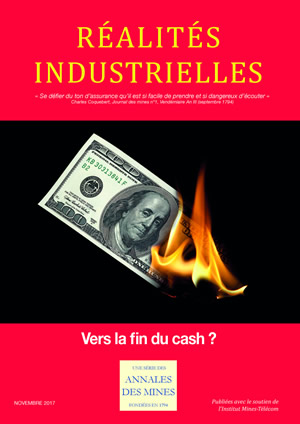
Introduction
By Rémi STEINER
General engineer from the Corps des Mines, Financial Services, Conseil Général de l’Économie
1 - Fiat money and public policies
How the Riksbank encourages innovation in the retail payments market
By Cecilia SKINGSLEY
Deputy Governor Sveriges Riksbank
Sweden is a low cash society on the verge of becoming a very, very low cash society. Decreasing cash usage is, of course, mirrored in increasing use of electronic payments. The Swedish Central Bank managed to construct a scheme where the fast payments are backed by central bank money. Today, over half of the Swedish population have downloaded the fast payments app (Swish) on their smart phone and it has become a prominent feature in the retail payment landscape, providing a substitute for cash in person to person (P2P) payments.
Dare make a prediction about money?
By Thierry GAUDIN
Honorary engineer from the Corps des Mines, Prospective 2100
Since money is a technique, and techniques evolve while changing society, we must inquire into its technical nature and long history in relation to societal changes. Starting from the postulate that money depends on trust and that trust evolves, facts are drawn from this long history to help us understand, independently of official doctrines, how the relation between money and society functions. Quite clearly, contemporary “dematerialization” is deeply altering this relation, and it is not at all evident that this change is under control. The risk of a collapse seems to exist, as in 14th century Europe. Are complementary forms of money ‒ multiplying through a sort of “uberization” ‒ capable of filling money’s functions?
Forbidding cash payments: A few legal and historical remarks
By Myriam ROUSSILLE
Agrégé professor in law schools, professor at Mans University
Have we come to the end of cash payments in France? The coming years will tell. For the time being, one thing is for sure: paying bills in cash has never been a major social practice in France. This situation is not simply evidence that the French are not fond of cash. It is also, perhaps above all, the result of deliberate actions by authorities who, for decades now, have used regulations to orient our payment patterns. One reason why the ranking of means of payment in France stands apart has to do with such legal considerations. Of course, the specific characteristics of the country’s banking system are also a likely reason for this situation.
Pieces of a history of money: French particularisms, appearances and reality
By Patrice BAUBEAU
Associate professor in contemporary economic history, Paris-Nanterre University, & researcher, Laboratoire Institutions et Dynamiques Historiques de l’Économie et de la Société (IDHES)
To identify a phenomenon’s specific characteristics, we usually have to evoke an implicit or explicit norm, a model, an average of observed cases. But in the case of money, the norm is so prevalent we tend to pass off as a “particularism” an ordinary phenomenon that calls for an unconventional view on the facts of the case. Four examples are presented of a legacy of French particularisms: the presumed effects of the so-called “fiduciary trauma” in the 18th century, the lasting attraction of gold and silver, the persistence of outdated forms of money, and the French “preference” for payment by checks. By bringing to light ambiguities and paradoxes, these examples show that these particularisms are accidental; but the accidents have lasted and gradually become structural characteristics.
New means of payment, avatars of fiat money: New risk factors in the fight against money laundering and the financing of terrorism
By Bruno DALLES
Director of Tracfin Service, French Ministry of the Budget, Public Accounts and Civil Service
The acceleration of the digital revolution and the development of new means of payment (some with known risks) create serious problems for investigating money laundering and financially tracking terrorism. Under the terrorist menace, French lawmakers tightened the rules for electronic money in 2016, in particular for prepaid smartcards. Regulations should be tightened further to hold new payment service providers liable. The European passport and the liberalization of services have weakened the power of regulatory authorities to oversee these new businesses. The lack of an international harmonization of the measures necessary for fighting against money laundering limits the effectiveness of such actions, even though certain businesses with operations in Europe are dubious.
Is digital money disruptive for central banks?
By Laurent CLERC
Director of Financial Stability, Bank of France
Used for a very low percentage of transactions, digital money is not currently a danger for monetary policy or financial stability. But its growth is spectacular. By combining new forms of money and new payment systems, it could soon prove to be “disruptive” for the banking system and central banks. To cope with this trend, central banks might eventually issue their own forms of digital money. The arrangements for doing so are under discussion. Most of them imply the extinction of fractional-reserve banking and, eventually, of cash and bank deposits ‒ with major consequences for the creation of money.
Digital Base Money: a few considerations from a central bank’s perspective
By Yves MERSCH
European Central Bank
There are many ways to design Digital Base Money (DBM) for non-banks. The different options have potential impacts – both positive and negative – that need to be studied and considered carefully. Only when the best way of designing DBM has been identified, can a decision be made as to whether DBM of non-banks should be introduced at all. The most important question for the European Central Bank is whether introducing a DBM would affect our ability to honor our mandate to maintain price stability.
The future of paper money
By Gilles VAYSSET
Managing director of Services to the Economy and of the Network, Bank of France
In spite of the steady growth of payments by debit or credit cards and of the diffusion of innovative electronic (contactless, mobile, instant) means of payment, the circulation of paper money is still rising in most developed countries. This paradox is but apparent. According to several studies and estimates, the percentage of paper money held for transactions represents a small part of the paper money in circulation. There are several motivations for holding paper money (ease of use, availability, security, a necessity for persons who cannot open a bank account, confidentiality…) and several uses for it (transactions, hoarding, international demand…). Even though pressure from digital payment services will probably lessen the use of paper money in the middle or long run, the latter’s function as a store of value and the confidence in it will probably still be two mighty reasons why people will continue holding paper money in the coming years.
Vulnerable groups: Feedback from a program of La Banque Postale on the access to opening a bank account
By Didier BRUNE
Director of Strategy and Development, La Banque Postale
Like all other banking establishments, La Banque Postale, has seen customers deserting its offices, as they conduct most of their everyday operations via smartphones and gradually reduce the use of cash. Given the availability of post offices, especially in underprivileged neighborhoods on the periphery of urban areas, and the decision to equip all windows open to the public with the possibility for cash transactions, the French postal bank is still serving nearly three million persons who continue to perform cash operations from their accounts. One explanation for this is that nearly two thirds of the people living in these neighborhoods are unable to use digital devices for even simple transactions. Although the problem of persons “excluded” from the banking system is often seen from the angle of income, it might be more relevant to see it as a matter of practices ‒ an exclusion related to the use of digital technology (now becoming a major cause of “social exclusion”). When imagining a time when cash will no longer be in use, La Banque Postale thinks in terms of the human and technical infrastructure to be maintained so that these groups not be excluded from the banking system. What is an acceptable cost for this maintenance?
2 - Market maneuvers
Instant payments, a substitute for cash?
By Rémi STEINER
General engineer from the Corps des Mines, Financial Services, Conseil Général de l’Économie
Payment services in the United Kingdom have undergone a thoroughgoing change. British consumers and firms were long used to antiquated, second-rate payment services, to waiting at least three days for a payment to be executed. Over the past decade, they have become accustomed to nearly instant bank transfers and to a burgeoning offer of new services. Meanwhile, the payment industry in the eurozone was busy meeting the objective of lifting national borders, which hampered transactions. Since 1 August 2014, a bank transfer or debit is executed in the same conditions whether the payer and beneficiary are both in France or whether one of them is in another eurozone land. With a time lag of a few years compared with the United Kingdom, Instant Payment could soon (as early as November 2017) upend habits and vested positions on the continent.
The Instant Payment revolution: Who are the players?
By Jean-Marie VALLÉE
CEO, STET
November 2017 signals the roll-out of a new payment service. Under Instant Payment, a bank transfer of an amount initially set at €15,000 euros can be made right away to and from accounts. The money will be available on the beneficiary’s account in less than ten seconds. It will be possible to make an Instant Payment 24 hours a day, seven days a week, every day of the year. For the first time in the Single Euro Payments Area (SEPA), banking institutions will be executing transactions nearly in real time. In other words, the payer’s account will be immediately debited; and a few seconds later, the beneficiary’s account, credited. Instant Payment entails several changes in interbanking systems for the purpose of managing: the flow of payments, interbank liquidities and the “availability” of the systems involved. Instant Payment is being launched in a context where practices in the payment industry are undergoing major changes owing to the widespread use of smartphones. This new tool will spread and harmonize instant payments throughout Europe while boosting the growth of cross-border business transactions in the SEPA zone. For this purpose, the European Payments Council (EPC) has drawn up regulations for rolling out Instant Payment; the rule book was published in November 2016. However stakeholders have room to determine the needs and requirements specific to their market segments.
Instant payments, a social phenomenon in a changing world
By Thierry LABORDE
Assistant general manager & head of Domestic Markets, BNP Paribas
Instant Payment takes on full meaning in a context where instantaneousness is the standard for consumers. Banks must respond to this context. The characteristics and uses of this new payment service are described along with trends in Europe and the world. An approach is proposed to the development of Instant Payment in France.
Toward a world without banks?
By Hugues LE BRET
Chair of the board of Financière des Paiements Électroniques (FPE), founder of Compte Nickel
Banks are powerful. They have stable customer bases and high incomes. Their financial statements often exceed the GDP of their country of residence. They adapted to the Internet revolution during the first decade of the 21st. century. However the underway digital revolution runs much deeper, affecting everyone’s behavior patterns. Fintech is a provocative new word formed by contracting finance and technology. Fintech firms already account for 10% of the funding of start-ups worldwide. This situation has a strong impact on payments, data, and new banking and investment services, not to mention managerial tools or the security of transactions.
Orange Bank, the first telecombank
By Jean-Bernard MATEU
Director of Banque Mobile Europe, Orange
In an environment fully changing from the viewpoint of banks, customers or technology, Orange Group has decided to launch a natively mobile bank with an incomparable user experience. For this, Orange benefits from a combination of unique assets, its key to success: a trade name that strongly reflects key values such as security and reliability, a solid distribution network, a financial base and, above all, the confidence of 28 million customers. Evidence of its legitimacy in financial services is the success of Orange Money (a payment service mainly offered in Africa) and the successful launching of Orange Finanse (in Poland). For Orange Group, this new business is a natural extension of its telecommunications activities. A business model for inventory management will serve to build a durable, profit-making business.
Making in-store payment enjoyable by adopting mobile payment
By Gwarlann DE KERVILER and Nathalie T. M. DEMOULIN
IESEG
The increasing penetration rate of smartphones changes behaviors based on mobile unique features. Our research provides a first attempt to better understand the adoption of in-store smartphone usage to enhance a brick-and-mortar experience. More particularly, it focuses on proximity mobile payment (p-m-payment), which corresponds to a recent tendency of shoppers to finalize the transaction through their smartphone while they shop in a store. Using a perceived value approach, this paper identifies utilitarian, hedonic and social benefits as well as financial and privacy risks as key drivers of adoption for p-m-payment. A comparison between the drivers of this new in-store mobile usage and the ones for more familiar tasks such as mobile information search, highlight clear differences in what drives intention, as shoppers are more experienced with the latter. The paper discusses the implications for mobile and channel researches and provides suggestions for retailers to facilitate and take advantage of p-m-payment.
3 - Miscellany
The “London whale” in shallow waters: JP Morgan and the organizational debacle in 2012
By François VALÉRIAN
General engineer from the Corps des Mines, Conseil Général de l’Économie, adjunct professor of Finance, Conservatoire National des Arts et Métiers (CNAM)
The affair involving the so-called “London whale” cost the American bank, JPMorgan Chase, more than six billion dollars. US Senate hearings provide a sound source of documentation on this affair. They also shed light on the errors committed by an organization that believed it had implemented an innovative, profitable strategy for covering risky transactions whereas it was running serious, poorly evaluated risks.