
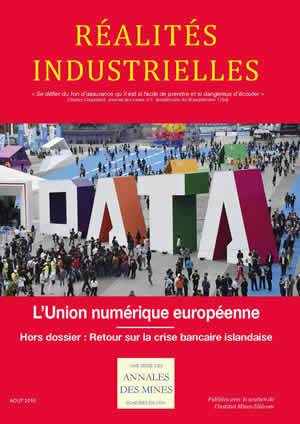
Foreword
By Andrus ANSIP
Vice-president of the European Commission in charge of a Single Digital Market
and Günther Hermann OETTINGER
European Commissioner on the Digital Economy and Society
Introduction
By Jean-Pierre DARDAYROL
Engineer from École des Mines, Conseil général de l’Économie
Visions of a digital Europe
The Digital Single Market: The viewpoint of a Polish data-mining firm that collects and analyzes personal data from consumers in central Europe
By Éric SALVAT
Axia Digital
The EU Digital Single Market has to find an answer: how will improving transparency and the protection of consumers’ personal information allow the firms that own and process data to create value from their digital assets? What do corporations expect? How will individuals see their wealth and personal estates increase in worth owing to new methods for creating value from personal data? What do they expect from all this?
Towards a geopolitics of data
By Thierry BERTHIER
Associate professor in mathematics, researcher, Chair of Cyberdefense and Cybersecurity, Saint-Cyr-Thales-Sogeti
and Olivier KEMPF
Ph.D. in political science and associate researcher at the Institut de Relations Internationales et Stratégiques (IRIS)
Some pundits present data as a resource, whereas others see it as the prelude to a new currency. The Internet of objects will foreseeably multiply the volume of data in comparison with what we now know. Data will undoubtedly become the key element, economically and politically, in our societies. As this succinct description shows, this trend mainly arises out of private parties’ actions, since public authorities (in France and Europe) seem powerless before this new driving force. Although data are becoming the key instrument of power, we still lack an analytic grid for measuring a nation’s power in terms of its digital data.
The European Internet: Common interests and EU law
By Pierre BONIS
Association française pour le nommage Internet en coopération (AFNIC)
The history of the Internet’s growth on the continent since the mid-1990s attests that Europe has never managed to assert itself as an economic and political power in this new industry. The endless debate between demand- and supply-side policies has, with respect to the development of a European Internet, turned into an opposition between, on the one side, those who advocate an approach mainly based on stimulating competition for the immediate benefit of consumers and, on the other side, those who want the EU to better protect its industry and create the conditions for the emergence of European champions in digital technology. At international meetings, this European hesitancy is evinced by the disagreement between a “northern” bloc, very close to American propositions, and a “southern” one, in favor of a specifically European approach.
The European Digital Union: The potential impact of the EU’s ELDAS Regulation on Euro-African transactions
By Alain DUCASS
International expert for the digital transformation of Africa
Having scarcely received attention in France, EU Regulation No. 910/2014 of 23 July 2014 on “electronic identification and trust services for electronic transactions in the Internal market” makes a big step toward a Digital Single Market in Europe, in particular toward an electronic administration. Although it mainly concerns exchanges between citizens and EU member states, this regulation might also help develop transactions between Europe and Africa.
Which policies?
The digital economy, a challenge for competition-based policies
By Edmond BARANES
University of Montpellier
and Andreea COSNITA-LANGLAIS
University of Paris Ouest Nanterre
Beyond any doubt, the digital economy is upending the organization of markets and operation of the economy. By turning amateurs into professionals via service platforms and confronting traditional economic sectors with new business models, digital technology has generated teeming, complicated ecosystems. What characterizes these firms is that they usually operate in bi- or multifaceted markets, i.e., they position themselves as middlemen between various categories of customers or users. Based on drawing profit from crossing the effects related to these various categories, their business models thus produce sometimes surprising practices that contrast with the usual conclusions drawn from competition-based policies.
The “double jeopardy” of vulnerable populations faced with pervasive digital technology
By Élodie ALBEROLA, Patricia CROUTTE and Sandra HOIBIAN
CREDOC
The strategy of a Digital Single Market in the European Union holds potential for improving living conditions, in terms of both consumption (more purchasing power, access to a broader supply of products and services) and the offer of public services (efficiency, fluid procedures, savings, etc.). But as the example of France shows, a quite real issue in a country that ranks well in digital technology (equipment and uses), is the inclusion of vulnerable segments of the population (the elderly, disabled, chronically ill, recipients of public assistance, inhabitants of rural areas) so that they are not left along the side of the digital highway. Personalized assistance is apparently indispensable for relieving these social and individual difficulties.
The Digital Single Market and regulation of personal data
By Catherine BARREAU
Professor of corporate law at the School of Law and Political Science, University of Rennes I
In 2015, the European Commission issued sixteen proposals for installing a Digital Single Market. According to several pundits, this market contains a hidden treasure, namely personal data, which firms tap for commercial purposes. Data on individuals’ private lives have a special legal status in the EU and member states: they are protected like a fundamental human right. For a long time, a mere directive set the framework, but in the spring of 2016, a specific regulation was adopted. Will it prove capable of creating the hoped-for balance between the protection of fundamental freedoms (especially with regard to consumers’ private lives in a digital economy) and the demands from firms for flexibility and simplicity? This new regulation should be uniformly applied throughout the EU’s domestic market, but it leaves room for member states. This has aroused concern about a “renationalization” of procedures for protecting personal data that would impede the realization of a Digital Single Market.
How to regulate digital platforms in Europe?
By Winston MAXWELL
Associate attorney at Hogan Lovells
and Thierry PÉNARD
Professor of economics at the University of Rennes I
The success of digital platforms, which play a role both constructive and destructive in certain sectors of the economy, has aroused societal, political and economic concerns. In Europe as in France, the question of regulating platforms is on the agenda. Though recognizing the problems stemming from powerful organizations like Google, Amazon or Facebook, this article shows that regulation would encounter several difficulties, both economic and legal. Given the digital marketplace’s instability and its strong potential for technological and societal innovation, attention is drawn to the cost and inefficiency of interventions against these websites. A pragmatic approach based on existing law is preferable as a remedy for the shortcomings of these digital platforms, especially in emerging markets. The European Commission has advocated this cautious approach, and the OECD has formulated it as a methodology in Better Regulation in Europe.
How to regulate platforms?
By Sébastien SORIANO
Chairman of the Autorité de Régulation des Communications Électroniques et des Postes (ARCEP)
Owing to its philosophy of total decentralization, the Web (2.0 or even 3.0) has conquered the world and is now centered around a few giants. Thanks to their formidably efficient models of “disintermediation” (or rather “re-intermediation”), platforms are now the masters of the digital economy. The stakes are so high that a form of regulation is to be worked out. Given the world market and accelerated innovations in the digital economy, the cost of poorly designed regulations would be very high. This article explores new, agile and co-constructed, forms of regulation. Regulation is necessary for confidence to reign in this new business, which is laying the ground for tomorrow’s economy.
The Europe of digital security: Very legalistic, hardly technological and insufficiently economic
By Nicolas ARPAGIAN
Scientific director of Digital Security at the Institut National des Hautes Études de la Sécurité et de la Justice (INHESJ)
Although Europe claims, rightly so, to have a knowledge-based economy and solid resources for creating economic value, it is not at all in the lead on digital security. Most of what it produces in this domain is texts (EU directives and regulations) that impose obligations for the security of the information industry’s infrastructure. Since the 28 member states have not managed to create the conditions for a global player in cybersecurity to emerge, the fight against cybercriminality is mainly being undertaken by national police forces. The EU Agency for Network and Information Security (ENISA) is still struggling to obtain sustainable financing for the coming years. Since member states are using digital technology to defend their own strategic interests (the security of their vital operators, economic or diplomatic intelligence, etc.), they are reluctant to endow Europe with the integrated, effective tools for making it count in dealings with the big powers in the digital world, namely; the United States, China and Russia.
Higher education’s contribution to the building of Europe
By Yves POILANE
Director Télécom ParisTech
Now that Europe no longer seems to be taken for granted by its peoples and member states, neither economically, socially nor culturally, what assessment can be made of the two major driving forces in the construction of a “European higher education area”, namely: the Bologna Process (1999) and the Erasmus Program (launched nearly thirty years ago, in 1987)? What if these programs turned out to be the principal contributors to the building of Europe?
The EU’s Digital Single Market and French health policy
By Aymeric BUTHION
Direction générale des Entreprises (DGE), Ministry of the Economy, Industry and Digital Technology
Given the ageing of the French population, the rising number of chronic illnesses and the “medical desert” in certain areas in France, a public health imperative is to provide care in a different way. This is also an economic imperative for the country, since its spending on health is growing so fast. The national health system is changing under the brunt of the digital revolution. Beyond the computerization of medical establishments or of patients’ records, digital technology allows for developing new services in all fields in the chain of value in the health business: the well-being, information, prevention, care and follow up of patients. Developing an e-health industry should now be a priority for France. The country has everything needed to succeed. Not only must several impediments be overcome in institutional and regulatory matters, but also obstacles must be lifted to the adoption of new practices by both patients and health professionals. As is often the case with information technology, the success of the changes under way hinges on the adoption of new practices by the largest number of people possible.
Miscellany
The Icelandic financial crisis and self-fulfilling prophecies: The chronicles of a predicted bankruptcy (2006-2008)
By François VALÉRIAN
Conseil général de l’Économie, associate professor of finance at the Conservatoire national des Arts et Métiers (CNAM), member of the Laboratoire d’excellence en régulation Finance (Labex ReFi)
The meltdown of the three major Icelandic banks in the autumn of 2008 has been set down to phenomena as varied as: bloated assets in financial statements, an “adventuresome” deregulation, the lack of supervision, the banks' poor governance, weak ethics, a macroeconomic disequilibrium and the absence of international cooperation. As a study of more than a hundred reports issued between the start of 2006 and the summer of 2008 by commercial banks, credit-rating agencies and public organizations shows, this banking system began melting thirty months before its collapse owing to a process of stigmatization. A circular argument based on analyses of the risks related to sovereign debt and of those related to the banking system laid the grounds for a self-fulfilling prophecy that would ultimately deter the banks’ efforts to refinance or reimburse their debts. Similar research could be conducted on other situations where opinions about the risks of failing sparked a crisis…