
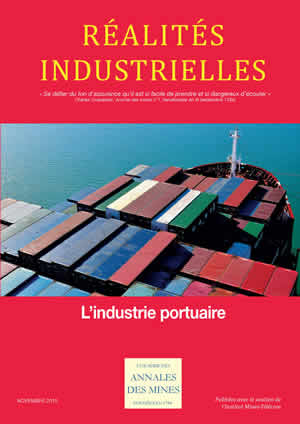
Foreword : Une ambition forte pour les ports français
By Alain VIDALIES
Secrétaire d’État chargé des Transports, de la Mer et de la Pêche
Introduction : L’avenir nous est ouvert
By Serge CATOIRE
Conseil général de l’Économie
1 – Geography, infrastructures and the environment
What place for French ports in new international maritime connections?
By Raymond VIDIL
Président d’Armateurs de France
The port reform, launched in 2008, has brought together in HAROPA three ports that used to be rivals: Le Havre, Rouen and Paris. HAROPA, now the fifth group of ports in northern Europe, manages 120 million metric tons of merchandise per year. France’s strategy for an integrated port policy seeks purposes to develop French ports and make them competitive. The ten principal ports in the world handled 4,9 billion tons of freight in 2012. What will be the position of French ports as the planet’s big ports handle ever more traffic? What levers can be used to make them more competitive and reposition France on the map of major maritime routes? This strategic issue will have major consequences on the economic and social situation in France.
The interministerial delegation for the development of the Seine river valley
By François PHILIZOT
Préfet, Délégué interministériel au Développement de la vallée de la Seine
The axis of the Seine River is now the top-ranking port and maritime complex in France. Given the stiff competition between seaports in the area stretching from Manche Department to the North Sea, this axis has not yet been optimally developed along an east-west corridor running from the Parisian Basin to the center of Europe. For several years now, the French government has intervened to reinforce cooperation between ports and set up an integrated system of logistics, which is of prime importance, especially in Upper Normandy. The first step was to create HAROPA, which associates the ports of Le Havre, Rouen and Paris. The central government along with the regions of Île-de-France and Upper and Lower Normandy is drafting a strategic plan for the Seine with widely shared, long-term orientations. The contract for an interregional plan signed on 25 June 2015 provides for a coordinated programming of investments in infrastructures and boosts coordination and efforts to improve logistics.
What prospects for Marseille, the Mediterranean’s top-ranking port in the 20th century?
By Christine CABAU-WOEHREL
Présidente du directoire du Grand port maritime de Marseille
As an interface between the hinterland and the rest of the world, seaports lie at the center of the economic, political and social history of relations between geographical entities. Given structural changes in the world economy, how can the position of the Marseille-Fos port, at the interface between Europe and the rest of the planet, help it remain a leader in the Mediterranean and reinforce its position as a “global port” indispensable for freight and passenger traffic? The 20th century’s business model based on the specialization in a dominant industry has seen better days. A new model based on clusters of businesses that, capable of cohabitation in a single territory, use efficient infrastructures to work out competitive solutions in the quest for added value.
African ports: Modernization on the march
By Olivier de NORAY
Directeur des Ports et Terminaux, Bolloré Africa Logistics
Widening the Suez Canal; developing a transshipment platform of a global size in Tangiers; building new container terminals in Abidjan, Tema, Lagos, Kribi and Mombasa; modernizing the ports in Pointe-Noire, Conakry, Lomé and Cotonou; all these are a few examples, among the most significant, for demonstrating the extraordinary growth in the maritime and port industries in Africa. In less than ten years, the continent is rapidly coming up to international standards. This spectacular modernization reflects not only the African economy’s dynamic growth over the past decade but also the awareness that an efficient port system is a necessity for joining in the globalization trend and benefitting from its positive effects on development. After analyzing needs in the port industry and describing this first phase of modernization, attention is turned to the port industry’s prospects in Africa for the coming years.
Singapore, a maritime barycenter in southeastern Asia
By Vanessa BONNET
Direction générale du Trésor, ministère des Finances et des Comptes publics – Ministère de l’Économie, de l’Industrie et du Numérique
The region covered by the Association of Southeast Asian Nations is now an unavoidable crossroads for maritime traffic: about 15 % of international container shipments, and eight of the fifty largest seaports in the world. In this strongly growing region, Singapore, located in the middle of the Strait of Malacca, is like a barycenter of maritime transportation - now the planet’s second hub port (after Shanghai but far ahead of Shenzhen and Hong Kong). The city-state’s port handles in a month as much container traffic as the port of Le Havre in a year. Shipping strategies in ASEAN countries, in particular Malaysia and Indonesia, stimulate a strong but still positive competition inside the region. Ports in the strategic Strait of Malacca are modernizing to maintain their regional leadership and world rank.
2 - Technology
Port industries
By Mathilde GOUGEON
Ingénieur des travaux publics de l'État, chef de projet pour la mise en œuvre de la Stratégie nationale portuaire, au bureau de l’Analyse économique des transports fluviaux, maritimes et des ports (DGITMMEDDE)
and Marc SANDRIN
Sous-directeur des Ports et du Transport fluvial (DGITM-MEDDE)
The French port system has been deeply affected by the 2008 reform, which has refocused major seaports on their functions as promoters and organizers of the port, its premises and facilities. Their geographical position makes port zones the cornerstones of the country’s industrial development. Their vocation is to become centers where industries and businesses in shipping will set up operations. Port authorities must work toward this objective in their 2014-2019 strategic plans, which are part of a national port strategy. Mainly based on heavy industry (petroleum, iron and steel, etc.), the business model of ports is being reoriented toward the concept of a platform, as historic clients take back seat to strategic industries in logistics and the circular economy. As gates of entry to the hinterland and as zones concentrating traffic, ports, when well endowed with real estate, have room for a significant share of national production in manufacturing and energy.
Shipping cereals toward the Rouen port: The results of a collective, efficient organization of human means
By Gilles KINDELBERGER
Directeur général de Sénalia
During the 2014-2015 season, Sénalia, a union of cooperatives, loaded 4.150.000 metric tons of grain on vessels with a tonnage ranging from 3.000 to 60.000. The loading rate was 3000 tonnes per hour, at three loading docks. Shipping by truck represented 64 %, by train nearly 12 %, and by barge a little more than 24 %. Sénalia is well equipped to load and unload cereals: up to 750.000 tons a month. It accounts for more than 54 % of the grain loaded in the Rouen port. Its goal is to combine its regular, “background” logistics with a “reactive” logistics for handling unplanned orders. Sénalia’s operations are special owing to it being a grouping of cooperatives and its management of storage capacity. Furthermore, it must maintain the ongoing dialog indispensable for organizing logistics with members and private transit firms.
Railroads and ports: A coherent system for handling freight
By Sylvie CHARLES
Directrice générale du Transport ferroviaire et multimodal de marchandises de SNCF Logistics
Built to handle handling masses of merchandise, ports tend to favor rail services for hauling freight (as well as shipping by river or sea for short hauls). Cooperation between ports and the railway industry comes “naturally”, the situation of the one having an impact on the other, and vice-versa. For this situation to be profitable, a reciprocal understanding of each other’s needs and positions is necessary to reinforce cooperation between ports and rail services. This cooperation should extend farther, opening to all players in the railway industry, in particular those who manage the country’s infrastructure.
Liquefied natural gas, a maritime fuel: Initiatives for the energy transition now under way
By Julien BURDEAU
Directeur de l’Innovation de Gaztransport & Technigaz (GTT)
Usually considered to be a simple means for easily transporting natural gas over long distances, liquefied natural gas is rapidly gaining ground as a new maritime fuel. As it seeks to reduce its emissions of pollution and greenhouse gases, the maritime transportation industry is preferring this alternative to liquid petroleum fuels because of its low cost and environmental advantages. Developing this new fuel for maritime and river shipping runs up against several difficulties that, to be solved, call for, among other things, setting up a new supply chain - in which Gaztransport & Technigaz (GTT) wants to find its place.
At the core of new chains of businesses for recycling wastes: Ports
By Juliette CERCEAU
Chercheure associée, UMR PACTE
Guillaume JUNQUA
Maître Assistant HDR, École des mines d’Alès
Miguel LOPEZ-FERBER
Professeur, École des mines d’Alès
and Nicolas MAT
Chercheur Doctorant, École des mines d’Alès
The transition toward a circular economy raises more than one question for ports, given their role in the importation of raw materials. Practices for recycling and reusing wastes, as they become widespread, might reduce the demand for raw materials while opening opportunities for new businesses involved in collecting and treating wastes. Port zones will become major players in the economics of secondary raw materials, as they now are in the economics of natural resources. The strategies to be implemented to assist this trend will condition the potential place of ports in this new market.
3 – The human organization
From the 2008 port reform to HAROPA: A fresh start for French ports
By Hervé MARTEL
Président du Directoire du Grand port maritime du Havre et Président de l’Union des Ports de France
Embracing the widely shared view that French ports were losing their competitive edge, the reform of 4 July 2008 proposed a business model for making ports more apt to cope with the competitive international situation. HAROPA was created as an association of three ports: Le Havre, Rouen and Paris. Beyond the traditional assignment of managing port facilities, it seeks to promote a customer-oriented approach for improving the range of services necessary for developing industrial and logistic activities along the Seine axis. Despite an unfavorable economic situation, a momentum, still tentative, has started. Structural trends force us to reconsider the means for consolidating recovery in this major sector of the national economy.
The influence of plans of protection against technological risks on port zones: The example of Montoir-de-Bretagne and of Elengy’s methane terminal
By Alain GOY
(E 76) Responsable du Service technique, ELENGY, filiale de ENGIE
Drafting a plan of protection against technological risks (PPRT) in a port zone entails a range of activities: risk analysis, a master zoning plan, plans for loading facilities, studies of flows, etc. The PPRT do not overlook terminals for stocking methane. Given modifications in regulations, these plans can now focus on guaranteeing the economic performance of ports and the industries installed there. After a description of methane terminals, the changes made by ELENGY to improve safety in its plants are discussed, along with the PPRT for the port at Montoir-de-Bretagne, near Saint-Nazaire.
Dunkerque : Reconverting port zones
By Christophe HUSSER
Chef du pôle Développement durable à la direction de l'Aménagement et de l'Environnement du Grand port maritime de Dunkerque
and Stéphane RAISON
Président du Directoire du Grand port maritime de Dunkerque
Dunkerque and its port have long entertained an ambivalent relationship. As a market town and point of contention between the English, French and Flemish, Dunkerque’s development was hampered for military reasons. After its near destruction in 1945, its reconstruction and the “thirty glorious years” of post-war growth left a lasting imprint on the city’s industrial landscape: the urbanization of polder farmlands and the “artificialization” of half of the coast in North Department. Recession during the 1980s left gigantic industrial wastelands, and severed the port zone from the rest of the urban area. Reconverting these abandoned areas has brought local and port authorities together. Despite the unfavorable economic situation, a durable partnership between the port and city and experiments in urbanism have opened perspectives for a sustainable, environmentally friendly development of the port zone and its industry, and for opening this zone toward the surrounding area and its inhabitants.
Imports and exports: Controlling quality
By Didier MICHAUD-DANIEL
Directeur général de Bureau Veritas
Ports have many facets: business, logistics, customs, border controls, storage…. Given that 90 % of world trade takes to the sea, ports have a key role in fluidifying international transactions. Bureau Veritas tests, inspects and certifies merchandise, thus facilitating transactions between loaders, traders, shippers and customs in ports worldwide. Under the impact of globalization, controls (such as consignment based conformity assessment) have been developed in recent years, along with exchanges of information (port community systems) for handling transactions and detecting dangerous or counterfeit merchandise.
Adapting customs clearance procedures to the globalization of trade
By Jean-Michel THILLIER
Chef de service, adjoint à la directrice générale des Douanes et Droits indirects
Customs has to cope with several, sometimes contradictory, demands stemming from the globalization of trade. International supply chains must be secured and effectively controlled in a context where the pressure to facilitate lawful transactions is increasing. Customs has a unique position since it is the only agency overseeing the movement of merchandise across the European Union’s exterior borders. All this has set off a deep (still unfinished) change in the conditions for clearing merchandise through customs, an act entailing closer interactions with all parties. These strategic trends in customs clearance are a factor in the attractiveness of France and its logistic platforms.