
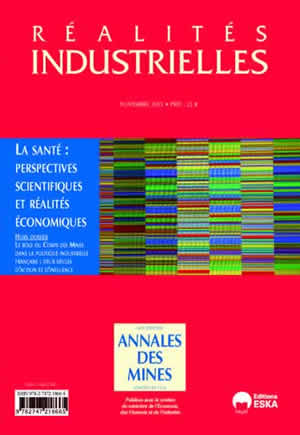
Editorial
By Pierre COUVEINNHES
Rédacteur en chef des Annales des Mines
Foreword
By Jacques N. BIOT
Président-directeur général de JNB-Développement SA
The state of the art in rare diseases
By Professeur Alain FISCHER
Unité d’Immunologie et d’Hématologie Pédiatriques, Unité INSERM 768 « Développement normal et pathologique du système immunitaire », Institut IMAGINE
Rare pathologies represent “extreme phenotypes” that, by helping us understand physiological mechanisms and physiopathologies, can be useful for designing treatments for more common illnesses. Such opportunities explain why research in therapy benefits from revitalizing the collaboration between academia and industry so as to produce spectacular industrial successes and, above all, a significant improvement for patients under treatment.
The safety of medication
By Lamiae GRIMALDI-BENSOUDA
Professeure associée, Cnam, Hygiène et Sécurité, et LA-SER
Jérôme SALOMON
Professeur associé, Cnam, Hygiène et Sécurité, et Institut Pasteur
Mounia N HOCINE
Maître de conférence, Cnam, Hygiène et Sécurité
Laura TEMIME
Maître de conférence, Cnam, Hygiène et Sécurité
and William DAB
Professeur, Cnam, Hygiène et Sécurité
Medication, along with the assessment of related risks, is relatively independent from policy-making in public health. It stems from specific decision-making processes and institutions. The conditions for studying the effects of drugs during clinical trials are quite different from the real conditions under which the medication will be used. Given this context, monitoring these processes is important, and must attain maximal reliability, whence several methodological problems. Among the various methods for assessing risks in large populations, pharmacoepidemiology provides an approach even though it was initially limited to studying the spread of infectious diseases.
Financing health-care systems
Beveridge and Bismarck reconciled?
By Gérard de POUVOURVILLE
(X70) - Professeur titulaire de la Chaire Systèmes de Santé, ESSEC
Welfare systems are usually classified in two major categories: the social insurance (or Bismarckian) model and the national (or Beveridgian) model. These models share two characteristics: the universality of the coverage offered and, given that they are compulsory, the principle that funding is based on the insuree’s contributive ability and not on the estimated level of risk. However they differ owing to the underlying tax base: the first relies on earned income alone whereas the second draws taxes from all sources of income. They also differ with respect to governance: the social insurance model involves management by organizations under the oversight of public authorities whereas the national model entails state management. Created by order in 1945, the French welfare state has, as it evolved, increasingly shifted toward a Beveridgian rationale with the state exercising ever more control over the three-party system of management set up after World War II.
Financing the production of care
By Philippe SAUVAGE
Directeur économique et financier, Assistance Publique Hôpitaux de Paris
Health expenditures often account for more than 10% of the GDP in wealthy lands. Socializing these expenditures is inevitable insofar as the amount to be spent on care overshoots what an individual is able to pay. Public expenditures on the health-care system have increased so much that they must be regulated, especially given the economic downturn. This calls for a collective effort to improve both our understanding and control of the health-care system. However this new governance cannot reach beyond a hard-toachieve balance between factors related to care and to management.
The economics of medication worldwide
By Christian LAJOUX
Président du LEEM (Les Entreprises du Médicament)
Although the major portion of sales in the pharmaceutical industry still comes from developed countries, the margin of growth has now shifted to emerging nations and the mass production of generic drugs. To win in this new game, the pharmaceutical companies in developed lands must wager on innovation by developing highly specialized drugs and biotechnological medication. The future holds promises for a made-to-measure medicine, the right dose administered at the right time — a medication adapted to each pathology and patient.
Research in the life sciences
The organization of the life and health sciences in France
By Professeur André SYROTA
Président-directeur général de l’Inserm
To understand the issues related to the organization of the life and health sciences in France, we must bear in mind three majors trends during the past decades. These trends have to do with the production of knowledge, public health and the economic dimension of research.
Funding charities or associations
By le Professeur Alice DAUTRY
Directrice générale de l’Institut Pasteur
and Sylvain COUDON
Directeur de la communication et du mécénat, Institut Pasteur
Since its foundation on 14 November 1888, the Pasteur Institute, a nonprofit organization recognized as serving the public interest, has always benefitted from the generosity of donors, famous or anonymous. They have supported this foundation during all phases of its development and the expansion of its scope of research. This generosity was initially due to individuals, and it took the form of donations or bequests. Now, it is increasingly due to firms who provide funds under legal arrangements regarding corporate sponsorship.
Miscellany
The role of the mining engineer corps in French industrial policy: Two centuries of action and influence
By Christian STOFFAËS
Ingénieur général des Mines, Président de l’Institut d’Histoire de l’Industrie
Created under the monarchy and instituted by the French Revolution, the corps of mining engineers has maintained itself despite fluctuations, and played an active part in defining France’s industrial policy during all phases of economic development and all changes of regime that the country has undergone: from the Encyclopedists to the tenants of Saint Simon, from reconstruction to “grand projects” (nuclear deterrence, the quest for independence in matters of energy, ÉdF’s program for producing electricity from the atom, etc.). There has, down through history, been a constant in these actions: the belief in the value of technological progress and industrialization. Given the current financial meltdown, industrial policy is no longer a forbidden topic. It is coming back onto the agenda. This return to the real economy is, in its wake, rehabilitating the role of mining engineers in line with the actions of their illustrious predecessors.