
Editorial
By Pierre COUVEINHES
Rédacteur en chef des Annales des Mines
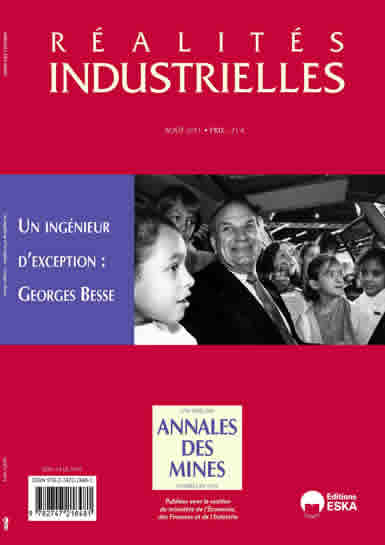
Foreword : Un ingénieur d’exception : Georges BESSE
By Jacques Alexandre MOATTI
Ingénieur général des Mines, Président de la SABIX
1 - A sketched portrait
Brève chronologie
Brève chronologie Georges BESSE (1927-1986)
The youth of an alumnus of École Polytechnique
By Christian MARBACH
X 56, Membre de l’Académie des technologies, membre du conseil de surveillance de Lagardère SCA, président d’honneur de la Sabix
This is the story of a child, one coming from a humble background, talented, intelligent, with support for his education, who passed the admissions examination for École Polytechnique. This itinerary might, quite rightly, be said to be a French destiny. Yes, a French destiny… a very fine itinerary that, in France, is not all that exceptional with regard to the first twenty years of education. We notice similarities at the start of careers between Georges Besse and several other “Polytechnicians” with the same pattern: humble family origins; the discovery by an educational system that is capable of detecting and evaluating the outstanding qualities in a child; parents who were initially reluctant in the face of the unknown but then proudly allowed their son to pursue his schooling once they learned that École Polytechnique, which dispenses an education for free, represents both the certainty of a fine trade and opportunities oriented toward serving the national community.
A personality!
By Christian MARBACH
X 56, Membre de l’Académie des technologies, membre du conseil de surveillance de Lagardère SCA, président d’honneur de la Sabix
After having led readers along Georges Besse’s educational itinerary, a portrait is sketched before turning in the third part to his managerial methods. In the second part of this triptych, the portrait is drawn with modesty. Pieces of information gleaned from various sources are put together with the requisite caution. After all, Georges Besse was discreet. Like us all, he evolved: the most assertive personalities change with the passing of the years and of tribulations…
Management according to Georges BESSE
By Christian MARBACH
X 56, Membre de l’Académie des technologies, membre du conseil de surveillance de Lagardère SCA, président d’honneur de la Sabix
When the time came to choose a title for this article, I wondered what words to choose. The reason the French title uses “management”, a Franglais word, instead of its French equivalents gestion, direction (vague) or commandement (too military) is to associate the concept of gestion, which implies qualities of organization, with that of leadership (English, once again!), which implies authority, decision-making, presence and charisma. Readers will come upon these various aspects in these pages and be able, in turn, to answer the question that we can ask about all top executives: what sort of manager was Georges Besse?
He arrives at PUK: Read the papers!
By Christian MARBACH
X 56, Membre de l’Académie des technologies, membre du conseil de surveillance de Lagardère SCA, président d’honneur de la Sabix
This text was written upon reading a file containing all the articles that came out in the press during the week following the appointments made by the government in 1982 of the future chief executive officers of recently nationalized firms. This is an exercise with compulsory figures: write a historical text by using only the articles of that particular week to sketch a portrait of Georges Besse as seen in newspapers at the time. Obviously, this procedure has not been literally applied. I know too much about the persons involved and the events to be able to fade into the background behind what the journalists wrote. Nor can I forget, while writing, what persons asked in other circumstances had to say about the Georges Besse of that time. Nor have I forgotten what happened later. A historian, even a nonprofessional one, has an advantage over the journalists of 1982: he knows what happened afterwards! I have tried to clearly indicate (through the typesetting) what is to be attributed to journalists and what is commentary.
He arrives at Renault: Read the papers!
By Christian MARBACH
X 56, Membre de l’Académie des technologies, membre du conseil de surveillance de Lagardère SCA, président d’honneur de la Sabix
The preceding article, written from reports in the press during the week following Georges Besse’s appointment, focused on his arrival at Pechiney Ugine Kuhlmann. In summary, journalists presented Besse, during this week, as a man fully adapted to the job at PUK both owing to his experience and qualifications and given the activities of the company to be restructured. The debate about the purpose of nationalizations was not over in February 1982, and certain newspapers did not fail to criticize the principle. All that did not keep them, however, from pointing out that, things being the way they were and since the chairman at the time did not want to remain in that position after the nationalization, Besse was a very good choice for PUK. Besse’s arrival at Renault took place in quite different circumstances…
2 - Testimonials
Georges BESSE, a lesson for the future?
By Raymond H. LÉVY
X46, président d’honneur de Renault, vice-président honoraire du conseil général des Mines
After the assassination of Georges Besse, Raymond Lévy was his successor at Renault. He draws the lessons from the life and actions of an exceptional personality, of, more simply, a “man” in the strong sense of this word.
The current relevance of Georges Besse’s example
By Luc OURSEL
Président du Directoire d'AREVA
AREVA has named its new plant for uranium enrichment after Georges Besse, one of the major figures in France’s nuclear program. This new plant uses the most advanced technology (such as centrifugation). It is in line with an approach to sustainable development.
Georges Besse, a great engineer, a great company director, a great public servant
By François de WISSOCQ
Ingénieur général des Mines honoraire
François de Wissocq, who succeeded Georges Besse as chairman of COGEMA, wrote in 1993 an account of his predecessor’s career. This account mainly, and understandably, dealt with Besse in the nuclear industry, where he spent most of his career. This is the industry that François de Wissocq came to know through his positions in services of the ministries responsible for Industry and Energy, and then in COGEMA. Since Christian Marbach’s articles do not focus on this period, it is worthwhile providing readers of this special issue with de Wissocq’s view. This contribution can be supplemented with testimonies about the period since 1994 or even with texts from the archives.
Deux portraits de Georges BESSE
- IN MEMORIAM : GEORGES BESSE (1927-1986)
- Extrait du livre un homme de notre siècle
Ingénieur général des Mines honoraire, Membre de l’académie des technologies, Président des Futuribles International
3 - Appendix
Georges BESSE, le bicentenaire de l'X et le bicentenaire du corps des mines
By Christian MARBACH
X 56, Membre de l’Académie des technologies, membre du conseil de surveillance de Lagardère SCA, président d’honneur de la Sabix
The Georges Besse Foundation
The Georges Besse Foundation was founded in 1987 by firms and by persons close to Besse, after the latter’s assassination. Its objective is to support young people who want to become engineers but have major monetary problems. Support is granted after examination of a candidate’s record and an individual interview conducted by a selection committee.
La SABIX
Sources utilisées
Miscellany
A synopsis of the roundtable “Quelle politique industrielle pour la France dans l’Europe?” presided by Christian Marbach on 18 November 2010 during the colloquium “200 ans d’histoire du corps des Mines”
By Franck LIRZIN
Ingénieur des Mines, Adjoint du responsable du pôle Entreprises Emploi et Economie de la direction régionale des entreprises de la concurrence, de la consommation du travail et de l’emploi (DIRECCTE) de Provence-Alpes-Côte d’Azur
and Ludovic WEBER
Ingénieur des Mines, directeur de cabinet du directeur général de la Compétitivité, de l’Industrie et des Services, ministère de l’Economie, des Finances et de l’Industrie
The year 2010 was marked by the bicentennial of the decree of 18 November 1810 that organized the “Imperial corps of mining engineers” and created the Conseil Général des Mines (CGM), from which the Conseil Général de l’Industrie, de l’Énergie et des Technologies (CGIET) stems. To celebrate this bicentennial, CGIET organized several exhibitions and events throughout the year with a forward- or backward-looking perspective. The grand finale was the closing colloquium held at Bercy in Paris on 18 November 2010, presided by Christine Lagarde, minister of the Economy, Finances and Industry. The third of the three roundtables organized for this occasion was chaired by Christian Marbach, a member of the Académie des Technologies, and facilitated by Jean-Marc Sylvestre, an economic journalist. It dealt with the question of the industrial policy for France in Europe. In introduction, there were audiovisual presentations by Bernard Esambert, Raymond H. Levy, Lionel Stoléru and Gérard Théry. Franck Lirzin and Ludovic Weber then presented a synopsis of papers written by young engineers from École des Mines. Discussions included interventions by industrialists and experts: Vivek Badrinath (executive director of Orange Business Services), Pierre Gattaz (president of the board at Radiall and president of Groupe des Fédérations Industrielles), Yvon Jacob (representing the Ministry of Industry), Patrick Kron (CEO of Alstom), Vincent Rigal (chairman of Solar Performance et Développement) and Nicolas Véron (economist at Bruegel).