
Editorial
By Pierre COUVEINHES
Foreword
By Christian STOFFAËS
Ingénieur général des mines, CGIET
and Xavier DALLOZ
Directeur de Xavier Dalloz Consulting et représentant en Europe du Consumer Electronic Show (CES)
I. A diagnosis for moving beyond of the crisis
Les causes véritables du chômage
By Maurice ALLAIS
Professeur honoraire à l’Ecole Nationale Supérieure des Mines de Paris – Prix Nobel d’économie
Retour aux fondamentaux
By Marcel BOITEUX
Président d’honneur d’EDF, membre de l’Institut EDF
Pour des ingénieurs socio-économistes
By Claude MARTINAND
Vice-président du Conseil général de l’Ecologie et du Développement durable, MEEDDM – CGEDD
Envie d'aventures
By Francis MER
Président directeur général de Safran, ancien ministre de l’Economie et des Finances
II. Economists talk…
Manifesto for the real economy: How are economists responsible for the current crisis?
By Christian STOFFAËS
Ingénieur général des mines, CGIET
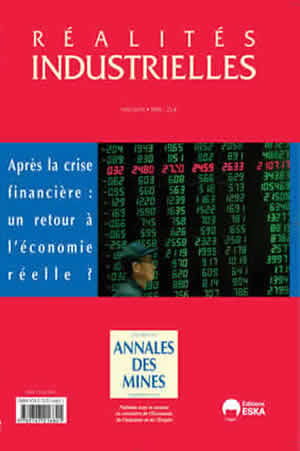
Associated with the liberal-monetarist revolution, economists provided, through the efficient market hypothesis, the intellectual framework for justifying financial deregulation, which pumped up an uncontrolled bubble of credit-backed speculation. The foreseeable happened: the bubble burst, thus causing the current “crisis” and concomitant recession. Since the efficient market hypothesis has collapsed — thirty years after the fall of the Marxist and Keynesian paradigms — what conception of the real economy should we turn to?
Putting an end to the hegemony of economic relations
By Michel BERRY
Ecole de Paris
By habitually considering that the core of social relations is economic, we come to mainly count on economic measures for pulling us through the crisis. Accordingly, we think that only firms produce wealth while other forms of organization (governments, associations, cultural formations, etc.) consume it. Although this was more or less true during the 19th and early 20th centuries, the economy’s part in human activities has decreased so much in wealthy lands that sources of wealth other than economic transactions alone must be brought under consideration in order to remedy the ailing situation into which society has sunk.
III. Entrepreneurs talk…
The crisis! What crisis, or rather which ones?
By André LAMOTTE
Centralien, Ph.D. MIT, MBA Harvard, fondateur de sociétés pharmaceutiques et biotech
Are we going to profit from a strong, sudden takeoff of the economy… the stronger the recession, the stronger the recovery? Or, on the contrary, does the crisis signal the start of a period of slower worldwide economic growth? Are we entering a long stint of deflationary stagnation that will eventually turn into stagflation… or into a series of brief recoveries separated by spells of recession? Is the American economy going to recover first while pulling along economies in Europe and around the world? Or will we experience a selective recovery with strong growth in emergent economies, ever more and more related to each other, but weak growth elsewhere for a long time? Will emergent economies, owing to the crisis, attract the best scientists and the most dynamic entrepreneurs by offering them R&D budgets and tax incentives? Will they thus convert their new economic power into dominant positions in tomorrow’s industries?
Government investments in high technolog y: A Keynesian approach
By Daniel PICHOUD
Ingénieur général de l’Armement (2e section)
Considerable government investments prepared the way for the major advances made in technology during recent decades. After having saved the financial system, it is necessary to find funding for preserving and, if possible, developing the real economy so as to fully employ our human resources. Another governance of the euro must be adopted so that member states have the same possibilities as those offered by the dollar to the American economy.
Coming back to the historical separation of financial operations
By Pierre-Henri LEROY
Président de Proxinvest
Recent problems that culminated in October 2008 have brought to light the gap separating many financial operations from a tangible economic reality. After two years of turbulence and a deep liquidity crisis that, fortunately, public authorities in Europe were able to bring under control, the causes of the crisis are still being debated. On 21 January 2010, President Obama announced that the United States would separate the activities of deposit-taking banks from the risky investments made by commercial banks and investment funds. European elites did not appreciate this radical decision even though it was fostered by the former chairman of the US Federal Reserve, Paul Volcker (82 years old). This proved that it was the outcome of a long period of thought. Europe should start giving thought to pursuing this possibility.
The strategy of luxury, a strong point for France / a company strategy for the coming world
By Vincent BASTIEN
X67 / Professeur affilié à l’Ecole des Hautes Etudes Commerciales (HEC)
Other articles in this issue examine the macroeconomic, financial and social aspects of the crisis. This article focuses on the effects at the level of firms, a key level too seldom receiving serious treatment in France. We should not stop creating wealth. Going back to the “state of nature” is definitely not a solution. Scientific progress, which has benefitted humanity, must be pursued. To do this, we must adopt a bottom-up approach of corporate management. This microeconomic view is fundamental: firms, whether capitalistic or not, are the place where wealth is created. Without the creation of wealth, civilization is no longer possible.
The crisis, a catalyst for restoring the priority of the real over the virtual economy
By Franck BIANCHERI
Directeur du LEAP (Laboratoire Européen d’Anticipation Politique)
Considerations that were geopolitical as much as economic, financial or monetary led the author, along with the Laboratoire Européen d’Anticipation Politique (LEAP), to announce in February 2006 the imminence of a global systemic crisis. This approach tends to confirm the central idea in this issue of Réalités industrielles, namely: in the “world after the crisis”, the real economy is going to come back to center stage, thus displacing the virtual economics of the financial sphere which has played the leading role in recent decades.
IV. Scientists talk…
What is futurology good for? Crises and metrology
By Thierry GAUDIN
Ingénieur général des Mines, Docteur en Sciences de l’information et de la communication, Président de « Prospective 2100 », rapporteur du groupe « Le Monde en 2025 » pour la DG Recherche de la Commission européenneTo understand the disarray of the institutions dealing with the financial and environmental crisis, a deep analysis must be made that resorts to neuroscience and history. This reinterpretation of the French Revolution, in particular of the role played by metrology and the currency question, seeks to detect the conditions for operational futurological studies that will be of help in addressing contemporary issues.
Restoring France’s and Europe’s competitive edge
By André-Yves PORTNOFF
Directeur de l’Observatoire de la Révolution de l’intelligence, Groupe Futuribles international
and Xavier DALLOZ
Directeur de Xavier Dalloz Consulting et représentant en Europe du Consumer Electronic Show (CES)
What is keeping us from finding a positive way to come out of the recession, from using the crisis to turn Europe into a successful continent with strong qualitative growth based on a sustained effort devoted to global, technological and organizational innovations — an effort that might serve as an example for many other lands? Nothing is stopping us, neither our debt nor the lack of financial or natural resources… nothing except the sway of false ideas and the domination of an ethics that is not compatible with sustainable development in a finite world.
V. Engineers talk…
The digital economy, a systemic challenge
By Jean-Pierre CORNIOU
Directeur général adjoint de Sia Conseil
Can the digital sector relaunch France’s national economy? For a few years now, this question has nagged experts and spawned top- quality reports. Despite their relevance, these documents all err by too simply separating the “new technology”, adorned with all virtues and loaded with promises, from the remainder of the world, presented as backward-looking and outmoded, as an obdurate obstruction to progress.
The role of business angels in financing the growth of innovative small businesses
Interview of Eric BERTHAUD, Président, Cabinet DETROYAT - by Bernard NEUMEISTER, Journaliste
What must be changed in France and Europe so that small and mid-size business succeed and become industrial giants? Eric Berthaud, the CEO of a dozen technological firms around the world and a business angel who invests in the future, enlightens us with his viewpoint…
Culture, a key to sustainable development
By Hervé DIGNE
Vice-président du Forum d’Avignon
As the crisis hits with its mechanical effects, it gradually changes… in the eyes of analysts, who now see it as something more than an economic issue — as a crisis of our society or even of meaning. Given this questioning, culture stands out as a response to the crisis. This was President Sarkozy’s leitmotif during the official 2010 new year ceremony. But the new role assigned to culture can be understood in many ways…
The financial crisis: a return to the real economy? or the place of France in a global economy?
By Grégoire POSTEL-VINAY
Ingénieur général des mines
The origins of the current crisis go back two, or even four, decades. They have to do with: the growth of telecommunications and its consequences; globalization and the insufficiently regulated financeering of the economy; modifications in corporate governance; the monetary policy conducted, in particular, by the United States; and the upsurge of the now emerged economies. Thanks to its assets, France can take up the challenge of the crisis under five conditions. First of all, it must rework its strategy and react proportionately to the means that other major countries are devoting to an innovative policy oriented toward the supply-side in industry and services, in particular toward: the greening of the economy, the digital economy, health, excellence in the sciences and techniques, and ongoing occupational training. Secondly, it must continue structural reforms based on the overall part of work in the life-span. Thirdly, it must orient savings toward productive investments. Fourthly, it must implement a robust policy for controlling public expenditures. Finally, it must work out, through national discussions and debates, a sufficiently shared view of the diagnosis and of the objectives to reach in order to come out of the crisis stronger than before.