
June 2009
abstract
Gérer & Comprendre
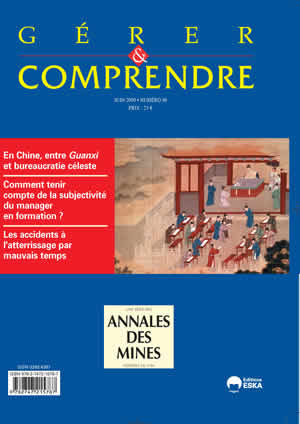
Issue 96
Editorial
By Pascal LEFEBVRE
OVERLOOKED…
In China, between guanxi and the celestial bureaucracy
By Philippe D’IRIBARNE
Directeur de recherche au CNRS
The type of management introduced by Lafarge in China is taken up with an idea of exercising power that, founded on a Western, political viewpoint, values equality in the eyes of the law and freedom of speech. Its reception by the company’s Chinese personnel provides evidence of how it fits into a cultural context where another conception of power prevails. Employees have favorably accepted a system of strictly applied rules, especially for evaluating achievements, even though it strongly deviates from the usual practices in Chinese firms (whether privately or state owned) where solidarity between members of a network (guanxi) is essential. Acceptance has been achieved because this system is not alien to Chinese culture. It takes on meaning in relation to traditional expectations with regard to the fair, nourishing power exercised by the celestial bureaucracy. However Lafarge has not managed to make its Chinese personnel accept to directly air disagreements between superiors and subordinates, or between peers. The Chinese mentality has no referent for endowing with a positive meaning such a direct expression of feelings.
Western- and Chinese-style management: Comments from a practitioner
Commentaire d'un praticien sur l'article de Philippe d'Iribarne « En Chine entre Guanxi et bureaucratie céleste »
By Dominique POIROUX
Vice-président France, Europe de l'Est, Asie, Moyen Orient et Afrique de Danone Advanced Medical Nutrition
How do communities of practice improve the performance of wage-earners in the service sector? The case of a call center
By Lamine MEBARKI
Doctorant, Laoratoire d'Economie et de Sociologie du Travail (LEST - UMR 6123) - Université de la Méditerranée
and Ewan OIRY
Maître de Conférences, Laboratoire d'Economie et de Sociologie du Travail (LEST - UMR 6123) - Université de la Méditerranée
This analysis of a call center enlarges our understanding of how communities of practice operate. It concentrates on a task — answering the telephone — normally considered to be relatively unskilled, whereas earlier research focused on core jobs in the knowledge economy.
TRIAL BY FACT
On the assembly line in a slaughtering house: Traceability arrangements and records
By Thierry ESCALA
Post doctorant , Membre associé au CERTOP UMR 5044
A slaughtering house is a special place for conducting observations, since living animals are turned into products to be sold. This transformation/packaging process is not limited to physical operations; it also concerns the production of records. Precious information is to be gleaned from analyzing the composition and typography of each record, as well as the sequencing of these documents throughout the production process. Traceability is more than a set of regulations to be applied; it also determines how a product is to be labeled, and it shapes interactions between the concerned parties.
The densification of (inter-)organizational arrangements in the furniture business
By Nicolas ARNAUD
Maître de Conférences, GRANEM UMR MA, Université d'Angers
Shipping furniture by truck, till recently deemed to be a behind-the-times activity and a low source of earnings, is now in the throes of change. Under the combined effect of changes in trucking during the early 1990s (in particular deregulation and the “progress contracts” worked out between furniture-makers and shippers), of the gradual modernization of the system of production in woodwork and of the emergence of a global demand for transportation and logistics, the furniture market’s structure has evolved significantly over the past ten years, along with its methods of management and organization.
IN QUEST OF THEORIES
Relations between manufacturing and retail businesses in France: Assessing the consequences of applying the Chatel Act
By Olivier MEVEL
Maître de Conférences, Université de Brest Laboratoire ICI - IUT de Brest
and Yvan LERAY
Maître de Conférences, Université de Brest Laboratoire ICI - IUT de Brest
Several laws in France regulate relations between industry and retail businesses. They seem to have led to a situation for sharing profits between manufacturers and distributors to the detriment of the purchasing power of consumers.
How to take the manager’s subjectivity into account during training?
By Bénédicte VIDAILLET
Institut d'Administration des Entreprises de Lille (Université Lille 1)
and Christophe VIGNON
IGR/IAE (Université de Rennes 1) - CREM (UMR CNRS 6211)
Training future managers contributes to what organizations and, as a consequence, our society will become. The persons who train managers should not spare giving thought to the following questions. What organizations does society need? What people are needed for them, and what relations should be fostered between these persons? What managers will we need tomorrow?
Landing accidents in bad weather
By Christian MOREL
Sociologue
Landing accidents due to bad weather is a special a type of catastrophe, one ensuing from a contradiction between natural and economic factors. Natural factors play a key role, since wind and precipitation are crucial variables hard to determine from one moment to the next. But economic factors are just as important: rerouting airplanes is costly, competition is strong, runways are tightly scheduled, etc.
Mosaics
Management consultancy
On Patrick Gilbert and Antoine Lancestre’s Le conseil en management: Analyses et études de cas (Paris: Dunod, 2008).
By Nathalie Raulet-Croset
The credit of the wealthy and the survival of the poor
On Laurence Fontaine’s L’économie morale, pauvreté, crédit et confiance dans l’Europe préindustrielle (Paris, Gallimard, 2008).
By Michel Villette
For a science of change
On Laurent Buratti’s La transformance: Une stratégie de mise en action des hommes et des organisations (InterEditons, 2009).
By Arnaud Tonnelé