Editorial
By François Valérian
Rédacteur en chef des Annales des Mines
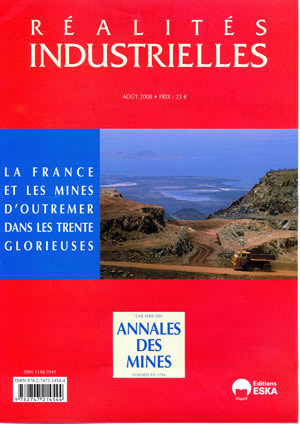
L’évolution des mines françaises d’outremer, depuis l’après-guerre jusqu’à la fin des années 70, peut sembler paradoxale à plus d’un titre. Il s’agit en grande partie d’une aventure africaine, et cela seul permet de dégager une première contradiction. L’industrie minière française était en expansion quand l’autorité politique de la France était en repli, du fait du processus de décolonisation. La situation du nickel calédonien n’était pas exactement la même, mais des enjeux proches de la décolonisation ont influencé le développement de la Société Le Nickel. En fait, l’enjeu principal pour la France était de conserver une position économique importante, un accès aux ressources et aux profits de la mine, en se cherchant d’autres appuis que le simple fait colonial.
La volonté politique et le talent des ingénieurs, leur passion même, dont le présent dossier témoigne, ont permis à la France d’obtenir dans ce domaine des résultats non négligeables. Nous avons choisi de nous borner à cette période d’expansion, dite des « Trente Glorieuses », dénomination qui a du sens pour l’industrie minière car à la fin des années 70, de nouveaux enjeux de mondialisation apparaissent, et il n’est pas sûr que la France y ait fait face comme à la décolonisation.
Tel est sans doute le second paradoxe de cette aventure. La France disposait dans les années 70 d’entreprises audacieuses et d’ingénieurs de grand talent. Aujourd’hui, en-dehors de l’uranium et du nickel, on ne peut dire que la France possède des entreprises de tout premier plan. Qu’ont de français les géants miniers mondiaux, BHP Billiton, Rio Tinto ? Or, ces entreprises immenses, qu’ont-elles de particulier ? Elles résultent de la rencontre entre des gisements considérables, australiens, sud-africains, américains, et des places financières très puissantes, Londres, New-York. La volonté politique et les connaissances scientifiques et techniques ne font malheureusement pas tout, surtout quand on veut développer des groupes dans un domaine aussi capitalistique que la mine. Si Paris avait été dans les années 70 ou au début des années 80 une grande place financière, la belle histoire des mines françaises se serait peut-être poursuivie différemment.
Avant–propos : Les opérations minières lancées pendant les trente glorieuses
By Paul-Henri Bourrelier and Jean Lespine
Ingénieur général des mines honoraire
Les opérations minières outre-mer
Overseas mining operations: BRGM, a key actor in public policy
By Paul-Henri Bourrelier
Ingénieur général des mines honoraire Ancien Directeur général du BRGM (Bureau de Recherches Géologiques et Minières)
and Jean Lespine
Coframines
BRGM had the assignment to pursue French mining operations overseas in what was becoming a postcolonial context. It was a major tool in French mining policy till the 1980s. Appendix 1: La Société des Mines de Fer de Mauritanie (MIFERMA) Marc Gallet Appendix 2: COMILOG, a “success story” Philippe Gros Appendix 3: The Taiba phosphates (Senegal) Louis Lasserre Appendix 4 : The Togo phosphates Jacques Houyvet
Société Le Nickel
By Philippe Gros
Ancien président directeur général de la Société Le Nickel, 1986-1998
Founded in 1880 in Paris, Société Le Nickel (SLN) came through the cataclysms and recessions of the 20th century but still remains, today like yesterday, an indispensable player in the nickel industry. It owes this long existence to the fighting spirit of a group of men who, over the generations, were discovers, pioneers, builders, financiers or industrialists as well as to all those who followed them in this adventure. It also owes it to New Caledonia with its major ore deposits and to the growth in worldwide demand for nickel.
Société Minière et Métallurgique de Peñarroya
By Gilbert Troly
Ancien Directeur de l'exploitation du groupe IMETAL
More than an article is needed to recount the history, even if abridged to a few decades, of an important mining company. A book of the sort often found in English is needed by authors who have more respect for their industrial heritage than the French. These few pages can tell but one of the many aspects of this story.
Uranium mines and French mining companies: A magnificent adventure
By Jacques Blanc
Secrétaire Général de Cogema 1976-1987 Animateur et coordonnateur du Groupe Paucard (histoire de l'uranium français) 1998-2007
The French mining adventure still arouses enthusiasm. Evidence of this comes from a major witness whose passion for the mining industry has not cooled.
France, an inspiration for attempts to stabilize world markets
By Robert Diethrich
Chef adjoint de la délégation française au Conseil de l'étain de 1971 à 1976 président du Groupe d'étude du plomb et du zinc de 1976 à 1978
By their very nature, raw material markets are unstable; periods of overproduction and shortages follow each other with variable intensity and wide, often sudden, price fluctuations. Government interventions might turn out to be necessary.
Miscellany
Gaston Moch, a cadet fighting for peace
By Paul-Henri Bourrelier
Ingénieur général des mines honoraire
Jules Moch, a graduate of École Polytechnique and a Socialist friend of Léon Blum, has left his name in French history. Jules, his grandfather (a cadet and officer under the Second Empire and Third Republic) and Gaston, his father (also an engineer from Polytechnique) have been forgotten even though this exceptional lineage reflects a century of French history. To make up for this, this article focuses on Gaston Moch (1859-1935), who has the distinction of being the only one of Dreyfus’s classmates to defend him publicly. His technical and scientific credentials, his predictions about modern warfare, his European vision, his pacifist and linguistic advocacy, all this justifies this focus on an inspired itinerary.
Sharing scientific knowledge: Issues and risks (Report on the Rendez-vous du Club des Annales des Mines)
By François Boisivon
Ecole de Paris du Management
Time is not the same for science as for public opinion, as we notice during ever more frequent environmental and health emergencies. A diverse, broad public, drenched with contradictory information, is impatient to know the truth that experts and scientists seem incapable of explaining in simple terms and with a single voice. Should we, however, forgo informing the public on scientific questions? In modern democracies, the answer is obviously “no”. Public debates about scientific issues need information in order to avoid the risks of manipulation.