
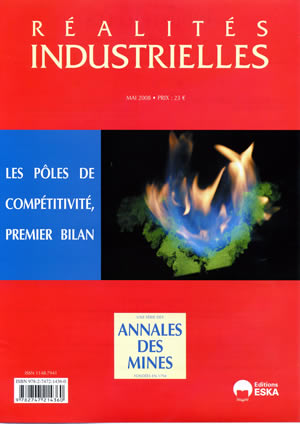
Editorial
By François Valérian
Rédacteur en chef des Annales des Mines
Poles of competitiveness: Inventory and prospects in the spring of 2008
By Grégoire Postel-Vinay
Ingénieur général des Mines
The French policy of supporting poles of competitiveness has set off a momentum. The instruments need, of course, to be improved and adapted. But what is needed to succeed is continuous, visible public support in defining and implementing each pole’s strategy.
Local experiments
The nuclear pole in Burgundy, or the art of variance
By Stéphanie Fen Chong
Doctorante, MLAB, Université Paris-Dauphine et CERNA - ENSMP
and Frédérique Pallez
Professeur, CGS -ENSMP
The relatively atypical position of the nuclear pole of competitiveness in Burgundy apparently ensues from the doctrine adopted when poles were launched. Although some public authorities had a more normative (or selective) conception, the choice finally made was to propose an “institutional shell” while waiting for parties in the field to infuse it with life by choosing the themes, axes, partners, limits, etc. Created on the initiative of the nuclear industry, Pôle Nucléaire Bourgogne has inherited this legacy. This sometimes causes it to be at variance with conventional models and spawns debate locally.
The new industrial dynamics in the Nord-Pas-de-Calais Region
By le professeur Francis Wallart
Ancien Délégué Régional à la Recherche et à la Technologie
Despite its history as a single-industry region, Nord-Pas-de-Calais has proven capable of mobilizing all concerned parties to use its six poles of competitiveness to impart a new driving force to its economy. Although the underlying idea is that economic development depends on innovation, there is no miracle solution. For innovation to occur, there must be a convergence between attitudes, persons and parties.
Imaginove, a pole of global competitiveness
By Ludovic Noël
Directeur du pôle IMAGINOVE
The poles of competitiveness have, in a short time, proven their ability to generate an impetus in their field of concern. Most of these poles are shifting from technological to global competitiveness by providing support for international programs and acquiring new skills and qualifications. The tools are not yet very reliable, and public support is needed to enable the poles to move onwards to a new phase of development.
Minalogic and the economic ecosystem in Grenoble
By Jean Therme
Directeur du CEA Grenoble, Directeur de la recherche technologique du CEA
Minalogic (Micro Nanotechnologies et Logiciel Grenoble-Isère Compétitivité) is a pole of international competitiveness based on an unusual marriage between microelectronics and software technology. Proceeding from the clearly formulated observation that innovation alone will generate new activities and produce sustainable jobs in Western industry, this pole has proposed endowing firms with a long-term competitive advantage thanks to miniaturization, embedded intelligence and connectivity. Minalogic is located in the ecosystem of Grenoble, France, an area long reputed for its ability to bring research, training and industry together thanks to support from public and private interests.
Solutions of secure communications
By Céline Haouji
Master Professionnel « Valorisation de l’Information » Université de Marseille III
Given its strategic position, ambition and structures (with major manufacturers, small businesses and research laboratories), the Solution Communicantes Sécurisées (SCS) pole of competitiveness has turned toward national and international partnerships. This orientation is essential, since the products coming out of projects backed by the pole are made for worldwide markets.
A center of applied research contributes to innovation and local economic development: The Eastern Plasturgy Pole
By Claude Trink
Président
and Gilbert Pitance
Délégué général, PPE
A research center can do much more than support technological progress. It can make proposals and spearhead local economic development. This is what has been achieved by the Pôle de Plasturgie de l Est (PPE), with its grounds in Moselle’s strong manufacturing tradition.
Integrating a strategy of sustainable development in the poles of competitiveness: The example of Cosmetic Valley
By Denis Chabault
Doctorant, IAE Tours - CERMAT
Setting up a pole of competitiveness does not just impart momentum to a region. The pole becomes a showcase for industry. Close attention must be paid to expectations about the industry in question. Cosmetics must now cope with strong environmental concerns and with demands from activist NGOs. Cosmetic Valley, a pole of competitiveness in Centre Region, is trying to take up this challenge.
A dynamic cluster of information and communication technology in Ontario
By Allison Bramwell
Chercheuse associée au Centre d’études internationales de Munk, et candidate doctorante à l’Université de Toronto
Companies that do not strongly compete with each other and are turned toward world markets, a university where research is conducted in industrial applications and the curriculum alternates periods of work in the classroom and on the job… these are a few factors accounting for the success of the new “technology cluster” in Waterloo, Ontario.
Crossing viewpoints
Poles of competitiveness and the agencies that fund research and innovation
By Jean-François Guthmann
Chef de la Mission « Financement de la Recherche et de l’Innovation » Contrôle Général Economique et Financier Ministère de l’Economie, de l’Industrie et de l’Emploi
When the poles of competitiveness were launched in 2005, the French government substantially modified the cartography of the organizations that fund research and innovation. Two new agencies were set up (Agence Nationale de la Recherche and Agence de l’Innovation Industrielle); and two previously distinct structures, placed under a public “holding” (OSEO: Agence Nationale de Valorisation de la Recherche and Banque du Développement des PME with its subsidiary, SOFARIS). Three years later, an initial assessment can be made of the place these agencies have taken in funding projects approved by the poles.
Training and poles of competitiveness
By Claude Maury
Ingénieur général des Mines
At first glance, we are surprised to see that the poles of competitiveness have not made training a priority. Given the importance of skills and talents, they must develop the dimension of learning.
The Observatory of the poles of competitiveness
By Thierry Weil
Docteur en physique, Ingénieur général des Mines
The Observatory of the poles of competitiveness made a call for contributions; and the selected articles and research findings are published in this issue. We thank Thierry Weil and the staff at the Observatory for their work.
The keys to success: A comparison of seven poles of international competitiveness
By Gabriela Miranda
Economiste au sein du Programme LEED de l’OCDE
In Grenoble as in others poles with an international dimension, the government, local authorities and other participating parties (universities, private firms) must sustain their efforts to create a web of confidence and become actual economic partners in international projects. Confidence and collaboration are the key words for the future of these poles.
A policy comparison: The examples in Japan and South Korea and their partnerships with French poles of competitiveness
By Christian Vicenty
Direction générale des Entreprises Ministère de l’Economie, de l’Industrie et d'e l'Emploi
The models of innovative poles adopted by Japan and South Korea tend to be exogenous: top-down development with clearly defined priorities and the stated aim of competitiveness in the international market. In practice however, they are counterbalanced by strong initiatives from private innovators, who play the leading role in funding R&D in these two lands.
How to relate poles of competitiveness and centers of transfer?
By Philippe Lefebvre
CGS, Ecole des Mines de Paris / ParisTech
The poles of competitiveness do not all respond to the same problems in matters of innovation. For some of them, mainly those with participating small businesses, the question of transfers between research projects and firms is central. But how to achieve this? Should “centers of transfer” change or not; and if so, how? The Pole Microtechniques in Franche-Comté is a clarifying example.
Poles of competitiveness: Real leverage for innovation in small and midsize firms?
By Philippe Bassot, Cécile Ezvan and Julie Koeltz
CM International
Some poles of competitiveness have managed to mobilize small businesses, but much is still to be done to involve the latter in the pole’s organization. The poles must reach out toward firms and make clear proposals regarding qualifications, cooperation, market positions and access to funding.
The poles of competitiveness assessed: What “cluster model” for France?
By Julie Tixier
Maître de Conférences, IAE de Tours
and Luciana Castro Gonçalves
Enseignant-chercheur à l’Université Paris-Est Professeur à l’ESIEE Management
Given that poles of competitiveness are of recent date, a quantitative grid for assessing them cannot reflect the reality if it focuses only on performance criteria. Given the current development of these poles, a better suited approach would be to take into account previously existing relations and the relations between the parties participating in a pole. Accordingly, the discriminating factor becomes not a pole’s productivity but its control over information and its mobilization of a collective, cognitive heritage, which distinguishes French regions from rival sites.
Miscellany
ISAE: Merging two major engineering schools in a process of internationalization
By François Bouchet
Directeur adjoint de l’Institut Supérieur de l’Aéronautique et de l’Espace (ISAE)
Can engineering schools merge like companies? Common points exist: the need for a plan of action, economies of scale thanks to synergy, distinct “cultures” to be brought together while maintaining respect for individuals, the feeling of belonging together that is to be created within the new establishment… In the quite special education market, two French engineering schools (Institut Supérieur de l’Aéronautique et de l’Espace and Écoles des Officiers de l’Armée de l’Air) are trying to position themselves so as to maintain their originality in the system of grandes écoles.