
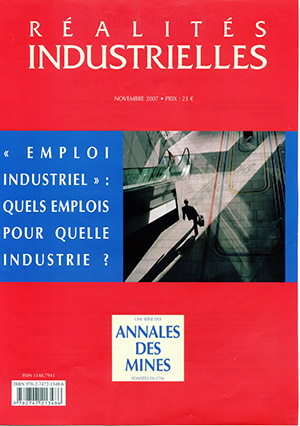
Editorial
By François Valérian
Rédacteur en chef des Annales des Mines
Winning strategies and future occupations
A new impetus for industry in France
By François Bouvard
Directeur associé senior
and Philippe Duclos
Directeur associé, McKinsey & Company
The development of services, zigzagging production figures, outsourcing, offshore operations, factory shutdowns, emerging countries in world trade… Under the magnifying glass of the media, French industry seems frail, when it does not give the impression of shaking on its foundations — to the point that some people doubt whether it can be preserved. However an in-depth examination of manufacturing in France leads to a more balanced description. The much dreaded decline is of relative proportions, but industry’s quite real loss of competitiveness is reason to worry.
Occupations with prospects
By Elisabeth Rignols
Ministère de l'Economie, des Finances et de l'Emploi, SESSI
The growing number of baby-boomers going on retirement will free jobs. Occupations in industry are quite varied, and not all of them will experience growth. In the long run, the occupations with a future are the ones that will enable firms to react to international competition and innovate. At stake in industry is the development of jobs that, filled by qualified personnel, correspond to high added-value activities. In the short run however, a job shortage will lead public authorities to take measures with financial incentives for making these occupations more attractive.
Environmental firms
By Thierry Chambolle
Ingénieur général des Ponts et Chaussées honoraire Membre de l'Académie des technologies, Membre du Haut conseil de la coopération internationale
To develop employment in industry, we must turn toward growing markets. What market is growing more than the environment — in the short and long run as well as worldwide? It is a major source for jobs under condition that the right choices are made about the market segment and technology.
Services for industry: Industry’s new value and model
By Georges Drouin
Président du Groupement des professions de service (GPS) Membre de la Commission des comptes des services
and Camal Gallouj
Professeur à l'IAE de Brest, Université de Bretagne Occidentale Membre de la Commission des comptes des services
The increasing complexity of firms and the need to adapt have spurred an expansion of industry-related services, which are now comparable to a full-fledged industry. This calls for redesigning the traditional boundary between manufacturing and the service sector.
Industry, grandeur or bondage?
By Sophie de Menthon
Présidente d'ETHIC
Every trade has its value — this saying could be revived in France in its job search. Employment outside manufacturing will not suffice to win the fight against joblessness. The tax load borne by companies must be lessened. The training for manual jobs must be improved. And we should stop looking down on new occupations, for instance in call centers, which other countries are quick to fill.
Work or employment: Businesses creations, start-ups and business angels
By Jean-Michel Yolin
Conseil général des Mines
In twenty years, employment in the nongovernment sector has hardly varied in France, whereas the number of jobs in this sector rose by six million in Great Britain. Out of the top 100 American firms, 63 are less than 25 years old, whereas the number of French companies under this age can be counted on one hand at most. These French handicaps stem from the inability to create viable businesses. How to explain this? Cultural factors and taxation have long been disincentives for individuals to invest in setting up new companies. Might, some day soon, the persons subject to the tax (ISF) on big fortunes turn into business angels?
Politiques en débat
Macroeconomic policies and employment
By Thomas Cazenave and Arnaud Geslin
Inspecteurs des Finances
Macroeconomic employment policies are back, after a period when they were declared outdated. They are a means for keeping the unemployment related to the business cycle from turning into durable joblessness. Their tax and budgetary measures make the economy more competitive.
The destruction and creation of jobs, and the revitalization of local areas: The territorial dimension of a changing economy
By Claude Trink
Président, Groupe Sofirem
Everywhere, firms are being restructured, and they cannot be asked to take into account the idea of revitalizing the areas they are leaving. This revitalization differs from a mere reclassification of wage-earners. Reclassification taps existing jobs whereas revitalization tries to create jobs. Sofirem, the oldest French “revitalization company”, focuses on company plans and the attractiveness of local areas. Its guiding idea is that no local area should be left to fend for itself after an industry has been restructured.
The “social” VAT, pro and con
By Denis Kessler and Philippe Trainar
SCOR Global P& C
The“social VAT” is more complicated than it seems at first sight. It covers up the real issues of how to pay for welfare and how to reform the payroll withholding taxes that fund the welfare state. France cannot spare itself a general debate about these issues and must seek a rapprochement with other systems in the euro zone.
35 hours: A point of view
By Denis Gautier-Sauvagnac
Union des industries et métiers de la métallurgie
The controversy about the 35-hour workweek in France has undergone astonishing shifts. In the early 1990s, there was a relative consensus about shortening the time spent working. Debate did not flare up until the law had been voted. The new act then came under criticism from all quarters, but repealing it is apparently not on the agenda. The subject still stirs up controversy.
Do “senior jobs” have a future in France?
By Claude Vimont
Conseil Emploi Formation
In France, there is a quite high employment potential among persons 55-64 years old. Various programs for early withdrawal from the labor force over the past thirty years have had an impact on this age-group. A more or less clearly formulated consensus makes France stand out from other Western countries. Public authorities, employers, labor unions and wage-earners all agreed that older workers should go on retirement early so as to free (possibly but not always) jobs for young people. Unfortunately, the results have not done much to stimulate growth.
En guise de conclusion provisoire
By Grégoire Postel-Vinay
Ingénieur général des mines, responsable des études, de la prospective et de l'évaluation Direction générale des entreprises
Répondre au défi actuel de la concurrence mondiale, c'est accepter de fournir les efforts que d'autres avant nous, Royaume-Uni, Etats-Unis, ont su fournir, tout en tenant compte des atouts propres à notre pays.
Miscellany
Plans for preventing mine-related risks, a keystone in French policy
By Christophe Didier and Xavier Daupley
Ineris, Direction des risques du sol et du sous-sol
The shutting down of mining installations does not mean that no attention needs to be paid to mines. Various problems might arise in former mining areas. The French plan (PPRM) for preventing mine-related risks can forestall problems and help work out a sustainable redevelopment of mining areas.
The French policy of preventing post-mining risks
By Christophe Didier
Ineris, Direction des risques du sol et du sous-sol
The plan (PPRM) for preventing mine-related risks is part of a global policy for reducing risks after mines have been shut down. This policy combines regulatory procedures, scientific monitoring and arrangements for providing compensation.
EU-wide electric companies: A market model or an integrated model?
By Jean-Michel Glachant
Université de Paris Sud
The European energy market has not arisen out of political decisions; it has been built by firms. The activities and domains of these firms have been Europeanized. Nonetheless, political decision-making is necessary to orient this Europeanization by bringing regulations closer to overseeing competition at the EU level.