
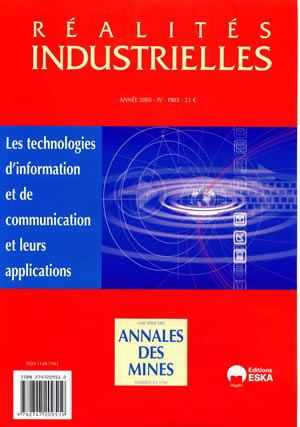
Éditorial
By François Valérian
Rédacteur en chef des Annales des Mines
Les technologies
Micro- and nanoelectronics
By Laurent Gouzènes
Directeur du Plan et Programmes d'Étude STMicroelectronics
The continuous miniaturization of transistors over the past forty years has brought microelectronics down to the manometric scale. Nanoelectronics has been born! The awesome scientific and technologic challenges in this new field justify ever more internationalized research programs. But the stakes are also economic, for both companies and governments. For this reason, we should pay close attention to the scientific and financial aspects of this emerging technology.
The FPRTD: Accomplishments in the field of information and communication technology, and prospects for the 7th Framework Program
By Patrick Schouller
Direction Générale des Entreprises - STSI
What accomplishments has the EU’s 6th Framework Program for Research and Technological Development (FPRTD) had in the field of information and communication technology ? How to help the 7th Framework Program more clearly foresee prospects in this field ? Answering these two questions involves assessing the past and making forecasts. After recalling the original purposes of EU research programs, accomplishments in info-tech are quantitatively examined. A qualitative illustration is provided with the help of a few examples so as to show the rationality of the choices made. Finally, the challenges facing the 7th FPRDT are taken under consideration.
Traceability
By Georges Kayanakis
ASK
Electronic traceability is opening vast prospects for monitoring functions in production, stock-management and logistics inside firms. Developments in industry and services as a result of this growing market in information technology depend on sustained efforts in research and training so as to enable France to acquire the knowledge and skills for improving its competitiveness.
Information technology’s decisive contribution to economic growth and to territorial planning and development
By Jacques Pomonti and Françoise Roure
Membres du Conseil général des technologies de l'information (CGTI)
Information technology provides a major lever for economic development and for territorial planning. Public policies have had the priority of supporting national network infrastructures. But now, the target should be to provide high-speed access to Internet in areas where this is not yet possible because the necessary investments are not economically profitable.
New communicating objects: An abundant, potential supply for which markets ?
By Jean Paul Laurencin
Économiste chargé de recherche
and Evelyne Janeau
Psychologue (Luce/MSH-Alpes)
Lifestyles as well as systems of production and transactions have considerably changed thanks to the new tools and services produced by information and communication technology. If multifunctional concentration characterizes tomorrow’s tools, the services associated with them should be the pivot of future applications.
Les applications
The mobile phone, our new companion
By Grégoire Olivier
Membre du Directoire, Safran
and Thierry Buffenoir
Directeur général délégué, Sagem Communication (Groupe Safran)
In less than fifteen years, GSM has become the leading means of communication. This market has an apparently limitless potential for growth. Improving services for well-equipped countries and extending the market to developing counties requires ongoing efforts in R&D. In this context, French operators and manufacturers have several assets.
Assisted driving: The prospects
By Daniel Augello
Délégué à la Politique Transports, Renault SA
The traffic system is so complicated that drivers are not responsible for everything. Users do not build the roads or manufacture vehicles; nor do they control the weather, traffic density, number of work sites or erroneous road signs. But they are responsible for making decisions depending on what they encounter on the road. The vehicles they use, the highway system and traffic management must increase safety and enable users to optimize their decisions, or even make up for the consequences of their slightest mistakes.
The A380’s avionics
By Pierre Froment
Airbus
Airbus has decided to adopt a modular avionics for its latest model, A380. This new architecture is a response to the quick pace of changing needs, since the life span of an aircraft program is a few decades whereas the services demanded by airlines and passengers are of much shorter duration. This concept will facilitate future modifications of the A380 and become the new avionics standard for Airbus.
Information and communication technology and its applications in health
By Géraldine Capdeboscq
Bull
Applications of information and communication technology in the field of health should thrive in the coming years. This will create jobs in manufacturing, improve productivity, and reduce costs in this industry. France has the necessary sills for adapting info-tech to the field of health. Earnings will depend on the country’s investment in research and development and on incentives for actors in this field and in service firms, for software engineers and electronic manufacturers.
The electronic administration: unprecedented upheaval in the public sector
By Jacques Sauret
Directeur de l'Agence pour le développement de l'administration électronique (ADAE)
The civil service will soon be electronic, but how soon ? And how will the public administration be transformed ? This will deeply alter many current practices and influence our relations with the government.
The development of information and communication technology, and security issues
By Alain Esterle
Agence Européenne pour la sécurité des Systèmes d'Information (ENISA)
Security issues regarding information and info-tech networks have gradually compelled recognition and are conditioning developments in this field. Though starting from quite different positions, the EU and member states are moving toward increasingly coherent, complementary policies with regard to the security of information systems. The new target is to establish a technological, industrial and operational basis that will be competitive and independent at the national and European levels.
Defense and the new information and communication technology
By François Levieux
Directeur des processus techniques, Groupe Thales
Information and communication technology is increasingly used in military systems and equipment. It has thoroughly changed the organization and conduct of the armed services by hooking up in a network all operational information, which can be transmitted to each combatant.
Major changes in how firms are organized
By Jean-Michel Yolin
Ingénieur Général des Mines
A company’s competitiveness depends very much on the quality of the information it has and its capacity for tapping and processing it. It also depends on its ability to react. All processes related to information (production, consumption, transactions, data-processing or -mining) are concerned in the Internet, the economy’s new nervous system. Thanks to Internet, the shift can be made from a discontinuous to a continuous process; and delays, drastically reduced. This is one of the major changes affecting the operation of the economy and eventually its very structure.
Conclusion
France catching up ? The urgency of intelligent investments
By Grégoire Postel-Vinay
Direction générale des Entreprises, Responsable de la prospective
Investments in information and communication technology are necessary to cope with the challenges represented by the need for improving competitiveness and stimulating growth.
L'énergie en débat
What Europe for electricity and natural gas ?
By Patrick Buffet
Délégué général de Suez
The world of energy is undergoing a transformation, while a short-term vision has prevailed in decisions for opening EU markets. Two major issues must be addressed rapidly without any reserves. Thought must be devoted to the energy mix ; and a relevant market architecture must be defined.