
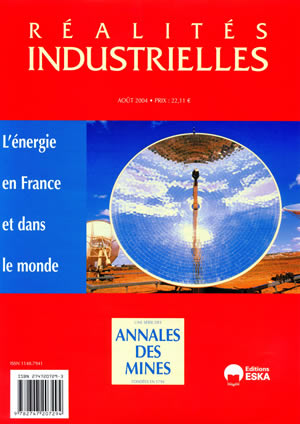
Foreword : La politique energetique française en débat de nouveaux textes "refondateurs"
By Dominique Maillard
Directeur général de l'Énergie et des Matières premières
Tendances
Proposals for an energy policy turned toward 2050
By Bernard Bigot
Haut Commissaire à l'Énergie atomique
The conditions for producing and consuming energy will undergo major change owing to new environmental, geopolitical and economic restrictions. This foreseeable upheaval forces us to lay down strategic lines for dividing by three our emission of greenhouse gases by 2050. Three main uses of energy should come under close scrutiny: heating, transportation and the production of electricity.
The security of the western European supply of electricity in 2004
By André Merlin
Directeur du Réseau de transport d'électricité Président d'ETSO (European Transmission Systems Operators)
After the incidents that marked 2003, parties in this sector must, together, foster an organization for guaranteeing the long-term security of our electricity supply. This is a key element in Europe’s collective security. Since its creation in 2000, the Réseau de Transport d’Électricité (RTÉ) oversees, in France, both the development of the grid for transporting electricity and the management of the flow of current through this network. The following two points are keys to the future: the managers of these interconnected transportation grids must be independent from other parties in this sector, and they must be given the means to assume their role.
Advances in controlled thermonuclear fusion in Europe
By Robert Aymar
Directeur général du CERN Directeur d'ITER (International Thermonuclear Experimental Reactor) (1994-2003)
The nuclear fission of hydrogen yields a million times more energy than its chemical combustion; but it is much harder to control. ITER, a project that has arisen out of international cooperation, has the goal of controlling this fission so as to take a giant step toward a reactor for generating electricity. The decision to build one is pending. The site for the plant is yet to be selected: why not Cadarache ?
Promoting replenishable energy sources in new, competitive electricity markets
By Dominique Finon
Directeur de Recherche au CNRS, Centre international de recherche sur l'environnement et le développement, EHESS & CNRS
and Philippe Ménanteau
Ingénieur de Recherche CNRS, Département Energie et Politiques d'environnement, Université de Grenoble II
Since the mid-1980s in many European countries, renewable sources of energy have been highly touted for producing electricity. These efforts must be adjusted to the opening of electricity markets to competition. The means used till now (in particular guaranteed purchase prices) have been criticized for being costly and not being adapted to a competitive environment. EU directive 2001/77/C encourages member states to stimulate the growth of renewable energy. It also provides for assessing the convergence toward a system of quotas and of tradeable emission permits, a system that does not necessarily have all the qualities claimed for it.
Automakers using hydrogen
By Pierre Beuzit
Directeur de la recherche du groupe Renault
A worldwide consensus has emerged that hydrogen and fuel cells are “the” solution, in the context of sustainable development, to the quest for an alternative to petroleum. Very simply put, the automobile of the future will be electric-powered. Automakers represent the industry most involved in research on fuel cells and hydrogen as a source of energy; but other applications are also under study. This technology could become competitive on the automobile market by about 2015.
The duties of public service in relation to cogeneration and renewable energy sources
By Patricia de Suzzoni
Commission de régulation de l'énergie
In France, the costs of programs for cogeneration and renewable energy are ultimately paid by consumers via mechanisms based on bids, the obligation to purchase at a guaranteed price, and a CRE evaluation. The suggestion is made to test in France tradeable emission permits before creating a European market.
Faits et chiffres en 2003
Bilan énergétique provisoire de la France pour 2003
By Richard Lavergne
Secrétaire général de l’Observatoire de l’énergie, ministère de l’Economie, des Finances et de l’Industrie
L'évolution annuelle de l'énergie en France depuis 1973
By Louis Meuric
Adjoint au Secrétaire général de l’Observatoire de l’énergie, DGEMP
La facture énergétique de la France en 2003
By Louis Meuric
Adjoint au Secrétaire général de l’Observatoire de l’énergie, DGEMP
L'électricité
By Sylvie Scherrer
Observatoire de l’énergie, DGEMP, ministère de l’Economie, des Finances et de l’Industrie
Le gaz naturel en France
By Véronique Paquel
Observatoire de l’énergie, DGEMP
Les combustibles minéraux solides
By Sami Louati
Observatoire de l’énergie, DGEMP