
March 2003
abstract
Gérer & Comprendre
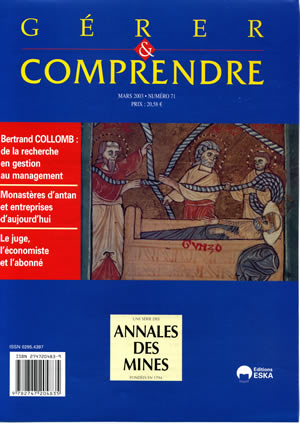
Issue 71
Editorial
By Francis LEFEBVRE
Secrétaire général du Comité de rédaction
TESTIFYING
A single-company man
Entretien avec Bertrand Collomb, président du Groupe Lafarge
By Bernard Colasse and Francis Pavé
How did it come about that a young person, who had just written his dissertation and been trained in operations research in the best American universities and thus seemed headed for an outstanding academic career, spent three decades in a building materials firm without being bored? The answer: by making the company the world leader in its field! To this end, it was necessary to know how to stand back out of the reaches of the tyrannical hold of models and constantly ask: “What’s happening? How to interpret it? How to describe it?” For Bertrand Collomb, who founded CRG and now heads the Lafarge Group, this was the basis for a scientific approach to management. Looking away from dogmatic ideas, listening to facts and people, this approach enabled him, in the Group, to combine the efficiency due to size with the effectiveness of local initiatives.
OVERLOOKED
Probability theory and practices in industry: The hard start of statistical quality controls in France
Les débuts difficiles du contrôle statistique de qualité en France
By Denis Bayart
Centre de recherche en gestion - École polytechnique
The phrase “probability revolution” refers to a set of methods that originated during the early years of the 20th century in developed countries and spread with mass manufacturing. In France, the organization of the military and of the weapons industry provided a quite useful testing grounds for statistical controls of quality. J.E. Estienne, head of an artillery squadron, and M. Dumas, a young engineer in naval artillery, were among the very first to run tests using tools and reasoning based on probability. These pioneers accomplished a remarkable job working on these questions despite the relatively limited means at their disposal at the time.
DEBATED
Do you speak English or Globish?
By Jean-Paul Nerrière
ancien vice-président de Digital Equipment Europe, directeur commercial d’Automobiles Peugeot, vice-président d’IBM USA
English-speakers, who make up only 11,3 % of mankind, are proud to speak the language supposedly used by the global village. Other people speak an odd pidgin English, which J.P. Nerrière has named Globish. Non-English-speakers often speak it rather fluently, whereas English-speakers pain to speak and understand it. Might it not be time to recognize Globish as the world village’s official language? This would free non-English-speakers from their complexes and show English-speakers what they have to do to be understood. It would also provide French with a good chance to prosper.
OTHER TIMES, OTHER PLACES
Yesteryear’s monasteries and today’s firms: Human resource management in Cluny from the 10th to the 12th century
La gestion des ressources humaines à Cluny du Xe au XIIe siècle
By Jean Nizet
Universite Catholique de Louvain
and MOSAICS
During the 11th and 12th centuries, Cluny became the center of an order of several thousand monks with hundreds of monasteries spread over all of Europe. Guided by its missions of praying for the dead, caring for the poor and sick, etc., this monastery located in Burgundy, France, soon came to be organized, under the authority of its all-powerful abbey, so as to control the material, financial and human resources necessary for it to thrive. Whether we look at this monastery’s organization at its beginning or examine its structures or internal controls, surprising parallels emerge with contemporary organizations.
Mosaics
Un temple du droit
À propos du livre de Bruno Latour « La fabrique du droit - Une ethnographie du Conseil d'État », Édition La Découverte 2002
By Claude Riveline
ENSMP
Dans le secret des comités de direction
À propos du livre de Nicolas Flamant « Une anthropologie des managers », PUF, coll. Sciences sociales et sociétés, Paris, 2002. Prix « Ressources Humaines » - 2003
By Hervé Laroche
ESCP-EAP
Au pays de l'argent-roi
À propos des livres d'Émile Zola « L'Argent », 1891 et de Jean-Marie Messier (avec Yves Messarovitch) « Mon Vrai Journal », 2002
By Dominique Jacquet
Paris X - Nanterre
D EBATED
Virtual transactions, a question of confidence
Débat animé par Gérard Moatti, SOCIETAL
et mis en forme par Jean-Paul SCHAER
For fields such as E-business, teletransactions and trading on the net, where technology and law cannot, by themselves, guarantee the security of transactions, confidence becomes a key question. But how to build up trust in a system of virtual exchanges? What new parties are involved? What status and degree of credibility do they have? By using experiments in diversified circles, can an “architecture of confidence” be designed to give a boost to such transactions?
TRIAL BY FACTS
The judge, the economist and telephone-users: The pricing of local area calls
Le cas de la tarification du dégroupage de la boucle locale du réseau téléphonique
By Daniel Fixari
CGS, École Nationale Supérieure des Mines de Paris
About a matter as important as liberalizing the part of France Télécom’s network nearest to users (the local area), we might think that economists have taken power and imposed their theoretical concepts via Brussels, which has been won over to their cause. However the matter is much more complicated than this. Regulatory authorities play the role of judge and open detailed hearings where contrasting voices are heard. But every time they render an opinion, these judges strongly emphasize that it is temporary and has been formulated, given the pressure, on the basis of incomplete information. What consequence will the enormous work they have accomplished have on telephone-users? on France Télécom and its competitors? on economic growth? The matter has not yet been settled.